
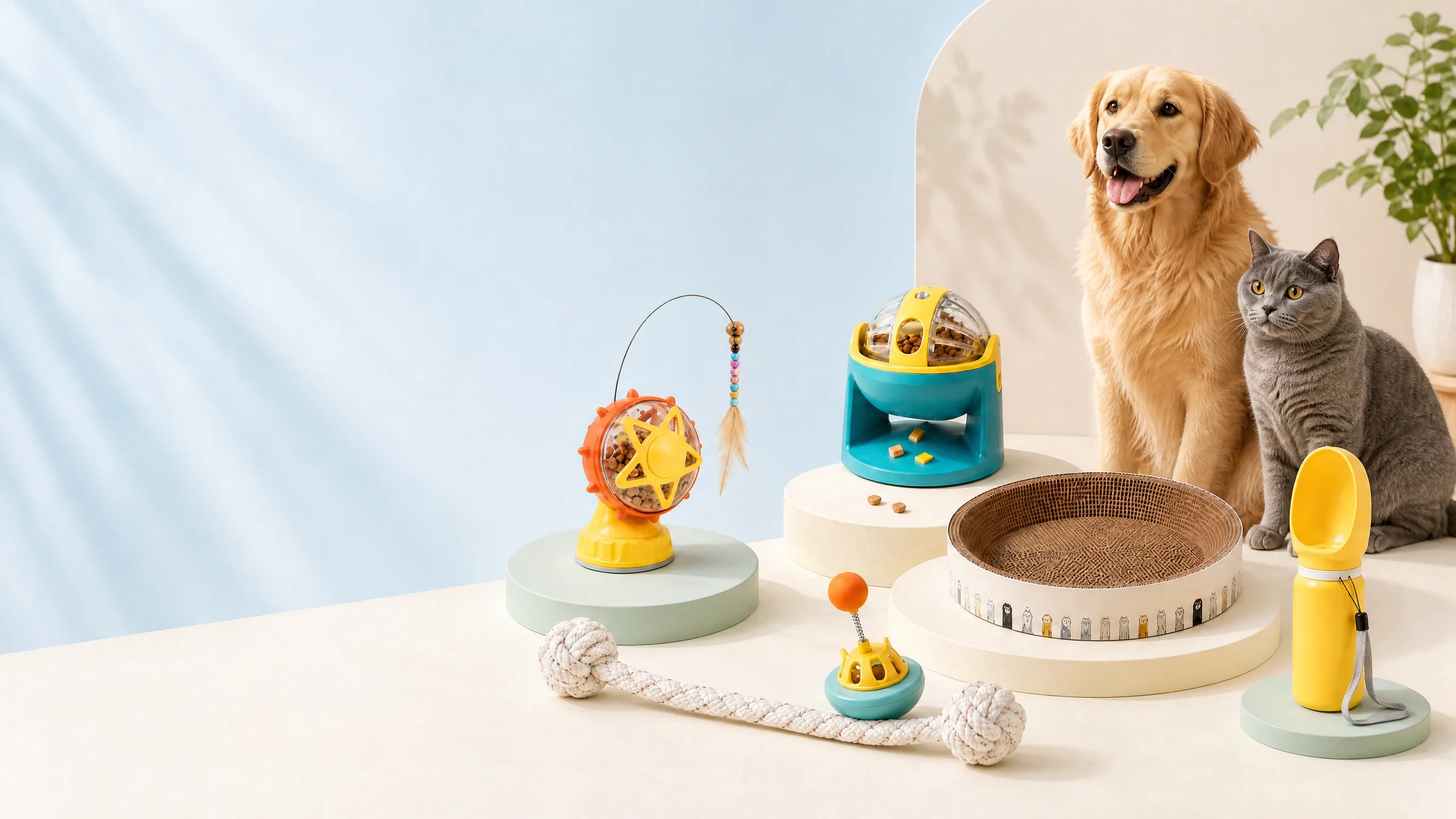
The best cat toys for boredom and enrichment are not necessarily the most complex or expensive. A strong selection usually combines toys that imitate hunting, food puzzles that encourage foraging, objects for chasing or batting, and opportunities for supervised human interaction. Because cats differ in age, confidence, play style, chewing habits, and food motivation, the right choice is the one that matches the individual cat and can be used safely and consistently.
For buyers, retailers, shelters, and pet-product brands, the most useful approach is to evaluate a toy by the behavior it invites rather than by its appearance alone. Indoor cats retain natural behaviors such as stalking, pouncing, scratching, climbing, and investigating; appropriate outlets can make the home environment more engaging.[1] Enrichment should therefore be planned as a varied routine, not as a single “best” product.
What Makes a Cat Toy Enriching?
An enriching toy gives a cat a meaningful action to perform. It may require the cat to track a moving object, solve a simple food puzzle, explore a new texture, or make a choice about how to approach an object. The goal is not to force every cat to play in the same way. Instead, owners should offer options and observe which activities the cat chooses.
A useful enrichment range includes physical activity, mental problem-solving, sensory exploration, and social interaction. A wand toy can support a short hunting sequence with a person. A puzzle feeder can make part of a meal more active. A ball track or sturdy rolling toy may support independent play. Boxes, paper bags with handles removed, and other simple household objects can also be engaging when they are clean and monitored.[2]
Match the toy to a natural play pattern
Many cats respond to toys that move, flutter, chirp, jitter, or vibrate because these features resemble aspects of prey. Wand toys, plush mice, balls, springs, and motion-activated toys can each appeal to a different play preference. Some cats prefer ground-level chasing, while others are more interested in vertical movement or toys that can be carried.
The most effective play sessions often resemble a sequence: notice, watch, stalk, chase, pounce, and finally catch. With a laser pointer, owners should transition the cat to a tangible toy or another appropriate “catch” at the end of play rather than leaving the cat with no physical object to capture.[2] The light should never be directed into a cat’s eyes.
Best Cat Toy Types for Boredom and Enrichment
Interactive wand and teaser toys
Wand toys are well suited to owner-led play because a person can vary speed, direction, pauses, and distance. Move the toy along the floor, behind furniture, or around a corner instead of waving it continuously in the cat’s face. This creates opportunities for observation and pouncing while allowing the cat to control whether to continue.
Strings, ribbons, and feather attachments should be used only with supervision and stored out of reach afterward. If an attachment becomes loose or damaged, remove the toy from use. These requirements should be reflected in product instructions, packaging, and retailer training.
Food puzzles and treat dispensers
Food puzzles can turn part of a cat’s normal feeding routine into a foraging activity. Puzzle balls, stationary feeders, lickable-food designs, and simple treat-dispensing formats differ in difficulty and cleaning requirements. Start with an easy design so the cat can learn the mechanism, then increase complexity only if the cat remains interested.
Use the toy with an appropriate portion of the cat’s existing food or treats rather than adding unlimited extras. A food puzzle is an enrichment tool, not a reason to disregard the cat’s overall feeding plan. Research on indoor-cat enrichment describes puzzle toys as one way to support exploratory and predatory behaviors around feeding.[1]
Ball tracks, rolling toys, and motion toys
Ball tracks can provide self-directed batting while keeping the ball contained. Rolling toys and motion-activated products may be useful when an owner is busy, but they should not be treated as a substitute for checking the cat’s environment. Observe the cat with any new self-play product before leaving it available.
Consider the noise level, activation method, battery access, cleanability, and stability. A toy that is too loud, unpredictable, or difficult to reset may be ignored by some cats. Product selection should prioritize a clear use case over a long list of electronic features.
Plush, catnip, and texture-based toys
Small plush toys can suit cats that like to carry, bite, bunny-kick, or wrestle. Catnip-filled products appeal to some cats but not all, so buyers should avoid assuming universal interest. Examine seams, eyes, noses, ribbons, loops, and other decorations as potential wear points. The suitable size depends on the cat’s behavior: an aggressive chewer may need a larger, simply constructed toy that cannot be swallowed.
Boxes, paper, and low-cost enrichment
A varied enrichment program does not require only purpose-built products. Clean cardboard boxes, paper bags with handles removed, and crumpled paper can offer hiding, ambushing, and batting opportunities. Texas A&M’s veterinary school also highlights scratching posts and elevated perches as important non-toy forms of enrichment because they support normal scratching, climbing, and observation behaviors.[3]
Comparison Checklist for Choosing Cat Enrichment Toys
| Toy type | Main enrichment value | Best for | Supervision and sourcing checks |
|---|---|---|---|
| Wand or teaser | Chasing, stalking, shared play | Cats motivated by movement and human interaction | Supervise strings and attachments; confirm replacement-part details |
| Food puzzle | Foraging and problem-solving | Food-motivated cats and measured meal enrichment | Check difficulty, cleanability, portion control, and material specifications |
| Ball track | Batting and independent play | Cats that enjoy repetitive swatting | Inspect containment, edges, stability, and wear resistance |
| Motion-activated toy | Novel movement and short activity bursts | Curious cats that respond to unpredictable motion | Confirm noise, battery access, activation settings, and supervision guidance |
| Plush or catnip toy | Carrying, biting, wrestling, sensory novelty | Cats that prefer tactile play | Check seams, small parts, size, and chew damage regularly |
| Box or paper bag | Hiding, exploration, ambushing | Cats that enjoy simple environmental changes | Remove handles, staples, and damaged pieces; keep the area dry and clean |
Specifications, materials, packaging, compliance documentation, pricing, MOQ, lead time, and availability should be verified for the specific product and destination market. A general product category does not by itself establish suitability or certification.
How Owners Can Build a Better Toy Routine
Rather than leaving every toy on the floor, keep a small selection available and rotate the rest. The University of Wisconsin School of Veterinary Medicine recommends rotating toys to maintain novelty, while also suggesting ball tracks and food puzzles for independent activity.[2] Rotation can mean changing two or three items every few days, introducing a familiar toy in a new location, or pairing a toy with a different play routine.
Watch the cat’s response. Does the cat chase, carry, paw, hide, sniff, or ignore the toy? Does the cat prefer fast or slow movement? Does the cat stop because the toy is frustrating, noisy, or difficult to access? These observations help owners refine the collection without accumulating unused products.
Buyer and Retailer Decision Criteria
Evaluate a cat-toy assortment by intended customer, play mode, living space, noise level, cleanability, durability, packaging, and supervision requirements. For B2B enquiries, confirm the exact material composition, dimensions, age guidance, cleaning instructions, packaging language, testing or compliance documents, carton details, customization options, pricing, MOQ, lead time, and availability for the destination market. Do not infer a product claim from a photograph or general catalog description.
Frequently Asked Questions
What is the best toy for a cat that gets bored easily?
There is no universal winner. A practical starting set is one supervised wand toy, one food puzzle, and one durable self-play option such as a ball track or simple plush toy. Observe preferences and rotate the set instead of relying on one item.
Can cats play with toys by themselves?
Some toys are designed for independent play, including ball tracks, sturdy plush toys, and selected motion-activated products. Introduce new toys while observing the cat first, and keep string, ribbon, and other ingestible attachments out of reach when no person is present.[2] [3]
Are food puzzle toys suitable for every cat?
Food puzzles can be useful for food-motivated cats, but difficulty should be introduced gradually. Use measured food or treats and keep the cat’s overall dietary plan in mind. If eating behavior changes or the cat appears unwell, consult a veterinarian.
What should I do if my cat ignores every toy?
Try changing the movement, texture, location, time of day, or play format. Some cats respond better to boxes, perches, scratching surfaces, or quiet observation than to conventional toys. Persistent changes in behavior or activity warrant professional veterinary advice.
Conclusion
The best cat toys for boredom and enrichment create appropriate outlets for hunting, foraging, movement, exploration, and social play. A balanced collection usually combines interactive toys with food puzzles, safe self-play products, and simple environmental enrichment such as boxes, scratching surfaces, and perches. Match the choice to the cat, introduce products gradually, rotate for novelty, and inspect every toy for wear.
For retailers, distributors, and pet-product brands assessing a cat-toy opportunity, PawViso can help organize a product enquiry around the intended market and use case. Please contact PawViso to discuss the specific requirements; availability, specifications, materials, pricing, MOQ, lead time, and compliance must be confirmed for each enquiry.
References
[1]: Environmental Enrichment for Indoor Cats — National Center for Biotechnology Information
[3]: CAT-ching Up On Feline Enrichment — Texas A&M School of Veterinary Medicine & Biomedical Sciences
[4]: The Best Indoor Cat Enrichment Ideas: Toys, Puzzles, and More — Best Friends Animal Society
PawViso Editorial Team
Draft status: review pending. This article provides general educational information and is not veterinary advice.