
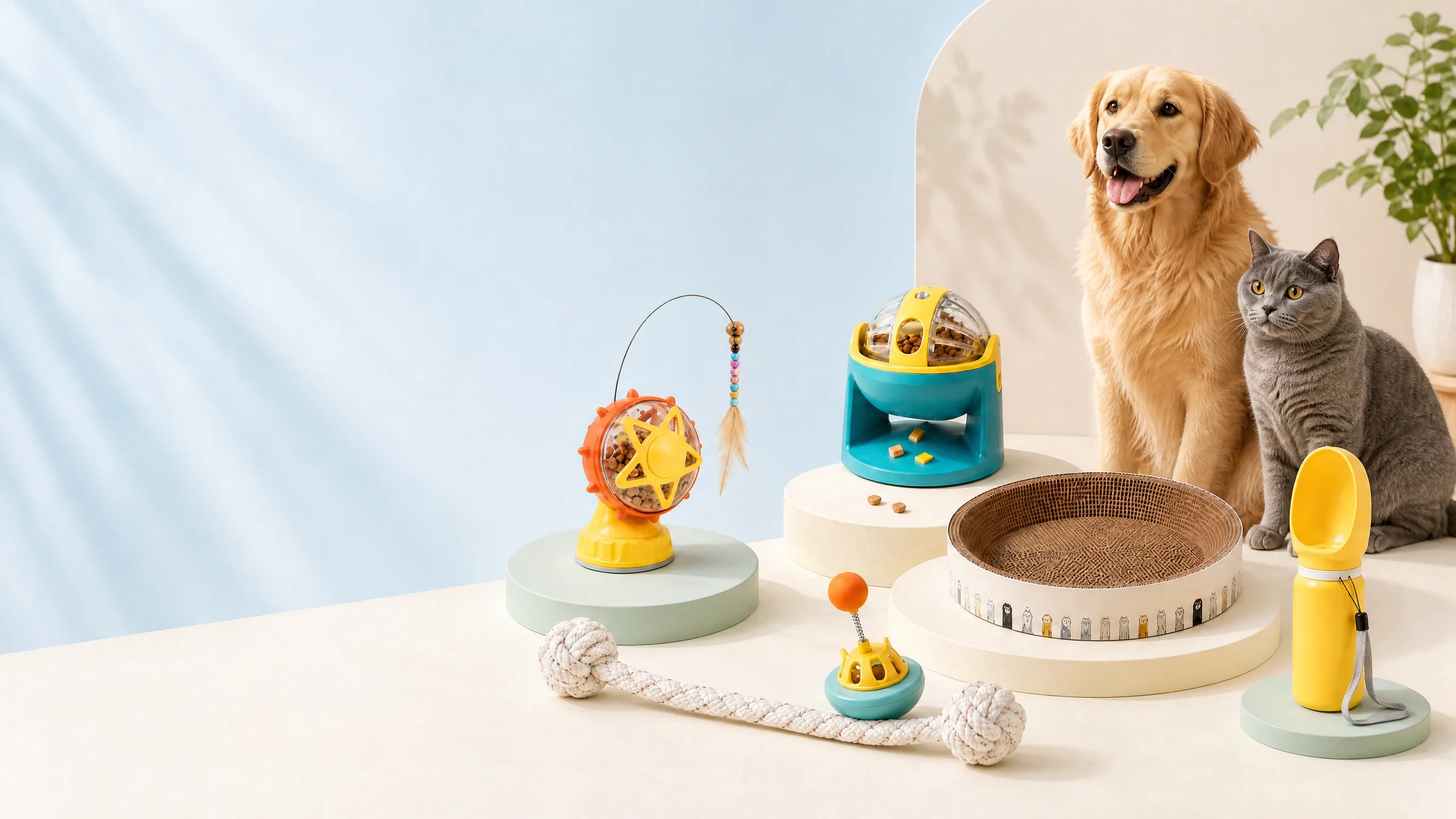
Comparing pet accessory brands for a wholesale or private-label program requires more than placing similar photographs side by side. Importers, retailers, distributors, and marketplace teams need to check channel fit, product information, documentation, and packaging readiness.
This guide offers a neutral framework for reviewing interactive toys, slow-feeding bowls as non-food pet accessories, scratchers, teaser toys, grooming tools, rope tug toys, and travel water bottles. It does not rank brands or make performance claims. Specifications, materials, packaging, compliance documents, pricing, minimum order quantities, capacity, and lead times must be confirmed with the supplier and buyer before a decision.
Start with commercial and channel fit
Begin with the buyer’s written brief: sales channel, destination countries, customer segment, packaging format, order pattern, and approval requirements. Retailers may need a compact range; distributors may require broader coverage. Private-label programs may prioritize artwork control.
Do not treat catalogue breadth, a polished website, or a brand name as evidence of operational suitability. Record what is confirmed, proposed, or still open. For products placed on the EU market, the European Commission explains that the General Product Safety Regulation includes product-safety and traceability responsibilities; the exact obligations should be reviewed for the product and route to market.1
Compare assortment logic instead of catalogue size
Map each candidate supplier against the categories and use occasions in the buyer’s plan. Identify a coherent assortment, not the largest catalogue. A comparison may include play, scratching, grooming, travel, and non-food feeding-accessory categories, but assess every SKU individually. Confirm which items are standard, optional, or development-specific with the supplier and buyer.
| Comparison area | Questions to answer | Evidence to request | Decision principle |
|---|---|---|---|
| Assortment fit | Which categories, price tiers, and channels are required? | Current SKU list and category mapping | Prefer relevance and manageable duplication |
| Product identity | What exact model, size, material, and intended use are proposed? | Specification sheet and approved sample | Match documents to the final SKU |
| Quality controls | Which inspections and records are used? | Inspection checklist and sample records | Compare process clarity, not slogans |
| Packaging | What retail, inner-carton, and master-carton formats are needed? | Dieline, packing proposal, and carton data | Check shelf and freight compatibility |
| Private label | Which artwork and labelling changes are possible? | Artwork template and approval workflow | Assess control points and ownership |
| Documentation | Which destination-market documents apply? | Available reports, declarations, and traceability records | Have the buyer’s reviewer confirm applicability |
Build a product specification comparison
Request a written specification for every shortlisted item. It should identify the product version, dimensions, tolerances where relevant, material description, colour reference, components, intended use, packaging contents, labelling fields, and inspection points. A photograph or generic marketing sentence is not a technical specification. If the item is electronic or battery-powered, request the exact configuration and the documents relevant to that configuration; never assume that a report for one model covers another.
For a slow feeder or slow-feeding bowl, keep the review within the scope of a non-food pet accessory. Confirm the physical design, dimensions, material, finish, cleaning-related product instructions, packaging, and applicable labelling with the supplier and buyer. Do not add food, recipe, feeding-quantity, nutrition, allergy, medical, or veterinary guidance to a product comparison article.
Quality comparison should focus on observable controls. Discuss pre-production sample approval, incoming-material checks where applicable, in-process inspection, final inspection, change records, and handling of non-conforming units. If the destination market or sales channel requires third-party testing or restricted-substance review, define the requested scope in the purchase documents. U.S. buyers can consult the Consumer Product Safety Commission’s business guidance on certificates and compliance responsibilities.2
Evaluate private-label and packaging workflows
Private label is a controlled approval process, not merely the addition of a logo. Compare how each supplier handles artwork files, colour references, barcode placement, language versions, warnings where applicable, packaging dimensions, sample approvals, and revision history. Establish who owns the artwork and who approves the final production file. Confirm with the supplier and buyer whether standard products can use buyer-specific packaging and whether mixed-SKU orders are commercially possible.
A practical approval pack may contain the approved reference sample, final artwork, purchase-order specification, packaging configuration, and document checklist. Record each version and approval date. Pricing, customization fees, minimum quantities, assembly requirements, carton dimensions, and production conditions must remain subject to confirmation with the supplier and buyer. Avoid describing a supplier as “custom-capable” unless the specific requested change has been reviewed and accepted in writing.
Review documentation for the destination market
Documentation should be evaluated against the destination market, product category, material, design, and sales channel. The buyer may request material declarations, test reports, labelling examples, traceability information, packaging details, and applicable conformity or safety documents. Review the issuer, date, product identity, test scope, and configuration match. A document is not useful for a different SKU or an unapproved material change.
For EU-bound goods, use the European Commission’s product-safety information and Safety Gate resources as starting points, then ask the buyer’s compliance professional to confirm the applicable route.1 3 For U.S. distribution, consult CPSC guidance and the relevant federal requirements for the proposed item.2 Verify local-language, packaging, importer, and traceability requirements before artwork approval. Keep a register showing which documents are available, pending, requested, or not applicable.
Use communication as a sourcing signal
Sampling provides a useful opportunity to compare communication practices. Record whether the supplier distinguishes confirmed facts from estimates, answers the same written brief consistently, identifies open decisions, and keeps revisions in a single record. A useful response states the quotation basis, sample status, document status, packaging assumptions, and responsible contact.
ISO 9001 presents quality management as a process-oriented approach focused on consistent requirements and customer needs.4 Buyers may use that principle as an evaluation lens, but they should not infer that a supplier holds ISO certification unless a current, verifiable certificate has been provided and accepted for the relevant entity and scope. Likewise, do not infer factory capacity, customer history, production volume, market share, delivery performance, or certifications from marketing language. Request evidence and have the buyer review it.
Create a comparable shortlist and approval pack
After the first sample round, create a weighted scorecard based on the buyer’s priorities. Documentation gaps, unclear product identity, packaging incompatibility, and uncontrolled changes may deserve greater weight than a small difference in quotation. Price should be considered together with testing, relabelling, inspection, freight planning, and other landed-cost inputs. All commercial assumptions must be confirmed with the supplier and buyer.
Ask shortlisted suppliers to respond to the same specification and provide samples under comparable conditions. Then review the results with purchasing, compliance, merchandising, and logistics stakeholders. The final supplier should receive one consolidated approval pack. This produces a defensible decision without unsupported “best” or “bestselling” rankings.
Frequently asked questions about comparing pet accessory brands
Is the supplier with the largest catalogue automatically the best choice?
No. Catalogue size matters only when the assortment fits the buyer’s channel and each shortlisted SKU has clear specifications, suitable packaging, and adequate documentation. A smaller, coherent range may be easier to approve and manage.
Can online product photos be used as the main comparison evidence?
Photos can support an initial screen, but they do not establish material composition, dimensions, tolerances, inspection criteria, packaging details, or market documentation. Confirm all relevant parameters with the supplier and buyer through written specifications and approved samples.
What should a private-label buyer confirm before approving artwork?
Confirm the final SKU identity, label text, language versions, barcode ownership, warnings where applicable, packaging dimensions, colour references, artwork version, and sample-approval responsibility. The destination-market reviewer should confirm product-specific requirements before production.
How should a buyer handle an unverified supplier claim?
Record it as unverified, request evidence tied to the specific product or process, and keep it out of sales copy and purchasing assumptions until the buyer’s review is complete. If evidence cannot be verified, treat the claim as an open risk rather than a ranking factor.
A practical next step for B2B buyers
Buyers can structure a comparison by documenting the target market, sales channel, shortlist categories, specification brief, packaging requirements, and documentation checklist. Use the PawViso contact page to share a sourcing brief, then obtain written confirmation of product parameters, sample requirements, private-label scope, documentation, and commercial terms before any order decision.