
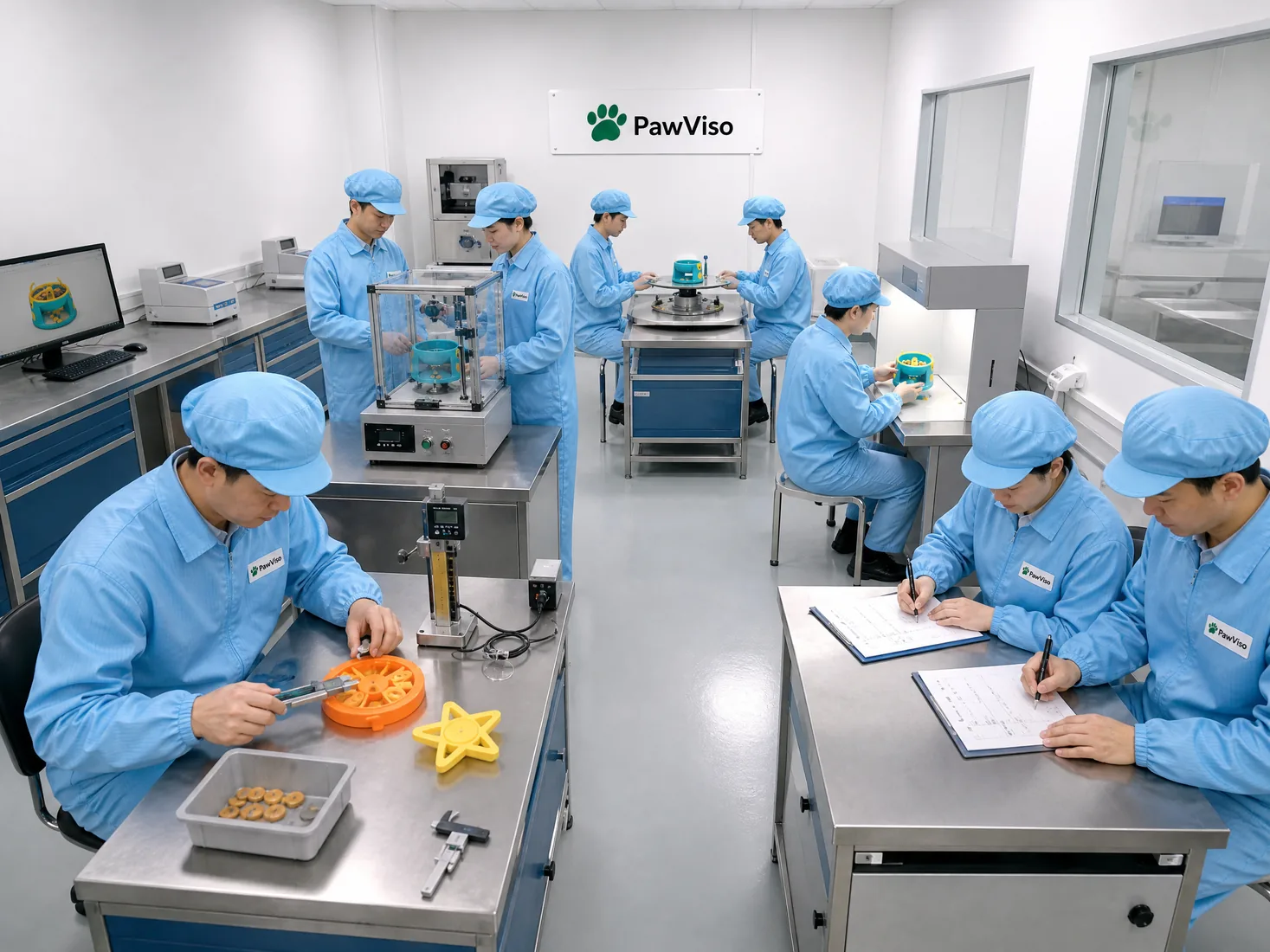
A pet product corrective action should begin with one buyer decision: hold the affected configuration until the factory and procurement team can show what is affected, what has been corrected, and what evidence supports the next release decision. It is not an instruction to “make it better” and it is not a promise that a defect will never recur. From a Chinese pet-product factory and procurement-partner perspective, an early, precise hold protects the buyer’s time as well as the factory’s ability to investigate the correct material, work order, packaging version and shipment.
This guide concerns a defect identified during production, final review, packing review, or before dispatch. It separates immediate containment from root-cause analysis, rework, verification and commercial release. It does not determine whether an item is compliant, safe, suitable for a particular pet, or reportable in any market. The responsible buyer or importer must confirm those project-specific matters for the actual SKU, destination, sales channel and claim set.
Module 1 — Decide whether to stop, segregate, or limit the affected product immediately
Decide the interim status before requesting an explanation. If the defect could affect an agreed must-pass criterion, the prudent buyer instruction is normally to place the identified units and related work in a visible hold status. The factory should not treat a hold as a conclusion that the whole order has failed. It is an instruction not to move unknown stock through packing, loading, transfer or rework without a record. Name the detected condition in observable terms: for example, “retail box carries artwork revision R03 instead of released R04,” “cap seal leaks in the agreed check,” or “one accessory is missing from sampled sets.” Avoid labels such as “poor quality,” which cannot tell the line what to contain.
At the same time, decide whether the defect is product-specific, packaging-specific, process-specific, or a document-control issue. A missing leaflet may require a physical inventory and packing stop, while a surface finish variance may require a defined visual sort. A component mismatch can require tracing backward to receiving stock and forward to packed cartons. The hold instruction should state what may continue, if anything. It is possible to allow unrelated SKUs or confirmed earlier lots to proceed, but only when their separation is supported by traceable evidence rather than convenience.
| Stock role | Buyer decision | Factory control while the action is open | Minimum identity record |
|---|---|---|---|
| Confirmed affected units | Hold for investigation, rework, or disposition | Physically or systemically segregate; block packing and loading | SKU, variant, quantity, location, lot or work-order link |
| Potentially affected units | Hold until boundary is established | Mark as pending; do not blend with released stock | Reason for potential link and production-time window |
| Confirmed unaffected units | Release only if separation is evidenced | Preserve their lot and packing identity | Evidence of different component, date, line, or revision |
| Reworked units | Keep separate pending verification | Mark rework instruction and completion status | Original lot, rework batch, operator and date |
Module 2 — Decide the containment boundary from traceability evidence, not from the sampled defect alone
Set the boundary around the common cause pathway, not only the defective unit found. One faulty travel bottle cap in a final sample may be isolated, or it may be linked to a cap delivery, cavity, assembly shift, carton configuration or inspection instruction. Ask the factory to map the product path from incoming component to finished carton. It needs a credible link between the affected SKU and the dates, work orders, components, line or subcontracted operation that could share the condition.
Batch or lot identification is valuable because it narrows a group of products made at the same time, while individual serialization identifies a single instance. GS1 notes that the appropriate identification level depends on traceability objectives and supply-chain context, and that higher-risk products are often identified at batch/lot or instance level.2 For a buyer corrective action, the practical question is simpler: can the factory show why a carton is inside or outside the hold? If not, the boundary should remain wider until evidence supports narrowing it.
Ask the factory to reconcile the boundary in both directions. Forward tracing asks where the suspect component or process output went: finished goods, cartons, pallets, warehouse locations, or dispatched movements. Backward tracing asks what entered the affected build: material lot, artwork revision, fixture, operator instruction and process record. This is especially important where a product and retail pack are assembled at different times. A correct product may have been packed in an incorrect box, and a correct box may contain the wrong product variant.
Module 3 — Decide whether the confirmed condition is correctable, sortable, replaceable, or a reason to reject the lot
Choose the treatment only after describing the nonconformity against the agreed baseline. The baseline may be a purchase order, approved product specification, golden-sample scope, packaging file, packing instruction, named test method, defect definition or buyer-authorized concession. State the specific mismatch and its evidence. “Wrong color” should become “inserts use the unapproved blue reference instead of the released black reference for SKU X.” “Leakage issue” should state the configuration, test setup, observation, sample identity and agreed pass condition. A precise description lets the buyer evaluate whether a repair changes the product, pack, document or evidence requirement.
A factory proposal should present real options rather than presume rework. Correction removes the observed issue on identified units. Sorting separates units using a written, repeatable criterion. Rework changes a product or pack through a defined operation. Replacement removes the suspect unit or component and substitutes a controlled one. Rejection or other disposition may be appropriate when the condition cannot be verified, the work would introduce unacceptable uncertainty, or the buyer decides the result no longer supports the order. These terms are operational labels; they do not decide contractual responsibility, regulatory status, or market suitability.
Module 4 — Decide what questions must be answered before calling the cause “root cause”
Require an evidence-based explanation, not a single-person attribution. Root-cause analysis is a systems approach for identifying underlying causes associated with a set of risks, rather than merely naming the person who found or made an error.1 In factory practice, the first explanation is often a useful hypothesis: an untrained packer, an incorrect line sheet, a worn fixture, an incoming material variation, or an obsolete artwork file. It becomes a root-cause conclusion only when the team can connect it to the actual defect pathway and explain why existing controls did not stop it.
The buyer should ask four linked questions. What physical or documentary condition directly produced the defect? Why was that condition present in this lot? Why did the prescribed control fail to prevent or detect it? What evidence would disprove the explanation? For instance, saying “operator error” is incomplete if the line had no current visual reference, the release file was ambiguous, or the inspection instruction did not identify the difference. a short five-why chain, process map or cause-and-effect review should lead to named evidence and an owner.
Where the investigation touches materials, labelling, claims, destination-market information or other market obligations, pause the scope at the point of uncertainty. The European Commission describes the General Product Safety Regulation as a framework intended to ensure that only safe products are available on the EU market and provides business-obligation information through its product-safety resources.3 That context does not determine what applies to a particular pet SKU. The buyer or importer should obtain appropriate project-specific confirmation instead of asking the factory to make a legal or safety determination through a corrective-action form.
Module 5 — Decide the rework scope as a controlled manufacturing operation
Approve rework only with a written scope that can be executed and checked. A clear rework instruction identifies the affected stock, original configuration, required end state, sequence, tools or materials, handling precautions, operator competence requirement, pack-out consequences and stop conditions. It also says what cannot be changed. For a retail-pack correction, that may mean “replace only the specified insert; do not substitute the product, label, leaflet, barcode or export-carton mark.” For a functional assembly correction, it may define the component revision and a post-rework operation check.
The factory should trial the planned operation on a small, identified set before applying it to held stock when the action could damage the product, packaging or records. A successful trial is evidence for the procedure, not a blanket conclusion about the full lot. It should be followed by trained execution, count reconciliation and the agreed verification. Do not present an informal bench repair as equivalent to a controlled production step merely because it looks simple.
| Rework-control element | Buyer approval point | Factory record | Stop or escalation trigger |
|---|---|---|---|
| Scope | Affected SKU, lot, pack level and quantities are named | Rework batch list and stock reconciliation | Suspect stock cannot be separated |
| End state | Restored condition matches the released reference | Current specification, image or approved sample link | Reference conflict or missing criterion |
| Method | Steps and allowed replacement materials are clear | Controlled work instruction and operator acknowledgement | Method requires an unapproved change |
| Trial | Trial answers the material risk of the operation | Trial sample ID, observations and approval | Trial creates a new defect or remains inconclusive |
| Traceability | Reworked stock remains distinguishable until release | Rework label, date, operator and lot link | Reworked and unreworked goods are mixed |
| Verification | Checks match the defect and rework risk | Results, photos and reviewer decision | Required evidence is incomplete |
Module 6 — Decide which records make the corrective action auditable and commercially usable
Request one connected corrective-action package, not scattered chat assurances. The package should link the original finding, containment, stock boundary, investigation, proposed treatment, rework execution, verification, reinspection and shipment decision. Each document needs a project identifier, SKU or variant, revision where relevant, date, owner and status. Photographs should identify the sample, carton or lot whenever practical. A buyer reviewing from another country must be able to tell whether an image shows the original defect, the rework trial, the final result, or an unrelated reference unit.
| Record | Buyer needs it to decide | Named owner | Closure test |
|---|---|---|---|
| Nonconformity report | What was found, against which requirement, and how it was evidenced | Factory quality lead | Defect description and affected configuration are unambiguous |
| Containment and stock log | What is held, where it is, and what may continue | Warehouse or production owner | Opening and final quantities reconcile |
| Cause-and-action record | Why the condition occurred and which control changes | Factory process owner | Cause, action, owner and due date are stated |
| Rework instruction and log | How identified stock was changed | Production owner | Completed quantities and exceptions are recorded |
| Verification or reinspection report | Whether the defined checks were performed and what they found | Quality reviewer or agreed inspector | Method, scope, results and limitations are visible |
| Buyer shipment decision | Whether specified goods may move and under what conditions | Buyer-authorized release owner | Decision names lots, quantity, date and open items |
Mid-article CTA — Need a corrective-action brief that buyers can review remotely? PawViso can help structure the defect statement, containment map, rework scope, evidence list and reinspection questions around an identified pet-product order. Email: info@PawViso.com.
For identification across parties, GS1 also recognizes that documents and transactions can need unique references, including identifiers usable for quality certificates and other records.2 A buyer does not need to implement a particular GS1 system to benefit from this idea. Use a simple corrective-action number that appears on the report, photo folder, rework log, inspection report and release email. It reduces the risk that a prior order’s photos or a different SKU’s report are mistaken for current evidence.
Module 7 — Decide what verification must prove before any broader reinspection
Verify the corrective action at the process level before relying on a finished-goods result. The first verification question is whether the new or restored control actually operates as intended. If wrong packaging was selected because two inserts were stored together, verification may include the revised location control, line issue check and visual reference at the packing station. If a closure was reworked, verification should include the agreed closure check on post-rework units. This is different from asking whether a random final sample happened to look correct.
Write a verification plan that names the characteristic, method, sample or population scope, timing, record and result rule. The plan should also include checks introduced by rework itself. A visual packaging correction may need pack-count, artwork-revision and barcode scan confirmation. A component replacement may require identity, fit and agreed function confirmation. Do not use “100% checked” as the entire method. State who checks, what they compare against, how exceptions are treated and how completed quantity is reconciled.
For transport packaging, distinguish a factory confirmation check from a named transport-performance procedure. ISTA says its 1-Series are non-simulation integrity tests useful for screening, while its 3-Series provide general simulations of damage-producing transport motions, forces, conditions and sequences.4 Therefore, a buyer should define the actual distribution question, configuration and evidence sought before treating any packaging check as sufficient. A reworked carton or insert might need only a controlled packing review, or it may require additional route-relevant validation; that decision belongs to the project requirements, not to a generic corrective-action label.
Module 8 — Decide the reinspection scope from the original defect, its cause, and the rework risk
Set reinspection to challenge the action, not to repeat the original inspection mechanically. If the root cause was a localized printed insert issue and every affected pack was reworked under a controlled instruction, reinspection should verify the insert revision, pack completeness, rework traceability and the relevant retail-pack presentation. If the cause could affect the wider product configuration, the scope must extend to the related function, components, variants or lots. The reinspection plan should state whether it is a targeted verification, a full final inspection, a new sampling exercise under the buyer’s existing plan, or a staged combination.
A reinspection report should show the population available, the identified reworked quantity, unreworked confirmed-unaffected quantity, sample-selection basis, reference documents, checks performed, defect observations, unperformed checks and resulting recommendation. Do not inspect only a “best” carton presented by the factory. Select across rework batches, locations, variants and packing stages as relevant. If the stock has been moved or relabelled, preserve the link between current location and original hold record before choosing samples.
The CPSC describes a corrective action plan broadly as remedial action that may include repair, replacement, refund or public notice, and notes that the appropriate plan can involve multiple measures.5 This guide does not advise on recalls or reporting. The useful operational lesson for buyer-managed factory actions is that a remedy can have more than one element. Rework, verification, stock control, documentation and a shipment decision should be assessed together rather than treated as isolated activities.
Module 9 — Decide the shipment disposition explicitly: release, conditional release, hold, or reject
Make the shipment decision after reviewing the evidence package, not after receiving a verbal assurance that rework is complete. The buyer-authorized decision should identify the exact SKU, variants, lots, carton or pallet quantities and documents reviewed. A release means the identified goods may proceed under the buyer’s stated conditions. A conditional release identifies a narrow accepted deviation or remaining action, its scope, owner and expiry point; it is not a general approval for a future order. A hold keeps identified goods blocked pending evidence or a new action. A reject or alternative disposition records that the buyer will not release the specified goods on the current basis.
Separate technical evidence from commercial authority. The factory can report completion and recommend a disposition. A procurement partner can coordinate records and inspection. The buyer’s designated release owner should decide whether the evidence meets the buyer’s purchase, channel and risk requirements. The parties should follow their contract for payment, ownership, delivery, remedies and communications. This article does not allocate liability or interpret contractual or regulatory obligations.
A timely decision should not mean a rushed decision. If evidence is incomplete, ask one focused question: what information would change the release outcome? It might be a count reconciliation, a rework-trial result, a wider inspection result, a current packaging proof, or buyer/importer confirmation of a market requirement. Asking for that specific item is more productive than declaring the entire action unacceptable without identifying the unresolved decision point.
Module 10 — Decide who owns each corrective-action task and how the quotation or order scope is protected
Assign owners before the action expands into a dispute. The factory normally owns containment execution, investigation inputs, rework instructions, process records and evidence from its operations. The buyer normally owns the approved baseline, defect policy, acceptance of deviations, market and channel confirmation, and shipment authority. A procurement partner may coordinate document control, translations, sample routing, production follow-up or inspection scheduling, but should not silently replace a named buyer decision. Write the task owner and decision owner separately, because the person who performs a check may not be authorized to waive its result.
The corrective-action file should also protect the commercial scope. If rework requires new components, altered pack-out, added sorting, replacement packaging, laboratory work, freight changes or schedule changes, the factory should identify the proposed scope and assumptions rather than quietly proceed. The buyer should confirm what is authorized in writing. This does not require a supplier to disclose internal cost structures, and it does not assume a fixed price or capacity. It gives purchasing a record of the change that can be assessed under the applicable purchase order and agreement.
Finally, do not transfer buyer/importer obligations through vague wording such as “factory to ensure all requirements.” A factory can support agreed checks and retain agreed evidence. The responsible buyer or importer must confirm requirements for the particular product, destination, labels, claims and sales channel. This distinction is particularly important when the defect may affect information printed on pack or evidence required for the market. A corrective action should make responsibilities clearer, not use urgency to blur them.
Module 11 — Decide how to close the action and prevent recurrence without making guarantees
Close the action when the identified defect, stock, evidence and control change are all resolved to the buyer’s stated decision rule. A closed record should show the original nonconformity, confirmed boundary, stock disposition, approved treatment, cause conclusion, completed correction, verification result, reinspection result where applicable, buyer shipment decision and named preventive control. It should also identify any open issue moved to a separate action. Do not close an action merely because the shipment departed, and do not retain it indefinitely merely because a theoretical recurrence is possible.
Prevention should be specific and modest in its claim. Examples include a revised work instruction with a controlled revision, separated packaging components, a first-off check against the current artwork register, a component-lot reconciliation, a fixture-maintenance check, or a training record tied to a newly introduced visual standard. State the control owner, start point, evidence and review date. The claim should be “this control was implemented and will be reviewed,” not “the defect cannot happen again.” Manufacturing controls reduce identified pathways; they do not guarantee future performance across every product, operator, supplier or order.
A well-managed closure also improves future buying. Preserve the final baseline, photos of the approved state, defect boundary, cause evidence, rework learning, named controls and approved exceptions in the supplier performance record. At the next RFQ, sample approval or production release, review whether the previous action changes the inspection plan, packaging instruction, component approval or change-notification trigger. This is prevention through controlled learning, not a guarantee about a future lot.
Frequently asked questions
Can a buyer release part of an order after a defect is found?
Yes, if the buyer has evidence that the released quantity is genuinely outside the affected boundary and the shipment record identifies exactly what is released. A partial release should not be based only on a factory statement that “the other cartons are fine.” It needs separation by lot, work order, component, revision, date, location or other relevant traceability evidence, plus the buyer’s documented authority to release that quantity.
Is 100% sorting enough after a failed inspection?
Not automatically. Sorting can be an appropriate treatment when the defect can be identified consistently and the buyer accepts the scope. The buyer should also ask whether the root cause can affect attributes the sort cannot see, whether the sorting instruction has a clear boundary, whether rework introduces new risks, and how the sorted quantity will be reconciled. A completed sort is one evidence stream, not a substitute for an agreed release decision.
Does reinspection have to use the same sample size as the original inspection?
No universal rule applies. The scope should reflect the initial defect, affected boundary, cause investigation, rework method, product or packaging risk, and the buyer’s existing inspection plan. A targeted reinspection may be insufficient where the action could affect a broad production window. Conversely, repeating unrelated checks can consume time without answering the corrective-action question. The buyer should state the decision rule before reinspection begins.
Who approves a concession for a cosmetic or packaging deviation?
The buyer’s named commercial or quality authority should approve it in writing, with the exact SKU, lot, quantity, description, evidence, expiry and shipment scope. The factory may recommend acceptance, but should not assume that a previous verbal preference permits a future deviation. If a concession could affect a market, retailer, label or claim requirement, the responsible buyer or importer must obtain appropriate project-specific confirmation.
Conclusion
A strong pet product corrective action is a buyer-controlled decision path: contain first, establish the boundary from records, describe the defect against the released baseline, investigate the cause, authorize a limited treatment, verify the control, reinspect at the right scope, and record a clear shipment disposition. The factory and procurement partner add value when they turn production evidence into a connected package for remote review.
Do not promise that rework, reinspection or a new line check makes every future lot perfect. Instead, require defined evidence, named owners and a controlled prevention step. That approach gives the buyer a defensible operational basis for a release, hold or rejection decision while keeping market, contractual and importer responsibilities with the parties that must confirm them.
Final CTA — Build a clearer corrective-action and reinspection brief with PawViso. Share the SKU, defect finding, current stock status, packaging level, target market and required shipment date so the next decision can be based on an identified scope and evidence plan. Email: info@PawViso.com WhatsApp: +86 186 8106 4480 — https://wa.me/8618681064480
This article is general B2B sourcing information and does not provide legal, veterinary, medical or safety advice. Project requirements, market obligations, evidence and release decisions need confirmation by the responsible buyer or importer for the actual SKU.
Related PawViso resources
- Continue with How to Choose Incoterms for Pet Product Orders. Use this guide to clarify cost, risk and handover points before shipment planning.
- Browse the PawViso product catalogue to identify product formats for a sourcing brief.
- Follow the PawViso sourcing process and review the B2B buyer FAQ before sharing project requirements.
External reference
For independent shipping-term and handover context, review International Chamber of Commerce Incoterms® 2020 overview. Confirm the requirements that apply to the selected product, target market and order.