
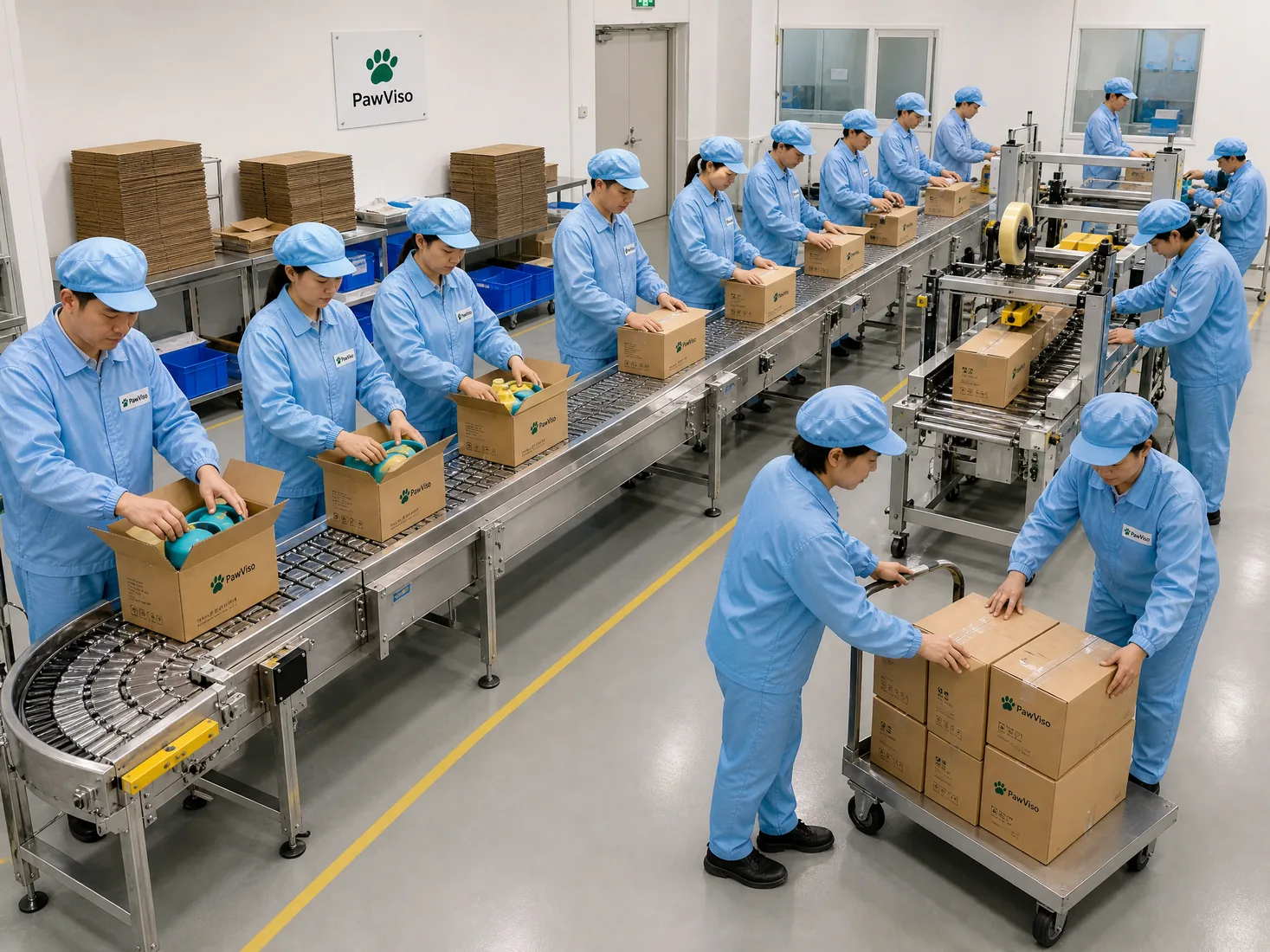
This guide is for U.S.-market retailers, importers, distributors, and private-label buying teams who source dog waste management products. It provides a buyer-focused framework and practical checklists for supplier screening, product specification, material evidence, sampling and pilot runs, packaging and retail readiness, quality-control practices, and the commercial tradeoffs you’ll face. It is not a substitute for buyer or importer confirmation of regulatory or performance claims; you must confirm final claims for your target market and comply with applicable laws.
Decision framework: what a pragmatic buyer needs first
Start with the commercial question: do you need a commodity reorder (low variation, fast turnaround) or a differentiated private-label product (spec feature set, design, packaging)? That choice determines minimum order quantity (MOQ), lead times, and the level of product evidence you should require.
Core decision points:
- Forecasted annual volume and SKU velocity: determines whether you qualify for lower MOQ or need to accept higher unit cost.
- Channel mix: e‑commerce vs. brick-and-mortar influences pack sizes, UPC/GS1 barcode needs, and display-ready packaging.
- Margin target vs. service levels: tighter margins push toward commodity buys; premium positioning justifies testing and higher-cost materials.
- Regulatory and procurement risk tolerance: willingness to accept supplier attestations vs. demanding third-party testing.
Quick procurement decision matrix
| Buyer priority | Recommended path |
|---|---|
| Lowest landed unit cost | Buy biodegradable dog poop bags wholesale in large quantities from established film extruders; accept basic supplier QC and commodity packaging |
| Branded/private-label | Require material certificates, sampling, pilot-run inspection, customized packaging and barcodes; expect higher MOQ and lead time |
This framework shapes the specific modules below.
Supplier screening and commercial terms
What to verify before you invite samples or issue a purchase order.
Must-have supplier evidence
- Business license, company registration, and trade references.
- Export experience to the U.S.: Incoterms offered, familiarity with customs paperwork, ability to provide ISF/AMS data or equivalent.
- Production capacity and seasonal load factors: monthly extrusion capacity, number of lines, shift patterns.
- Standard payment and delivery terms; MOQ, lead times, and options for partial shipments.
Technical and compliance signals
- Material certificates (see next section).
- Internal QC documentation: incoming material inspection, in-process checks, and final inspection standards.
- Traceability: lot numbering and ability to isolate batches by raw material roll number and extrusion run.
- Third-party audit history (BSCI/SMETA, ISO 9001) is useful but not a substitute for product testing.
Commercial clauses to negotiate
- Price breaks by committed annual volumes and sample-to-production conversion timeline.
- Penalties for late delivery or agreed corrective action plans. Include an acceptance window for incoming shipments.
- Ownership of tooling, artwork, and mold masters where applicable.
- Warranty and returns handling: define acceptable defect rates and credit/replacement terms.
Red flags
- Refusal to show production area or to allow a third-party inspection.
- Vague answers about resins, masterbatch, or compostability claims.
- Inability to provide lot-level traceability or refusal to sign basic contractual guarantees on QC sampling plans.
Product specifications and material/component evidence
Define the specification first, then insist on supporting evidence.
Essential specification fields
- Material type and composition by percentage (e.g., starch-blend PBAT/PLA/HDPE content).
- Thickness (microns or mils), dimensions (length, width, gusset), and bag capacity or load rating.
- Closure type: standard tie, drawstring, or resealable.
- Packaging unit: rolls per inner, bags per roll, outer carton counts.
- Dispenser compatibility (if you plan bundle SKUs).
When buyers ask for "biodegradable dog poop bags wholesale," they are buying a claim that needs substantiation. Request the following from suppliers:
Required material evidence
- Material Safety Data Sheet (MSDS) for each resin or additive.
- Certificate of Analysis (CoA) from the resin supplier showing key properties.
- Compostability or biodegradability certificates from accredited labs (e.g., meeting ASTM D6400, EN 13432) if the supplier claims conformity. Tag claims with scope: industrial compostability vs. home compostability.
- Migration and ecotoxicity test reports only where applicable to regulatory requirements or retail specifications.
- Heat-seal and tensile strength test results for welded bag types.
Note on claims: Do not accept an unsupported “biodegradable” or “eco” statement. If a supplier provides certificates, confirm issuer legitimacy and reporting period. Buyers/importers must confirm final claims and labeling obligations in target markets.
Compact specification comparison table
| Attribute | Commodity biodegradable bag | Private-label premium bag |
|---|---|---|
| Typical thickness | 9–15 microns | 18–30 microns |
| Packaging | Bulk rolls, minimal printing | Retail-ready printed boxes, dispensers included |
| Certification | Often none or supplier self-declaration | Third-party compostability test reports |
| Typical MOQ | Low to medium | Higher, depending on printing/tooling |
Include product functionality features in the spec:
- Perforation length and placement for roll-bag performance.
- Start tab type for dispenser use.
- Compatibility notes for "dog poop bag dispenser with flashlight", "dog poop bag dispenser wall mount", "dog poop bag dispenser for parks", and "dog poop bag dispenser for leash" variants—if you plan to sell dispenser+refill SKUs, specify roll core diameter and length so dispenser fit is predictable.
Search for "biodegradable dog poop bags bulk" if your priority is low unit price and high volumes. Bulk products often use simpler formulations that prioritize cost and extrusion throughput; they may lack compostability certificates.
Sampling, pilot-run checks, and acceptance testing
Sampling is where technical claims meet reality. Use a staged approach: sample → lab test → pilot production → pre-shipment inspection.
Recommended sampling strategy
- Pre-sample documentation: supplier provides spec sheet, CoA, MSDS, and any claimed test reports.
- Production sample: receive finished bag rolls from the same tooling and extrusion line intended for production.
- Verification lab tests: tensile strength, puncture resistance, thickness profile, leak tests, and compostability/biodegradability tests if required by the spec.
- Functional checks: roll dispensing from your chosen dispensers and manual use tests (opening, sealing/drawstring, perforation ease).
- Package integrity checks: carton strength, roll wrapping, humidity protection, and label accuracy.
Pilot-run checks
- Lot traceability: confirm pilot cartons have lot codes that map back to raw material batches.
- Run at representative speed: ask supplier to run at production speed to reveal defects due to machine settings.
- Keep a sample set from beginning, middle, end of the pilot run for comparative testing.
Acceptance testing checklist
- Random sampling per ISO 2859-1 or AQL standard you specify.
- Metrics to define: thickness variance tolerance, tensile strength min, puncture resistance min, seal integrity pass rate.
- Define non-conformance protocol and rework or replacement terms.
Testing labs and standards
- For compostability and biodegradability, request accredited laboratory reports and confirm test standard (e.g., ASTM D6400 or EN 13432) 1.
- For material composition, gas chromatography or FTIR analysis can confirm polymer types.
- For mechanical properties, standard tensile and puncture methods apply.
Remember: a supplier may present in-house tests; require third-party testing for critical claims. Buyer/importer confirmation is required to finalize claims on packaging and marketing.
Packaging, retail readiness, and dispenser compatibility
Packaging strategy depends on the sales channel.
E‑commerce and subscription channels
- Focus on minimal outer packaging that protects rolls and reduces dimensional weight in shipping.
- Include UPC/GTIN, batch code, and clear product claims with the certificate references available upon request.
- Consider multi-roll bundles sized to common subscription frequencies (30, 60, 90 days).
Brick-and-mortar and retail readiness
- Retail-ready packages need shelf impact, UPC/GTIN printed on cartons, and overpack master carton design optimized for shelf replenishment.
- Include unit-for-unit checks for point-of-sale barcode scannability and hang-hole or hook compatibility.
Dispenser and accessory compatibility
- If you offer accessory SKUs, define dispenser interface dimensions. For compatibility with "dog poop bag dispenser with flashlight", "dog poop bag dispenser wall mount", "dog poop bag dispenser for parks", and "dog poop bag dispenser for leash", specify:
- Roll core inner diameter
- Outer roll diameter (max)
- Bag width and perforation spacing
- Tab/start style
Compact packaging decision table
| Channel | Recommended pack count | Labeling focus |
|---|---|---|
| E‑commerce/subscription | Multi-roll bundles (4–12 rolls) | Shipping durability, clear online product specs |
| Supermarkets/independent stores | Shelf-ready boxes, single-roll or 2–4 pack | Shelf impact, UPC, ingredients/claims verification |
| Park/municipal dispenser supply | Bulk refills on pallet | Pallet labeling, dispenser-fit notes, weatherproof inner wrap |
Retail-ready artwork and legal copy
- Keep substantiated claims only.
- Include lot code and production date.
- If advertising compostability or biodegradability, include test standard and lab reference; buyers must validate any on-pack claim and local disposal guidance for end users.
Packaging logistics
- Optimize carton dimensions to maximize pallet utilization and minimize freight cost.
- Define inner wrapping requirements to prevent humidity ingress in transit.
- For international suppliers, ensure cartons have U.S. customs-friendly labeling and documentation.
Quality-control process and commercial tradeoffs
QC design should balance risk, cost, and operational capacity.
QC steps to embed in the contract
- Incoming raw material inspection: verify resin lot numbers against supplier CoAs.
- In-process checks: thickness mapping, weight-per-roll, perforation integrity, and seal checks at defined intervals.
- End-of-line sampling: AQL plan, visual inspection, and functional testing.
- Pre-shipment inspection (PSI): third-party agent to check carton counts, labeling, and sample functional tests.
Define acceptance criteria numerically
- Example: Thickness mean within ±10% of spec; seal integrity pass rate ≥ 98%; visual defect rate ≤ 2% (adjust per product category).
Tradeoffs buyers typically make
- Cost vs. certification depth: deeper third-party testing increases cost and lead time but reduces downstream risk.
- MOQ vs. SKU variety: narrower product lines enable lower unit costs; bespoke bags increase complexity and tooling cost.
- Lead time vs. transportation mode: air freight reduces lead time but increases landed cost; ocean freight requires larger, committed orders.
Insurance and liability considerations
- Consider requiring supplier product liability evidence and to carry indemnity clauses appropriate to volume and risk profile.
- For importers, ensure you have customs broker processes and product classification confirmed.
Quality-control cost-benefit snapshot
| QC activity | Typical cost impact | Risk reduction |
|---|---|---|
| Third-party compostability testing | Moderate per SKU | High—validates marketing claims |
| Pre-shipment inspection | Low–moderate per shipment | Moderate—prevents large batch defects |
| Continuous in-line monitoring | Capital/operational cost (supplier) | High—reduces variability |
No guarantee: QC reduces but does not eliminate risk. Buyers/importers must confirm final claims and legal compliance for the U.S. market.
Procurement module: accessory and vertical opportunities
You will often pair bags with dispensers, leash clips, park dispensers, or offer private-label bundles.
Accessory sourcing considerations
- Dispenser types: personal leash-mounted, stake-mounted park dispensers, wall-mounted units for community use, and combo units with lights (e.g., a "dog poop bag dispenser with flashlight").
- For wall or park units, verify mounting hardware specification and material durability for outdoor exposure (UV stabilization, corrosion resistance).
- For leash-mounted or personal dispensers (including "dog poop bag dispenser for leash"), check snap/clasp strength, ease of roll replacement, and battery specs if electronic components are included.
Bundle and SKU strategies
- Cross-sell refill rolls with dispensers; specify roll size to ensure interchangeability in "dog poop bag dispenser wall mount" and "dog poop bag dispenser for parks".
- Consider starter kits (dispenser + X rolls) to raise Average Order Value (AOV) and control initial product experience.
Manufacturer selection for accessories
- Differentiate manufacturing expertise: plastic injection-molded dispensers are separate from film extrusion. Ask for tooling records, material specs for plastic housings (ABS, polypropylene), and any IP considerations.
- For "puppy pad manufacturer" needs, if you also source training pads, verify absorbency specs, hydrophobic back-sheet composition, and pad dimensions. Sourcing both poop bags and pads from aligned suppliers can simplify logistics but requires careful supplier capability checks.
Logistics and aftersales
- Stock spare parts (mounting screws, replacement hinges) to reduce returns.
- Define warranty and replacement parts lead times in your supplier agreements.
Frequently asked questions
Q: How do I verify a supplier’s compostability certificate is valid? A: Ask for the full test report with lab name, accreditation details, test standard (e.g., ASTM D6400 or EN 13432), sample identification, and test date. Confirm the lab is accredited and that the test sample description matches your product. Buyer/importer confirmation is required for marketing claims.
Q: What minimum tests should I run on a sample roll? A: At minimum: thickness profile, tensile strength, puncture resistance, seal integrity, and a functional dispense test. Add compostability/biodegradability testing only if you will market those claims.
Q: Should I source dispensers and bags from the same supplier? A: Only if the supplier demonstrates proven competency in both film extrusion and injection molding, and if they can guarantee roll-to-dispenser fit. Otherwise, pair a film extruder with a plastics manufacturer and require compatibility specs.
Q: How should I set an acceptable defect rate in my purchase contract? A: Use an AQL aligned to your channel expectations. For consumer-packaged retail, a stricter AQL (e.g., 1–2%) is common; for bulk municipal supply, buyers often accept higher tolerance. Define specific failure modes (tears, leaks, printing errors) and credit/replacement terms.
Conclusion
Sourcing biodegradable dog poop bags bulk or wholesale for the U.S. market requires a layered approach: define your commercial path (commodity vs. private-label), screen suppliers for capacity and traceability, require material evidence for any biodegradability or compostability claims, and perform staged sampling and pilot runs with third-party laboratory verification when claims are critical. Decide packaging strategy by channel and ensure dispenser compatibility if you offer accessory SKUs such as "dog poop bag dispenser with flashlight", "dog poop bag dispenser wall mount", "dog poop bag dispenser for parks", or "dog poop bag dispenser for leash". Balance QC rigor with commercial realities: deeper testing raises cost and lead time but reduces downstream risk. Finally, document acceptance criteria, negotiate clear contractual remedies for non-conformance, and confirm all final labeling and claims with your legal and compliance teams—buyer/importer confirmation is required for final claims and target-market obligations.
Buyer search scope
This guide addresses the following U.S. B2B procurement search phrases. Each phrase is considered in the context of supplier selection, product specifications, samples, packaging and quality evidence rather than as a consumer recommendation.
| Search phrase | Buyer use |
|---|---|
| biodegradable dog poop bags wholesale | Primary procurement focus for this guide |
| biodegradable dog poop bags bulk | Related specification, supplier or range-planning query |
| puppy pad manufacturer | Related specification, supplier or range-planning query |
| dog poop bag dispenser with flashlight | Related specification, supplier or range-planning query |
| dog poop bag dispenser wall mount | Related specification, supplier or range-planning query |
| dog poop bag dispenser for parks | Related specification, supplier or range-planning query |
| dog poop bag dispenser for leash | Related specification, supplier or range-planning query |
Final CTA — Prepare a focused dog training & waste accessories sourcing brief with PawViso.
Share your target U.S. channel, product format, estimated order structure, packaging direction and customization requirements for a practical B2B discussion.
Email: info@PawViso.com
WhatsApp: +86 186 8106 4480
Related PawViso resources
- Continue with How to Compare Cost per Use for Dog Training Pads to compare a related supplier, sample and quality-control route.
- Browse the PawViso product catalogue to identify product formats for your purchasing brief.
- Follow the PawViso sourcing process and review the B2B buyer FAQ before sharing requirements.
External reference
Use ISO 9001 quality-management systems guidance as general quality-system context, and confirm the product-specific evidence that applies to the selected SKU, channel and target market.