
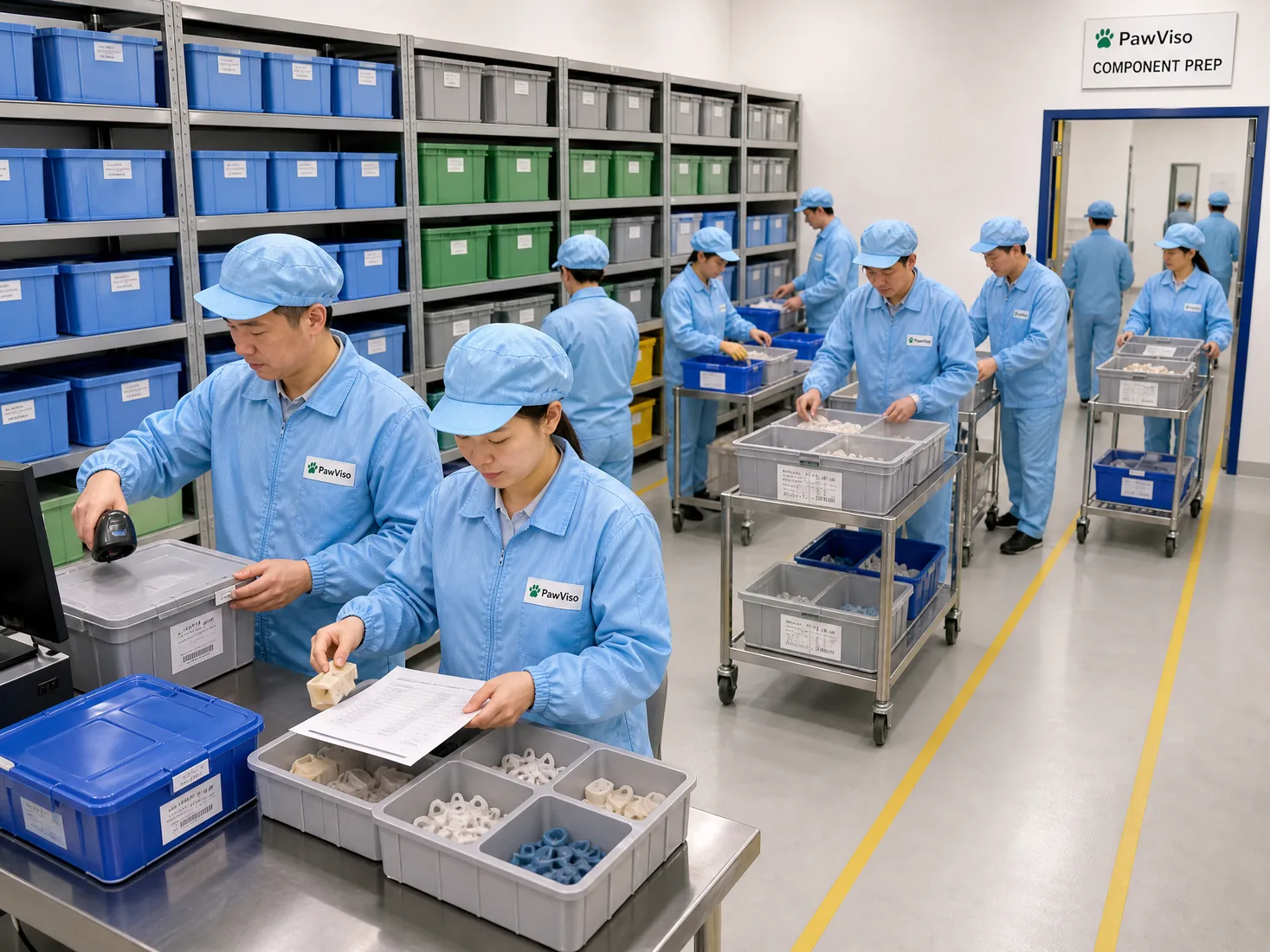
This guide helps U.S.-market buyers—retailers, importers, distributors, and private‑label teams—compare suppliers, design specifications, documentation, sampling, packaging, quality controls and commercial tradeoffs when sourcing dog walking and apparel products. It focuses on procurement processes and decision points; it does not make product-performance, medical, or regulatory guarantees. Buyer/importer confirmation is required before relying on any claim for market entry or compliance.
Decision framework: three questions to structure sourcing
Before engaging suppliers, clarify three commercial truths that will drive technical decisions and supplier choice.
-
What is your position on private label vs. existing designs?
- Private label means technical design, tooling and longer development time; it usually attracts higher MOQ and unit-cost advantages at scale.
- Rebranding existing SKUs can shorten time to market and reduce sampling rounds.
-
What are your minimum commercial constraints?
- Target landed cost, target retail price, acceptable MOQ, lead time, and preferred logistics route (domestic manufacturing vs. importing finished goods).
- Identify non-negotiables (e.g., domestic production only, or specific fiber content).
-
What is the primary risk you will prioritize?
- Regulatory compliance (labels, flammability), fit/performance (harness strength, closure reliability), or retail readiness (packaging and UPC/PLU requirements).
Use the answers to choose the right supplier profile: low-MOQ domestic converters, contract manufacturers for private label, or overseas partners for price-sensitive assortments. The rest of this guide translates those choices into practical procurement modules.
Supplier screening: evidence, capabilities and commercial terms
Screen suppliers by verifying capability, capacity and documentary evidence. Prioritize suppliers that can meet your commercial constraints and provide traceable documentation.
Key criteria checklist (use as first-screen table):
| Screening item | Why it matters | Minimum acceptable evidence |
|---|---|---|
| Business profile | Confirms legal status and capacity | Business license, tax ID, reference customers |
| Product scope | Matches your SKUs (jackets, sweaters, harnesses) | Product catalogue with SKU examples |
| Technical capability | Pattern-making, grading, sewing, hardware sourcing | Photos of factory lines, list of machinery |
| Minimum order quantity (MOQ) | Affects inventory risk | Written MOQ by SKU and per production run |
| Lead time calendar | Production planning | Typical lead times (sampling, production, shipment) |
| Quality systems | Reduces defects and recalls | Inspection reports, QC protocol or third‑party audit results |
| Evidence of compliance | Market acceptance and legal risk | Testing reports, label templates, material certifications |
| Samples and prototyping | Validates design and fit | Sample lead time and cost terms |
When you contact potential partners, request the items above in a single packet. For U.S. market imports, request records that support regulatory claims (e.g., testing for regulated hazards). Regulatory confirmation by your compliance team or counsel is required for final market claims; see official U.S. regulator guidance where applicable 1.
Sourcing note: If you need a "dog harness manufacturer" or "dog harness suppliers" specifically, add questions about hardware strength tests (breaking load), buckle standards, and compatibility with leash attachment points. For "custom dog harness wholesale" and "custom dog harness manufacturers," ask about pattern grading across canine sizes and repeatable adjustment tolerances.
Product specifications and material evidence
Translate design intent into measurable specifications. Specifications reduce ambiguity and accelerate acceptable samples.
Essential specification elements:
- Bill of Materials (BOM): fabric(s) with composition and weight (e.g., 100% polyester, 210 g/m²), hardware types (buckles, D‑rings), thread type and gauge, webbing width and tensile rating.
- Technical drawing(s): flat sketch with dimensions, seam allowances, stitch types, and tolerances for each size.
- Performance requirements: breaking strength for harness attachment points (specify test method and target), abrasion resistance, water resistance rating if relevant (e.g., hydrostatic head or water repellency test), colorfastness requirements (wash and lightfastness).
- Labeling and care instructions: fiber content, country of origin, care instructions and size labels formatted to meet U.S. market expectations; importer/buyer must confirm final label text and claims.
- Packaging and barcoding: folded dimensions, polybag or hang-tag requirements, UPC/PLU placement, and retail-ready packaging mockup.
Material evidence to request from suppliers:
- Mill certificates or material specification sheets for main fabrics and webbing.
- Hardware certificates—material composition (e.g., zinc alloy vs. stainless steel), plating finish, and corrosion/resistance test results.
- Laboratory test reports for any claimed performance metrics (e.g., tensile test for webbing) from accredited labs. State upfront which test standards you accept; ambiguous claims hinder acceptance.
Table: Minimum acceptance criteria for typical dog apparel/harness components
| Component | Typical measurable metric | Minimum evidence to accept |
|---|---|---|
| Webbing (harness load-bearing) | Tensile strength (N or lbf), width | Mill spec + lab tensile test report |
| Buckles & D-rings | Breaking load, corrosion resistance | Manufacturer spec + sample test or cert |
| Main fabric (apparel) | GSM, fiber content, colorfastness | Fabric spec + lab colorfastness report |
| Stitching | Stitch type, seam strength | Tech drawing + sample seam pull test |
| Labels | Content accuracy | Label artwork + placement spec |
Include the exact phrase "pet clothing manufacturers" or "pet clothing wholesale" when evaluating suppliers who cover both harnesses and apparel. When you need a "dog clothing manufacturers usa" option, confirm the supplier's manufacturing location and where final assembly occurs.
Compliance reminder: For child or human clothing, additional flammability and small-part rules apply; for pet products, market expectations vary. Always confirm obligations with your compliance team and use official regulator guidance where needed 1.
Sampling and pilot-run checks
A structured sampling process reduces rework and commercial surprises. Define a sampling protocol covering prototypes, pre-production, and pilot runs.
Sampling stages and what to measure:
- Prototype (fit/form): Single prototype to validate design intent and basic fit. Measure dimensions against tech pack tolerances and conduct initial fit checks on representative dog-size dummies or charts.
- Pre-production sample (PPS): Produced on intended production line with production materials. Use this to validate BOM substitutions, stitching, and hardware. Confirm labels, packaging proofs and hang-tag placement.
- Pilot production run: Small batch (agreed MOQ or fraction) to test full production flow, packing, and logistics. Use pilot run to validate shipping cartonization and retail-ready presentation.
Checklist for each sample:
- Dimensional report: measured points vs. spec tolerances.
- Photographic record: high-resolution photos of seams, hardware, labels, and packaging.
- Functional tests: buckle operation, leash-attachment load test (document method and outcomes), and wear trial notes from handlers if applicable.
- Inspection report: documented defects, AQL targets, and corrective actions.
Sampling governance tips:
- Mandate revision numbers on each sample so you track iterations.
- Maintain a decision log: accept/reject and reasons. This avoids later disputes.
- For "custom dog harness wholesale" projects, pay attention to size grading and adjust based on pilot-run findings—dogs’ body shapes are variable; you need consistent grading methodology.
Cost and timing: Expect sampling to add 2–8 weeks depending on complexity and factory proximity. Reserve budget for iterative tooling or hardware customizations. The sample process is where many product discrepancies are identified and resolved.
Packaging and retail readiness
Retailers and omnichannel distributors expect consistent retail-ready packaging, clear labeling, and efficient cartonization for receiving and shelf presentation.
Key packaging decisions:
- Retail format: hang-sell, folded in polybag with header card, or boxed. Each format affects unit cost, shelf space and returns handling.
- Protective packing: polybag or inner sleeve to protect against moisture and customer handling.
- Barcoding and labeling: UPC or GTIN placement requirements for your retail partners; include inner and master carton labels with SKU, quantity, and country of origin.
- Fold and pack specs: per-SKU folding instructions, bag size, number per polybag (if bundled), and orientation within master cartons.
Table: Packaging tradeoffs for common formats
| Format | Pros | Cons |
|---|---|---|
| Hang-sell (with hook header) | Ready for peg/rack display; high perceived value | Higher per-unit cost; more packaging waste |
| Polybag + header card | Low cost; protects unit | Less premium; needs clear display plan |
| Retail box | High protection and premium perception | Higher shipping volume and cost |
Retail readiness checklist:
- Mockup approved by buyer and manufacturer.
- Barcode registration and sample labels on PPS.
- Drop-test or transit simulation results for fragile hardware if needed.
- Master carton dimensions, weight and palletization plan for freight rate accuracy.
For importers, align packaging to optimize containerization and reduce non-recoverable freight costs. For domestic vendors (e.g., "dog clothing manufacturers usa"), confirm fulfillment center receiving requirements early to prevent repacking charges.
Quality control and inspection strategy
Define acceptance criteria and inspection regimes that match your risk tolerance and product value.
Quality control layers:
- Incoming material inspection: verify BOM items (fabric bolt checks, webbing tensile sample verification).
- In-line inspection: during production, random checks for stitch density, seam integrity, and hardware placement.
- Final random inspection (FRI): AQL-based sampling on finished goods before shipment. Standard AQL levels (e.g., 2.5) are common for apparel, but adjust for safety‑critical parts.
- Lab testing: periodic batch testing for declared performance characteristics (e.g., webbing tensile strength) and for any label claims you plan to make.
Inspection governance:
- Define checklists tied to your tech pack for factory QC teams and third‑party inspectors.
- Include reject criteria and rework instructions. For instance: unpacked sample with under-stitched seam → rework required; missing label → reject.
- Holdback policy: retain a percentage of shipment value until corrective actions are verified if defects are significant.
Selecting inspection levels: Use risk-based sampling—higher-risk items (load-bearing harness points, plated metal hardware) require more rigorous testing and lower AQLs. Use independent QC firms for FRI if you lack internal QA capacity.
Commercial tradeoffs: increased inspection rigor reduces defect risk but raises per-unit cost and time to market. Balance inspection frequency and intensity against historical supplier performance and product criticality.
Note on claims and testing: If you will assert specific strength or safety claims in marketing or packaging, secure third-party test reports and keep procurement documentation. Buyer/importer confirmation is required for final claims and target-market obligations.
Frequently asked questions
Q: What documentation should I require from a dog harness manufacturer before placing a large order? A: Request business registration and references, product catalogue, BOM, tech pack, sample photos, mill/hardware certificates, lab test reports for load-bearing components, MOQ and lead times. Confirm label and packaging proofs. Final compliance confirmation must come from your team.
Q: How do I decide between a domestic dog clothing manufacturers usa and overseas supplier? A: Compare landed cost, lead time, MOQ, control over production, and responsiveness. Domestic partners reduce lead time and sometimes simplify compliance, but typically at higher unit cost. Overseas partners can offer lower unit cost but add logistics and longer sampling cycles. Use a pilot run to validate the choice.
Q: How many samples should I budget for private‑label harness development? A: At minimum: one prototype, one pre-production sample (PPS), and a pilot run sample. Expect multiple iterations; budget 3–6 sample cycles for new tooling or complex hardware. Each cycle may incur tooling and freight costs.
Q: What are reasonable MOQ expectations for custom dog harness wholesale production? A: MOQs vary widely. For custom assemblies with specialized hardware, MOQs may be in the hundreds per SKU; for simple sewn apparel, MOQs can be lower. Negotiate graded MOQs (higher quantities for full colorways) and consider staggered production to manage inventory risk. Always confirm MOQ in writing.
Conclusion
Sourcing dog walking and apparel products requires a disciplined approach that converts design intent into measurable specifications, verifies supplier capability through structured evidence and sampling, and implements pragmatic quality and packaging controls. Use the decision framework to align private‑label strategy, commercial constraints and prioritized risks. Insist on measurable material evidence (mill specs, hardware certs, and lab tests) and a documented sampling and pilot-run plan to reduce downstream friction. Apply inspection regimes and packaging rules that reflect product value and retail expectations. Finally, document all supplier commitments in purchase orders and tech packs; buyer/importer confirmation is required for final claims and compliance obligations.
If you need a focused checklist or a customizable tech-pack template for "custom dog harness manufacturers" or "pet clothing manufacturers" projects, outline your product family (harness types, apparel SKUs, target prices and MOQs) and use this guide to build your supplier RFQ packet.
Buyer search scope
This guide addresses the following U.S. B2B procurement search phrases. Each phrase is considered in the context of supplier selection, product specifications, samples, packaging and quality evidence rather than as a consumer recommendation.
| Search phrase | Buyer use |
|---|---|
| dog clothing manufacturers usa | Primary procurement focus for this guide |
| custom dog harness wholesale | Related specification, supplier or range-planning query |
| custom dog harness manufacturers | Related specification, supplier or range-planning query |
| pet clothing wholesale | Related specification, supplier or range-planning query |
| pet clothing manufacturers | Related specification, supplier or range-planning query |
| dog harness suppliers | Related specification, supplier or range-planning query |
| dog harness manufacturer | Related specification, supplier or range-planning query |
Final CTA — Prepare a focused dog walking & apparel sourcing brief with PawViso.
Share your target U.S. channel, product format, estimated order structure, packaging direction and customization requirements for a practical B2B discussion.
Email: info@PawViso.com
WhatsApp: +86 186 8106 4480
Related PawViso resources
- Continue with How to Source Adjustable Dog Harnesses to compare a related supplier, sample and quality-control route.
- Browse the PawViso product catalogue to identify product formats for your purchasing brief.
- Follow the PawViso sourcing process and review the B2B buyer FAQ before sharing requirements.
External reference
Use ISO 9001 quality-management systems guidance as general quality-system context, and confirm the product-specific evidence that applies to the selected SKU, channel and target market.