
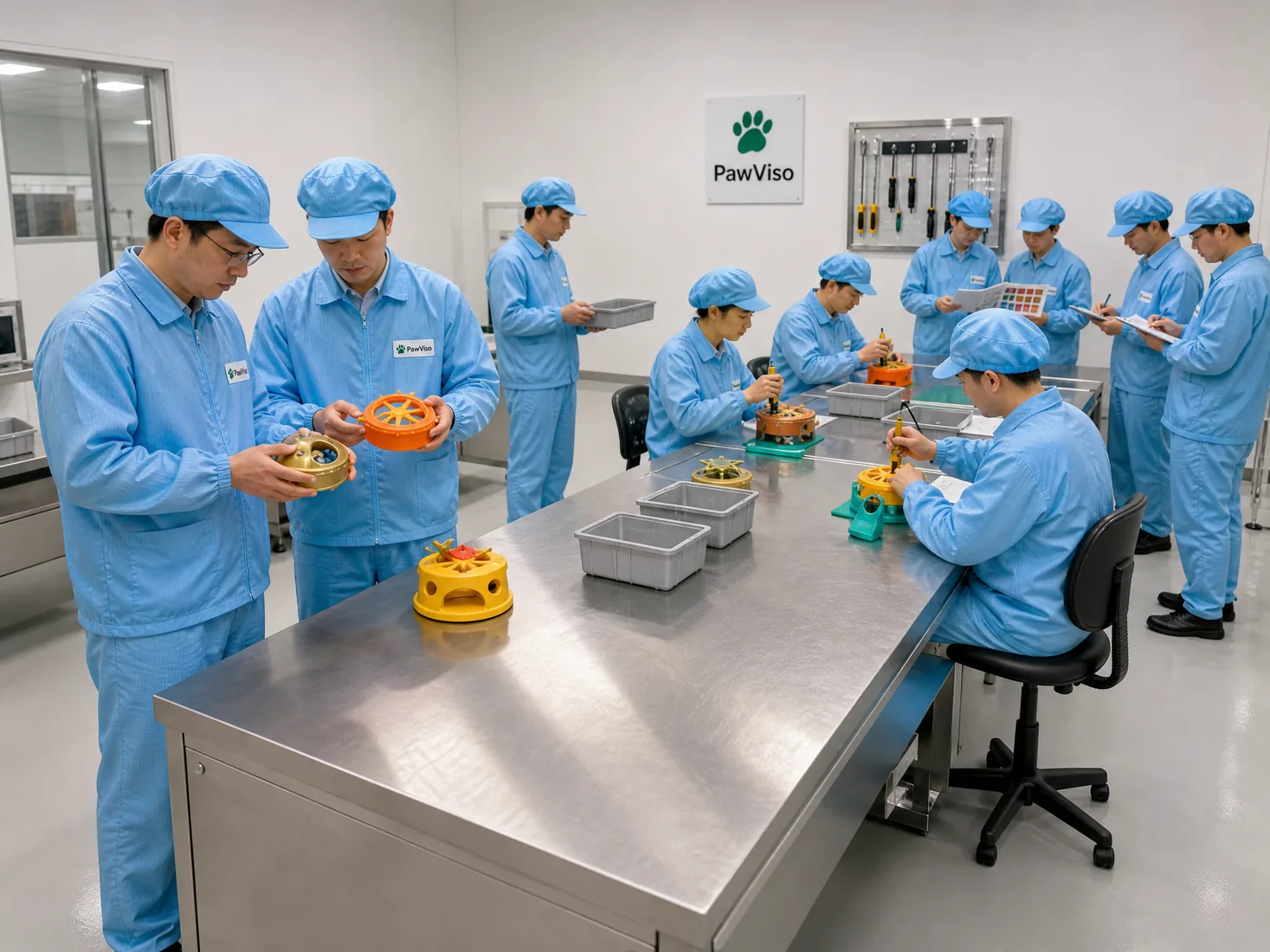
Sourcing private label pet ID tags requires clear buyer decisions across materials, personalization workflows, attachments and pack-out. This guide gives direct buyer instructions first, then explains supplier inputs, record requirements, tradeoffs and practical next steps for each decision area. It is written from a Chinese factory and procurement-partner perspective to help international buyers prepare specifications, evaluate quotes and control quality on arrival.
Read each module as a decision checklist. For every choice we explain the documents you should hold, what the supplier must confirm, and which gates (samples, pilot runs, inspection) belong to the buyer. Where a management system or product-identification topic is relevant we cite formal references and note the difference between system certification and SKU conformity 1. Where buyer/importer market rules apply we remind buyers to confirm local requirements themselves 3. We do not provide legal, veterinary or safety advice; we only describe sourcing workflow and records.
Module 1 — Material selection decision
Direct answer: Choose the tag base material by prioritizing buyer-controlled criteria: target retail price, perceived finish, engraving/printing compatibility, hypoallergenic requirements set by the buyer, and recyclability expectations defined by the buyer. Ask suppliers to quote material options (e.g., stainless steel grades, brass, aluminum, PET, TPU) with cost ranges, minimum order quantity (if any), sample lead times and process limitations for each material. Require the supplier to document material grade, mill certificates (if available), surface treatment steps and any known limitations for personalization techniques.
Explanation and next steps: The buyer should supply a ranked list of requirements (e.g., “engraving contrast over print longevity” or “soft-touch finish over metallic look”) so the factory can map those to available materials and processes. The supplier input should include material sheet thickness, density or durometer for polymers, corrosion-resistance notes from the mill, and recommended attachment methods for each material. Record material choices on the commercial specification and the technical drawing that accompanies the purchase order.
Compact roles table — material decision
| Buyer role | Supplier input | Record to keep |
|---|---|---|
| Define acceptable materials and price-target | Material options with process notes and sample cost | Approved material list and technical drawing |
| Confirm marketing claims or restrictions 3 | Mill certificates or supplier material statements | Material declaration attached to PO |
| Approve final material sample | Production sample photo report | Sample gate sign-off in QA file |
Tradeoffs: Metals generally accept high-contrast laser engraving; polymers enable color matching or soft-touch coatings. Each material needs a clear sample gate before bulk production because surface behavior during personalization varies by batch and finishing. Avoid assuming a material’s performance outside your contracted test criteria; instead define the verification steps you require.
Module 2 — Shape, size and thickness decision
Direct answer: Specify the exact shape, nominal dimensions and acceptable tolerances. Provide a vector drawing or CAD file with measurable dimensions, hole location and required radii. For flexibility, include a “plan B” size that the supplier can propose if tooling or minimum sizes create cost savings. Require a die-cut proof or sample to validate shape, and record approved tooling details and ownership (who pays, who keeps dies).
Explanation and next steps: The buyer’s decision affects production tooling, lead time and unit cost. Request a drawing with three main zones: personalization area, attachment point, and visible branding area. Ask suppliers to confirm feasibility, tooling cost, and estimated life of the die or mold. If you plan multiple SKUs with the same tooling, capture the SKU mapping and tolerances in the release documentation.
Compact shape/tolerance table
| Item | Buyer minimum to specify | Supplier confirmation |
|---|---|---|
| Nominal size (L×W×T) | Exact mm and tolerance ± | Feasibility and tooling cost |
| Hole diameter and position | Dimension + clearance | Punch type and wear expectations |
| Edge radius and chamfer | Radius value | Whether rework or deburring is needed |
Market constraints: Some markets limit tag dimensions for specific uses; confirm local labeling rules with your import team before finalizing sizes 3. Do not assume a supplier’s standard die will match your branding or personalization needs—require a sample tool-run and buyer sign-off.
Module 3 — Surface finish and coating decision
Direct answer: Define the surface finish option you require (e.g., brushed, mirror, matte bead-blast, electroplated coating, powder coat, enamel fill) and list any required topcoat or protective lacquer. Require a Finish Control Table in the spec that lists finish, target appearance, acceptable defects, and color references (Pantone or physical swatch). The supplier should provide finish-process steps, chemicals used, and a photograph set of pre-production samples for approval.
Explanation and next steps: Surface finish determines which personalization technologies will work and what unit-pack presentation is needed. For example, reflective finishes may require masking or different laser settings for contrast. Buyers must define acceptable optical properties (shine level, texture) to reduce subjective disputes. Require the supplier to provide process parameters (e.g., plating thickness range, bake times for powder coat) so any future claim or test can be traced to those parameters.
Specification/quote control table
| Spec item | Buyer input required | Supplier quotation note |
|---|---|---|
| Finish name and reference | Pantone or swatch | Process steps and lead time |
| Coating chemical or layer | Any banned substances list | Supplier material safety summary |
| Visual tolerance | Photos of acceptable/unacceptable | Rework rules and scrap rates |
Claims and marketing: If you plan to use performance or environmental claims on packaging or product pages, state the exact claim language during sourcing so the supplier can advise what documentary evidence can be supplied. Buyer statements and marketing claims should be supported by defined tests or certificates; do not assume generic supplier statements are sufficient 4.
Module 4 — Personalization workflow decision
Direct answer: Choose the data flow and personalization model: centralized batch personalization (factory applies text/ID en masse), blank tag plus in-market personalization (buyer or retailer engraves later), or on-demand variable personalization (each unit printed/engraved individually in factory during final packing). For private label pet ID tags, most buyers specify factory-applied personalization to control final appearance. Provide a clear data template (CSV/Excel) with required fields, font references, character restrictions, and error-handling rules. Require the supplier to return a personalization layout proof for each SKU and a proof sign-off sheet.
Explanation and next steps: The personalization workflow defines lead times, error risk and sample gates. If the factory performs personalization, ask for a sample run with your exact data set to validate fonts and spacing. If the buyer retains personalization in-market, capture responsibilities for personalization equipment or tooling and who bears the rework cost. Require the supplier to keep a serialized personalization log that links the data file, time stamp, operator ID and the production batch number for traceability.
Personalization data table
| Workflow | Buyer deliverable | Supplier deliverable |
|---|---|---|
| Factory batch personalization | Master data file, font files | Layout proofs, personalization log |
| In-market personalization | Blank tags spec + handover | Blank tag batch release certificate |
| On-demand factory personalization | Real-time data API or file | Proof and sample for each run |
Error handling and data security: Specify maximum allowed characters, forbidden symbols, and a fallback protocol for invalid entries (e.g., the supplier returns the line; buyer authorizes correction or skips). For personal data, include instructions for secure transfer and deletion policies in the contract. Keep records of signed proofs to avoid disputes over personalization errors.
Module 5 — Personalization technology decision
Direct answer: Decide which personalization methods you will accept for each SKU: laser engraving, mechanical engraving, pad printing, screen printing, digital UV printing, enamel fill, chemical etch or direct UV photo. For each method, specify the required visual outcomes (contrast target, line thickness min/max, registration tolerance). Ask suppliers to indicate which methods they propose for each material and to provide process limits (e.g., minimum font size for legibility, maximum color layers for pad printing).
Explanation and next steps: Each method has constraints: laser engraving requires material compatibility and may produce color contrast rather than color fill; pad printing has layer registration tolerances; enamel fill requires clean recessed areas or production of filled recesses. Ask suppliers to supply technology-specific proofs that include two control marks: a measurement control (e.g., a 1 mm rule) and a visual control (photo under consistent lighting). Validate the supplier’s ability to reproduce variable data (names, phone numbers) across the planned run size by requesting a variable-data sample set.
Technology decision tradeoffs table
| Tech | Best for | Buyer spec to control |
|---|---|---|
| Laser engraving | High-contrast single-color text | Contrast target, font min size |
| Pad printing | Multi-color simple graphics | Color recipe, layer registration |
| Enamel fill | Colored logos with recessed areas | Recess depth and curing parameter |
| Digital UV print | Full-color photography | ICC profile and color proof |
Record-keeping: Capture the selected technology and relevant process parameters in the production control plan and ensure the supplier returns process settings and first-piece sample photos for traceability.
Module 6 — Component attachment decision
Direct answer: Specify the attachment hardware you require (split ring type and gauge, rivet style, swivel clip, silicone loop, or direct sewn loop) and whether attachment components are included in unit pricing. Require suppliers to submit sample attachments with full material descriptions and load-rated specs if needed. Define buyer acceptance criteria for attachment function (fit, rotation, burr-free edges) and require a torque or pull-check procedure in the inspection plan.
Explanation and next steps: Attachment choice affects SKU packaging and transit handling; for example, thicker split rings may not fit standard hangcards. The supplier should detail part numbers for purchased attachment hardware and provide a vendor statement of origin or material data sheet. If a third-party component is used (e.g., stainless split rings sourced from a changeable vendor), require the supplier to record lot numbers and keep samples of the component batch alongside the main tag batch as a traceability step.
Attachment options compact table
| Attachment | Buyer action | Supplier input |
|---|---|---|
| Split ring | Specify gauge and finish | Sample ring lot + vendor name |
| Swivel clip | Approve clip model | Mechanical drawing and test photo |
| Silicone loop | Confirm loop length | Material durometer and color batch |
Practical note: Decide who owns the attachment component inventory at handover (buyer or supplier) and capture this in the purchase terms to avoid disputes at shipment 6. Attachments are common sources of customer complaints; a defined inspection gate for fit and finish reduces rework.
**Mid-article CTA — For a quick pre-quote checklist and sample-request template, contact our procurement team. We can share a customizable data-file template and a production-ready proof checklist to speed supplier responses.
Module 7 — Unit packaging and pack-out decision
Direct answer: Define unit-level packaging first (e.g., polybag, blister, gift-box, hangcard) and the desired presentation (tag visible vs. folded). Provide exact pack dimensions, hangcard artwork, and any secondary inserts (care cards, warranty card). For carton pack-out, specify units per inner pack, inners per master carton, required void-fill type, and carton orientation. Request a pack-out schematic and a photo of the production-line pack-out before bulk is shipped.
Explanation and next steps: Unit packaging affects inventory handling, retail readiness and per-unit landed cost. Buyers should specify which SKUs require retail-ready hangcards and whether barcode labels should be placed on the hangcard, bag, or master carton. The supplier must confirm the material and print method used for packaging and provide sample pack-out for buyer approval. If you plan shelf-ready displays, include a mock-up requirement and require the supplier to confirm pallet stacking pattern and pallet heights.
Pack-out table
| Level | Buyer to specify | Supplier deliverable |
|---|---|---|
| Unit pack | Bag/box/hangcard design + mockup | Unit-pack sample with product |
| Inner pack | Units per inner + labeling | Photo of sealed inner pack |
| Master carton | Units per carton + pallet pattern | Carton sample and pallet load photo |
Transit and protection: For fragile finishes or multi-component SKUs, request extra protective packing (e.g., kraft inserts, bubble, cardbacks) and require the supplier to include packaging cost per unit in the quote. Because transit performance varies by route, specify if the supplier should follow an ISTA or equivalent test protocol and capture that instruction in the purchase order 5.
Module 8 — Barcode hierarchy and product identification decision
Direct answer: Define the SKU and barcode hierarchy before production. Decide whether each tag variant receives a GTIN or whether a single GTIN covers multiple personalization variants. Provide the supplier with the exact barcode format (EAN-13/UPC-GTIN or internal SKU barcode), placement on unit pack/hangcard, and the barcode artwork. Require supplier confirmation that the printed barcodes scan at production and at your receiving location. If you assign GTINs, share the GTIN master list and mapping to the supplier so they can label packs correctly.
Explanation and next steps: Product identification is a buyer responsibility and should be controlled in master data 2. The buyer must decide if personalization variants (different names or phone numbers) are separate trade items (each requiring a GTIN) or the same GTIN with variable data. Document your decision in the barcode matrix and attach it to the commercial specification. Ask the supplier to run a barcode scan test on a sample production run and provide the scan log.
Barcode/spec control table
| Decision | Buyer input | Supplier action |
|---|---|---|
| GTIN per SKU or per variant | Provide GTIN list and mapping 2 | Print barcode per mapping and provide scan report |
| Label placement | Artwork with coordinates | Confirm printability and obstruction |
| Master label language | Language and regulatory text | Sample label for approval |
Traceability and data: Keep a version-controlled SKU master that shows GTIN, supplier SKU, unit-pack barcode and corresponding purchase order numbers to avoid mix-ups at handover. While supplier systems may support barcode printing, the buyer must own and control GTIN assignment and master data updates.
Module 9 — Sample program and quality-control gates decision
Direct answer: Define a staged sample program with explicit gates: initial concept prototype (visual only), engineering pre-production sample (first run with actual materials and personalization), pilot run (small batch produced under normal production conditions), and final pre-shipment sample. For each gate, specify acceptance criteria, expected lead time, and who bears the cost. Require suppliers to provide a signed inspection checklist for each gate and to keep photographic records, measurements and operator signatures.
Explanation and next steps: The inspection and sample program provide the objective evidence for acceptance; separate this from general supplier quality management system information 1. A supplier may hold a management system certificate, but the buyer must use SKU-level samples and test data to confirm conformity. Capture the sample disposition policy (e.g., buyer retains the approved sample for future reference) and state whether approved samples are considered master samples for in-line inspections.
Sample gates table
| Gate | Buyer action | Supplier deliverable |
|---|---|---|
| Concept prototype | Review and approve look | Photo + dimensional drawing |
| Engineering sample | Check materials and personalization | Physical sample + measurement report |
| Pilot run | Approve packaging and pack-out | Batch sample set + pack-out photos |
| Pre-shipment sample | Final QC before ship | Signed sample and inspection checklist |
Inspection regimes and records: Require the supplier to maintain batch records that map production lot numbers to sample approvals and inspection outcomes. For recurring production, specify the frequency of in-line checks and require corrective action reporting for nonconformances. A management-system certificate does not replace these SKU-level controls; ensure you maintain separate acceptance records tied to each PO 1.
Module 10 — Inspection, testing and shipment acceptance decision
Direct answer: Define the acceptance plan: which inspections occur at in-process stages, who performs AQL inspections for finished goods, and what third-party tests (if any) you require prior to shipment. Specify if production must pass a transit-simulation protocol or ISTA test for palletized loads and state who pays for testing and rework. Require suppliers to provide inspection reports, measurement data, and photos for each shipment. If you require a third-party pre-shipment inspection, include the inspector contact and access terms in the PO.
Explanation and next steps: The buyer’s acceptance criteria should list specific measurable checks (e.g., personalization legibility at X cm under Y lighting, barcode scan rate >Z%), not subjective language. For transit performance or damage limits, cite the test protocol you expect (e.g., ISTA procedure) and require the supplier to include test results with the pickup paperwork 5. If using AQL, specify the level and sampling plan; if you require 100% inspection for personalization fields, state that explicitly and capture the time/cost impact.
Inspection and test control table
| Test/Inspection | Buyer instruction | Supplier deliverable |
|---|---|---|
| In-line personalization check | Frequency and acceptance criteria | In-process records and photos |
| AQL final inspect | AQL level and sampling | Final inspection report |
| Transit test | ISTA protocol reference 5 | Test lab report and summary |
Handover and acceptance: Clarify the pass/fail criteria and the actionable steps on a failed shipment (e.g., rework, return-to-origin, discount) and who bears costs. Capture the delivery and acceptance term clearly in the purchase order and commercial contract; align responsibility with your chosen trade term 6. For example, under DDP contracts the supplier may be required to deliver accepted goods to your warehouse; under EXW the buyer handles more acceptance steps at the supplier site.
Module 11 — Ownership, reorder and aftersales decision
Direct answer: Decide the inventory ownership timeline, reorder points and responsibility for slow-moving SKU storage. Establish reorder minimums, requalification triggers (e.g., new material batch, tooling replacement), and a change-notice lead time. Specify whether tooling (dies, molds) is buyer-paid and who owns tooling at the end of production runs. Capture returns handling, warranty window (if any) and aftersales replacement unit rules in the contract.
Explanation and next steps: Ownership and reorder policies should be explicit to prevent disputes. If the buyer pays for tooling, include a clause that states tooling disposition at end of life (ship to buyer, scrap, or retain). Define requalification sampling (for example, a 50-unit pilot after any tooling change) before the supplier resumes normal production flow. Record reorder triggers as a reorder matrix in which lead time, safety stock and reorder quantity are linked to SKU sales velocity.
Ownership and reorder table
| Topic | Buyer decision | Supplier obligation |
|---|---|---|
| Tooling ownership | Buyer or supplier | Tool list, serial, and disposition plan |
| Reorder trigger | Units or days of stock | Lead time confirmation and capacity hold |
| After-sales replacement | Allowed replacements per returns | Replacement process and cost terms |
Trade terms and handover: Capture the agreed incoterm and handover point clearly in the PO to define risk and cost transfer 6. For recurring buyers, negotiate replenishment lead times and priority lanes. Keep purchase orders, tooling invoices and requalification records in your supplier file to speed future reorders and avoid specification drift.
Frequently asked questions
Q: Who should assign GTINs for private-label pet ID tags? A: The buyer or brand owner must assign and manage GTINs and master data; provide the supplier with the GTIN list and placement instructions so labels and barcodes are printed consistently 2.
Q: Can the supplier perform personalization and also be fully responsible for language/legibility? A: The supplier can perform personalization but the buyer must define exact data, fonts and proof approval steps. The supplier should produce a signing-proof and a personalization log; final acceptance of legibility remains a buyer-declared acceptance unless otherwise contracted.
Q: Do management-system certificates replace SKU-level sampling? A: No. A supplier’s quality-management certificate or system status is different from SKU conformity proof. Buyers should require SKU-level samples and records for each product line and PO to confirm conformance 1.
Q: What should I do if the packaging fails transit testing? A: Define the expected action in your contract: corrective action plan, rework at origin, or shipment hold. If you requested a specific transit protocol (e.g., ISTA), require the supplier to re-run the test and implement fixes; include cost allocation for re-testing in your purchase terms 5.
Q: How do I control personalization data security? A: Provide secure transfer protocols, require deletion or return of sensitive data after production, and capture this policy in the purchase order and NDA. Supplier must log data access and provide the buyer with evidence of data-handling practices.
Q: Who pays for tooling and what happens to it at end-of-life? A: Decide in advance. If the buyer pays tooling costs, the PO should state ownership and disposition. If not specified, negotiate tooling retention and replacement costs, and keep tooling serials and maintenance records.
Conclusion
This guide provides a structured decision path and documentation list to source private label pet ID tags: specify materials, shape and finish, define personalization workflows and technologies, control attachment components, set unit-pack and pack-out rules, manage barcode and SKU master data, and require staged samples and inspections. Clear buyer requirements, signed proofs and a documented acceptance plan reduce disputes at shipment and speed reorders.
Requirements need project-specific buyer/importer confirmation.
Related PawViso resources
- Continue with How to Build a Private Label Pet Product Line. Use this guide to connect customization, packaging and MOQ decisions.
- Browse the PawViso product catalogue to identify product formats for a sourcing brief.
- Follow the PawViso sourcing process and review the B2B buyer FAQ before sharing project requirements.
External reference
For independent product identification and barcode context, review GS1 guidance on Global Trade Item Numbers (GTINs). Confirm the requirements that apply to the selected product, target market and order.
References
- 1ISO 9001:2015 Quality Management Systems — Requirements
- 2Global Trade Item Number (GTIN) — GS1
- 3Regulation (EU) 2023/988 on General Product Safety
- 4Green Guides — Federal Trade Commission
- 5ISTA Test Procedures
- 6Incoterms® 2020 — International Chamber of Commerce
**Final CTA — For procurement templates, sample-gate checklists and a pre-quote packet, contact our sourcing team. Email: info@PawViso.com WhatsApp: +86 186 8106 4480 — https://wa.me/8618681064480