
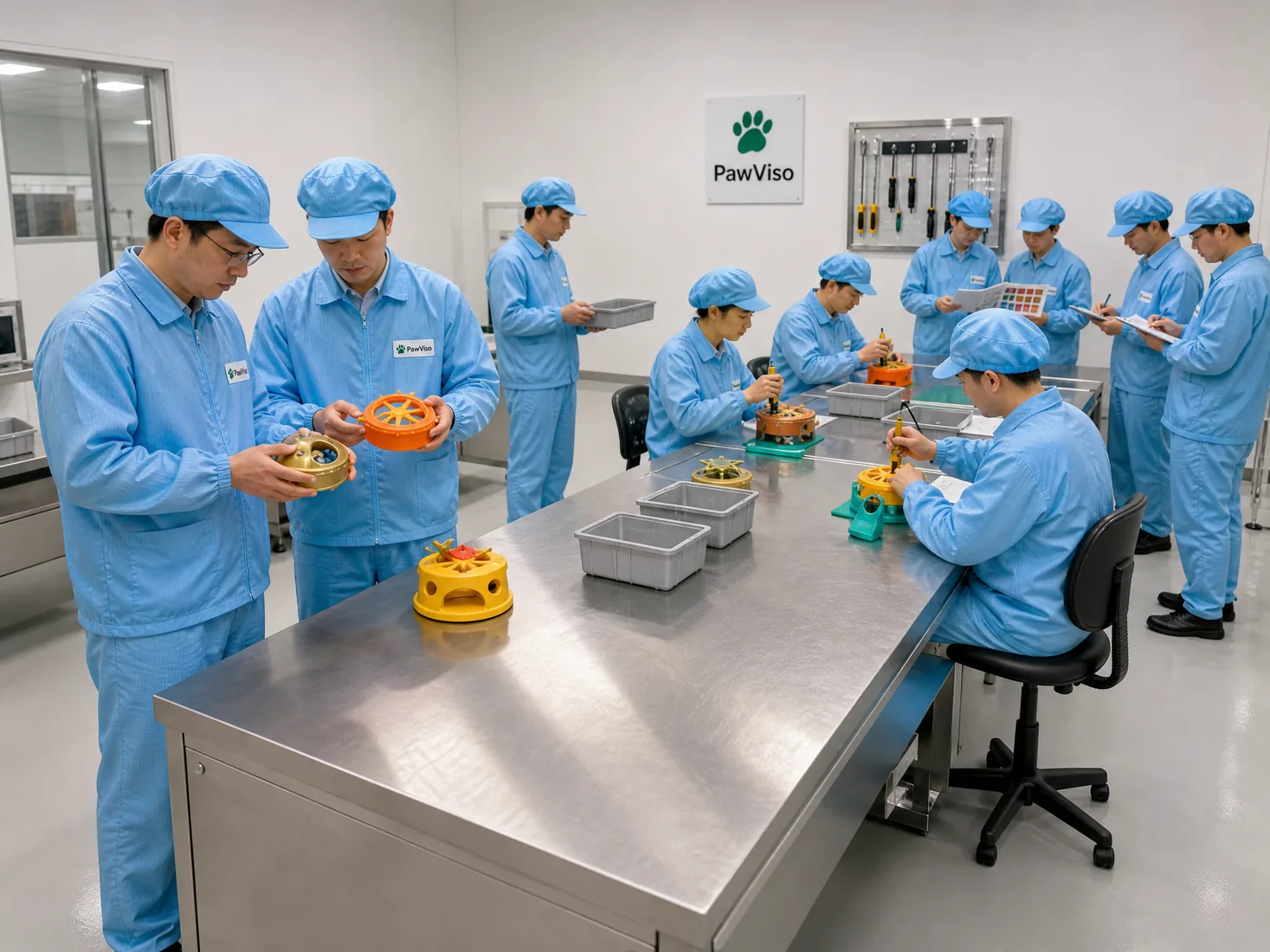
Creating a reliable custom pet toy color system is a critical procurement task for brands and retailers. Color consistency affects perceived quality, brand trust, and repeat purchases. For B2B buyers working with factories like PawViso, the system must move beyond subjective descriptions and integrate reference standards, production controls, documentation, and re-order discipline that account for materials, inks, and packaging interactions.
This guide walks procurement teams through a pragmatic, factory-facing system broken into six operational modules. Each module clarifies buyer decisions, supplier responsibilities, evidentiary outputs, common tradeoffs, and practical next steps you should include in contracts, tech packs, and quality plans. Use the checkpoints here as a template to build a color-management addendum to your purchasing agreements.
Module 1 — Define palette roles and buyer decision: which colors are brand-critical vs. cosmetic
Begin by classifying every color in your assortment into two or more roles (for example: brand-critical, product-optional, accent/trim). Brand-critical colors are those that must match tightly to a corporate identity or a seasonal campaign; product-optional colors can tolerate a wider range of variation. Make the classification explicit in your tech packs and purchase orders. This decision determines inspection criteria, acceptable tolerances, and sampling rules downstream.
Ask suppliers to propose a mapped palette that ties each SKU to a role, including visual swatches and reference codes for each material surface (e.g., plush fur, rubber, painted plastic, printed fabric). Supplier inputs should include production-friendly color recipes (pigment or masterbatch codes), typical color drift ranges during processing, and known interactions with surface finish (matte vs. gloss). Evidence you will require: lab-dye recipes, masterbatch certificates (if available), and photos of in-line trial runs under controlled lighting. Tradeoffs to surface: tighter-control roles increase lead-time and sample cost; relaxed roles reduce inspection effort but may reduce consumer-facing uniformity.
Practical next steps: create a single-sheet “Palette Role Matrix” that buyers and suppliers sign off on before tooling or die-making. For brand-critical colors require at least one signed-off physical standard (see Module 2) and define re-order triggers (e.g., any change in pigment supplier, production country, or material supplier). For product-optional colors, specify an expanded numerical tolerance and a simplified approval path.
Module 2 — Establish color references and tangible standards: buyer decision on standard types and acceptance levels
Decide which reference systems will govern approvals: physical standards (e.g., master swatches, foam blocks, sewn swatches), instrument references (spectrophotometer target files), or commercial color systems (Pantone, RAL). Buyers must select the primary reference type and the acceptable secondary references. For example, you may choose a physical master swatch as the contract standard, with a supplied Delta E spectrophotometer target as the measurement reference for ongoing production. Specify whether the physical swatch or the instrument file is the legally binding standard for non-conformity claims.
What suppliers must deliver: an initial Physical Color Standard (PCS) for every brand-critical color, plus an Instrumental Color Standard (ICS) file exported per a specified spectrophotometer profile (D65/10°, or your market-specific setting). Supplier evidence should include photos under controlled lighting, scanned ICS files, and the batch masterbatch/ink recipe. Tradeoffs: physical standards are more robust for visual appraisal but costly to produce and ship; instrument files are compact but assume both parties use calibrated devices and consistent measurement geometry.
Practical next steps: include acceptance language in the PO: e.g., "Delivery must not deviate from the signed PCS beyond Delta E X for brand-critical colors," and define how disputes escalate (third-party measurement, lab standard). Also decide who retains the master PCS — buyer, supplier, or both — and how replacements are handled if lost or damaged.
| Reference Type | Buyer Decision Points | Supplier Deliverables |
|---|---|---|
| Physical Color Standard (PCS) | Who signs/owns PCS; shipping and storage protocol | Master swatch/part; high-res photos; recipe |
| Instrumental Color Standard (ICS) | Device/profile specs; Delta E threshold | Spectro target file; test patch readings |
| Acceptance Basis | Typical Use | Pros/Cons |
|---|---|---|
| Visual tolerance to PCS | Final consumer visual match | Pros: intuitive; Cons: lighting & observer variability |
| Spectrophotometric match to ICS | Production QC, re-order checks | Pros: reproducible; Cons: needs calibrated instruments |
Module 3 — Understand material interaction: buyer decision on substrate-specific standards and testing scope
Colors behave differently on different substrates: plush, silicone, PVC, woven fabric, flocked surfaces, and printed coatings will each absorb or reflect pigments uniquely. Buyers must decide whether color approvals are tied to the RGB/Pantone name alone or to combined “color + substrate” standards. For many pet toys the recommended approach is substrate-specific standards: a red on plush will not equal red on rubber even when both are labeled “Pantone 186.”
Supplier inputs should include bench trials on the exact materials and finishes used in production, showing swatches for each relevant substrate-treatment combination. Evidence to request: side-by-side swatches with material IDs, production trial photos, and notes on process variables that affect color (dye bath temperature, curing times, pigment concentrations). Highlight known tradeoffs—matching across substrates increases cost and may require compromises in material selection or surface treatment.
Practical next steps: require tech packs to name the exact material supplier, grade, and color standard together (e.g., "SKU-A, Plush 10mm, PCS-Red-A, Material Batch ID"). For products with multiple materials, insist on combined approvals—buyers sign off on a multi-material assembly sample (see Module 4) rather than single-material patches. Define rework limits and decision thresholds for in-line corrections (e.g., adjust masterbatch concentration vs. reject lot).
Module 4 — Draft artwork and print/paint control: buyer decision on artwork treatment, color separation, and print method approvals
If your toy includes printed artwork, embroidery, stamped logos, or painted features, color control must extend to artwork files and specific process approvals. Buyers should choose the approved artwork formats (vector vs. raster), spot color specifications, and whether to use CMYK, spot inks, or digital-print recipes. For embroidery and appliqué, buyers must approve thread colors, stitch density, and positional tolerances. Require suppliers to submit pre-production print proofs and embroidery samples tied to the PCS/ICS.
Supplier evidence should include separated artwork with spot color callouts, physical print proofs on the exact material, and production setup sheets that list machine parameters (squeegee hardness, mesh count, ink type, curing temp). Tradeoffs: spot inks provide color consistency but raise tooling and inventory complexity; digital prints reduce setup but may vary over runs and require more frequent checks.
Practical next steps: create an "Artwork Color Control Checklist" that requires: (1) approved artwork file with named color calls matching PCS/ICS; (2) printed proof on exact substrate; (3) signed sample approval page. For high-volume SKUs, require process capability notes from the supplier—e.g., stable recipe settings and in-run check frequencies.
Mid-article CTA — Consider a color-governance pilot: Select one seasonal SKU as a pilot to implement the full color system above. Run a single PO through Modules 1–6 to validate workflows, record costs, and refine tolerance bands.
| Artwork Element | Buyer Checklist Items | Supplier Evidence |
|---|---|---|
| Screen Print | Spot color codes; mesh/ink specs; proof on substrate | Signed print proof; setup sheet |
| Embroidery | Thread color codes; stitch count | Embroidery swatch; thread certificate |
| Painted Parts | Paint type; curing profile | Painted sample; process parameters |
| Decision Tradeoffs | When to Choose |
|---|---|
| Spot inks | Brand-critical solids requiring tight match |
| CMYK/digital | Complex visuals or short runs where flexibility matters |
Module 5 — Sample approvals and tolerances: buyer decision on sample hierarchy, acceptance tests, and allowable deviation
Design a sample-approval flow that distinguishes between artwork/color trials, engineering samples, first production samples (FPS), and pre-shipment samples (PSS). Decide which sample stage is mandatory for each palette role defined in Module 1. For brand-critical colors require a signed PCS and a formal FPS that matches the PCS within your defined tolerances. For product-optional colors you may accept a digital proof plus a PSS.
Supplier inputs must include measured Delta E reports for FPS and PSS (if using spectrophotometry), photographic records under specified lighting, and a signed sample approval form showing who approved each sample and any concessions granted. Evidence should also include batch/lot numbers for the materials used to create the sample so that reproduction is feasible. Tradeoffs: tighter Delta E thresholds reduce variance but can increase sample rejection rates and time to ship.
Practical next steps: publish a “Sample Acceptance Matrix” that ties SKU role to required sample stage and tolerance band. Use a simple coding system on approvals (e.g., A1 = approved brand-critical final; B2 = approved with minor visual deviation acceptable for product-optional). Clarify how color deviations discovered after shipment are handled and whether re-sampling or rework is required.
| Sample Stage | Typical Use | Buyer Acceptance Requirement |
|---|---|---|
| Engineering Sample | Fit, construction check | Optional visual note; not color binding |
| First Production Sample (FPS) | Full production process sample | Required for brand-critical; instrument & visual match |
| Pre-Shipment Sample (PSS) | Final lot check | Required if material/ink/batch changed since FPS |
| Tolerance Band | Typical Application | Measurement Method |
|---|---|---|
| Tight (brand-critical) | Core brand colors | Spectrophotometer + visual check |
| Moderate (product-optional) | Seasonal or fashion colors | Visual check to PCS; instrument spot checks |
Module 6 — Production records, packaging consistency and reorder controls: buyer decision on record retention, packaging color specs, and re-order triggers
Decide up front how production records are retained and what data points are mandatory for each lot: masterbatch/ink batch IDs, material supplier lot numbers, machine settings, operator sign-off, and in-line color check results. For packaging consistency, include color standards for labels, hangtags, inner bags, and shipping cartons in the same system so unboxing aligns with product color expectations. Suppliers must provide lot-level production records and packaging sample photos for each shipment.
Buyer evidence should include a documented lot history that ties product color checks to production runs and packaging batches. Define re-order triggers and controls: require a production spreadsheet or system entry that links PO, lot, PCS/ICS used, and any deviations or corrective actions. For re-orders, decide whether the prior lot’s approval is sufficient or whether a re-sample is mandatory whenever any upstream change occurs (material supplier, pigment supplier, country of manufacture, or process change).
Tradeoffs: strict record and re-sampling rules reduce risk but increase administrative overhead. A pragmatic approach ties re-sampling requirements to change events rather than every re-order. Also decide whether GTIN/product data and label color requirements are included in the color system as a compliance item for SKU management 2. Finally, distinguish your organization’s color-governance process from general quality-management certification or SKU conformity obligations; color-system approvals are a product-level control that complements but does not replace a supplier quality-management system 1.
Practical next steps: require suppliers to submit a standardized "Color Production Record" per shipment that includes photos, spectral readings (if used), and all batch IDs. Put re-order rules into purchase terms: e.g., "Re-order with identical upstream inputs — no re-sample required; any upstream change — FPS required." Also include a retention clause for records (where and how long production/color records must be held) and clarify audit access rights.
| Production Record Item | Purpose | Minimum Evidence |
|---|---|---|
| Masterbatch/Ink Batch ID | Traceability to color recipe | Supplier certificate; batch label |
| Machine Settings | Reproducibility | Setup sheet; operator sign-off |
| Packaging Color Spec | Unboxing consistency | Packaging PCS; photos; Pantone/ICS file |
| Re-order Condition | Re-sample Required? | Rationale |
|---|---|---|
| No upstream changes | No | Save time; rely on lot records |
| Material or pigment change | Yes | Different inputs alter color |
| New production country or process | Yes | Process variables affect outcomes |
Module 7 — Production sampling cadence and documentation
Buyers must decide on a structured sampling cadence that fits order size, risk tolerance and product complexity. For custom pet toy color systems, sampling should include at minimum: pre-production color checks (lab dips or color chips), initial production samples (first-offs), in-line production checks at agreed milestones, and final random inspection samples. Specify exact sample types you require (e.g., stitched toy face photo, molded squeaker shot, multi-material assembly) and the number of pieces per sample to match statistical confidence needs. State whether you accept digital images for interim approvals and when physical samples are mandatory. These decisions set expectations for lead time, cost and logistics.
Define the documentation package that must accompany each sample delivery. At a minimum, buyers should require a sampling sheet listing item identifiers, color references (see Module 2), material lot numbers, supplier lot codes, dye or masterbatch identifiers, date produced and the responsible production line. Insist that the supplier attach high-resolution photos under agreed lighting conditions and, if applicable, spectrophotometer readings (Lab* or ΔE values) tied to the approved reference. Establish who holds the samples after approval (buyer, supplier, third-party lab) and how long they are retained. Clear documentation reduces disputes and speeds reorders.
Include a decision on frequency of in-line color verification for long production runs. For multi-stage processes (e.g., dyed fabric then printed artwork then sewn), require checkpoints after each color-critical step. Decide acceptance criteria for each checkpoint: absolute match, within ΔE tolerance, or visually acceptable per buyer sign-off. If you plan to use third-party inspection, specify sampling plans (AQL or tightened levels) and the scope of color-related failures to be recorded in inspection reports.
Keep a versioned sample approval log. For buyers, insist the supplier maintain an approval register that links every production batch to a sample approval entry, the person approving, date and any deviation notes. Require the supplier to reference this register on shipping documentation. This record supports traceability if a later batch shows drift or a packaging inconsistency.
Module 8 — Tolerances, acceptance criteria and dispute resolution
Buyers must explicitly choose tolerance systems and acceptance criteria for color and assembly. Decide whether you want numeric tolerances (spectrophotometer ΔE thresholds) or visual tolerances (photographic or physical sample comparisons). Numeric tolerances are precise and allow automated checks but require controlled measurement conditions and standardized instruments; visual tolerances are simpler but subjective. For composite products, set tolerances per component (e.g., main fabric ΔE ≤ 2.5, trim print ΔE ≤ 3.5) and state which metric takes precedence if components conflict.
Define defect categories and their severity for color-related issues. For example, define “major” as a visible color mismatch on the primary surface affecting brand identity, “minor” as acceptable color variation on secondary trims, and “critical” where a wrong color could be unsafe or misrepresent the product. For each category, record remedial actions you expect: rework, full batch replacement, partial rework with price adjustment, or acceptance with discount. Clear, pre-agreed remedies reduce time-consuming negotiations.
Agree an escalation path and timelines for disputes. Specify how color mismatches are reported (photos, sample return), who will approve a rework plan, and how long the supplier has to respond. If you prefer technical adjudication, name an accredited lab or third-party color specialist to perform a blind test; state whether their determination is binding. Use 4 to support the need for objective substantiation when invoking test-backed decisions. Also specify cost responsibility for re-tests and who pays for returned or reworked goods.
Include a decision on release-for-shipment contingencies. Buyers should determine whether shipments can proceed if a percentage of the batch exceeds minor tolerances but remains within an agreed contingency level. If so, document discount formulas, rework scheduling and how merchandise segregation should be handled in the factory or warehouse. These pre-agreed rules prevent ad-hoc concessions at shipping time and protect both parties’ commercial interests.
Module 9 — Packaging color consistency and transit considerations
Packaging plays a key role in perceived color quality and brand continuity. Decide how strictly packaging colors must match product colors: exact match, complementary, or simply within brand color family. For printed cartons and labels, specify artwork files (Pantone, CMYK, or industrial print PMS), substrate type and finishing processes (varnish, lamination) because each affects final appearance. Require the supplier to submit print proofs and, where color-critical, press checks or photographic press sheets before full print runs.
Account for color shifts caused by packaging and transit. Paperboard and inks can shift under different humidity and temperature conditions during shipping; ask suppliers for recommendations on inks and coatings that retain color stability for the intended transit routes. When transit integrity of printed color is part of your spec, require package transit testing and documentation of any mitigations used (e.g., UV coatings, moisture-resistant varnishes). Use 5 to justify including packaging and transit tests when package appearance is a buyer requirement.
Record packaging batch identifiers and match them to product batches. Buyers should require that each packaging run carries a batch code linked to the product lot number on the pallet manifest. This linkage is essential when resolving post-delivery color complaints that may trace back to a specific print run or substrate lot. Decide how packaging variances are handled on mixed-pallet shipments and whether you allow multiple packing variants in a single shipment.
Include instructions for palletization and labeling to preserve color-critical items—e.g., do not stack color-sensitive samples under heavy loads, avoid exposure to sunlight in export warehouses, and specify humidity-controlled containers if necessary. Ultimately, specify who bears the cost of any additional packaging treatments or logistics controls needed to maintain color integrity during transit.
Module 10 — Production records, traceability and batch release
Buyers should require comprehensive production records that support traceability from raw materials through finished goods. Decide which records are mandatory at shipment: raw material certificates of analysis (COAs) for colorants or masterbatches, dye lot numbers, in-process color check logs, sample approval copies, print press sheets, and final inspection reports. Specify acceptable formats (digital PDFs, scanned attachments in a cloud folder, or printed packets with each container) and retention periods for records at both supplier and buyer ends.
Specify the batch release criteria the supplier must meet before shipping. This can include completed in-line checks, approval stamps on the sample log, signed corrective action completion (if any deviations were found), and third-party inspection clearance if part of the contract. If your procurement setup uses staged releases (partial shipments allowed as production continues), document what minimum documentation accompanies each release and the responsibility for reconciling records across shipments.
Decide how lot control will be implemented on the factory floor. Require lot numbers be stamped on component bags, cartons or sewn labels; require photographs of lot markings on the production line. Insist the supplier implements a policy for segregating nonconforming lots until disposition. These controls reduce the cost and complexity of recall-like events or corrective actions and make reorders more predictable.
Establish an audit rhythm and data-sharing expectations. Buyers may require remote access to production logs via a shared cloud drive, periodic delivery of production summaries, or scheduled supplier audits. If audit findings could affect color acceptance, decide in advance what remedial timelines you will accept and whether repeat shipments will be suspended pending corrective action. A clear audit and release process helps prevent shipment of unfitting color batches.
Module 11 — Reorder controls, long-term color stability and change management
For repeat orders and long-term product lines, buyers must set rules to preserve color consistency across production cycles. Decide on acceptable changes between reorders: Are exact matches required, or are small shifts acceptable if within pre-agreed tolerances? Define how master samples are retained and used—whether the factory keeps a retained sample per SKU and batch and whether the buyer will require periodic re-sampling (annually, per Nth order, or after any material supplier change).
Address raw-material lifecycle and supplier change management. Require notification and approval for any change to colorant suppliers, dye houses, substrate mills, ink formulations, or finishing processes that affect color. Specify the lead time you expect for notifying changes and whether new samples must be produced for each change. Decide if you require formal change-control documents (e.g., Engineering Change Notice, ECN) that detail the reason for change, the anticipated impact on color, and the mitigation plan. These measures limit unexpected drift over the product lifecycle.
Set re-order approval gates. For example, you may require full pre-production approval for the first reorder after a calendar year, or only an in-line visual check for small top-ups. Create a re-order checklist that includes: referencing the original approved sample ID, confirming material batch numbers, verifying any artwork or print files remain unchanged, and confirming packaging runs are from the same print batch or within acceptable tolerances. This checklist ensures reorders do not introduce unapproved variation.
Plan for stock rotation and slow-moving inventories that can affect color perception. Older stock exposed to different storage environments may show fading or spot variation when mixed with newer stock. Decide whether you accept mixed-age shipments, require segregation of older lots, or will require destructive/accelerated aging checks before acceptance. Agree in advance on disposition for aged goods to avoid disputes and to keep shelf presentation consistent for end customers.
Pipe table — example fields to include in re-order control log
| Field name | Example content | Buyer decision required |
|---|---|---|
| SKU / Style code | PLUSH-TOY-001 | Approve format and mandatory field |
| Approved sample ID | AS-PL-0001 | Determine retention period |
| Material lot number | FAB-LOT-20260801 | Require supplier notation method |
| Dye/Masterbatch code | MB-Red-256 | Decide on required documentation |
| Packaging print batch | PKG-BX-202608 | Require linkage to shipment |
| Last pre-prod check date | 2026-08-05 | Decide frequency of rechecks |
| Reorder gate | Full P-PAP / In-line check | Choose gate per order size |
| Comments / ECN ref | ECN-2026-07-02 | Decide change approval workflow |
Frequently asked questions
Q: How often should I require full physical pre-production samples for the color system? A: Decide based on product complexity, order quantity and change history. For first production runs and after any material or supplier change, require a full physical pre-production sample. For small reorders with unchanged materials, an in-line visual check or limited sample may suffice. State your risk tolerance and lead-time impact in the contract.
Q: Should I mandate spectrophotometer readings for every batch? A: Choose this if you need objective, repeatable color control. Spectrophotometer readings are useful when color tolerances are tight and measurement conditions are controlled. If you mandate readings, specify instrument type, measurement geometry and how ΔE will be calculated. If you do not mandate instrument readings, define a robust visual standard and consistent lighting for inspections.
Q: What happens if packaging and product colors don’t match after shipment? A: Define in advance the remediation pathway: rework, replacement, credit, or return. Ensure your contract ties product batches to packaging print lots and requires documentation for both. Require immediate reporting, photographic evidence, and, if necessary, the right to hold future shipments until the root cause and corrective action are agreed.
Q: How do I manage color drift across seasonal reorders? A: Require a change-management process with notifications for any material or process changes, and require sample approvals for changes you deem significant. Keep master samples, enforce lot-linked documentation, and schedule periodic audits or rechecks for long-run SKUs to detect drift early.
Q: Can I accept multiple acceptable color variants for the same SKU to reduce cost? A: Yes, if brand or market allows flexibility. Specify permitted variants (primary and secondary palettes), set tolerances for each, and clearly document which variant is used per production batch. Be explicit about how packaging and POS materials should reflect the variant used.
Conclusion
A disciplined custom pet toy color system protects brand integrity, reduces disputes and makes reorders predictable. Buyers must make explicit decisions on sampling cadence, tolerances, packaging controls, production records and change management, and then put those decisions into contractual and operational workflows. Carefully chosen checkpoints, traceability records and clear escalation rules convert color from a subjective risk into a manageable production parameter.
Project-specific color, compliance, testing and regulatory requirements must be confirmed by the buyer/importer for each order.
Final CTA — Start a controlled pet-toy sourcing conversation with PawViso. Share the product concept, target market, customization route, package direction and estimated order structure for a focused B2B discussion. Email: info@PawViso.com WhatsApp: +86 186 8106 4480 — https://wa.me/8618681064480
Evidence checkpoints
A named Incoterms® rule allocates responsibilities but does not replace a clear commercial and shipment-handover scope.6
Related PawViso resources
- Continue with How to Create a Custom Pet Toy Sampling Plan. Use this pet-toy guide to structure approvals, samples and evidence.
- Browse the PawViso product catalogue to identify product formats for a sourcing brief.
- Follow the PawViso sourcing process and review the B2B buyer FAQ before sharing project requirements.
External reference
For independent general product-safety context, review European Union General Product Safety Regulation. Confirm the requirements that apply to the selected product, target market and order.