
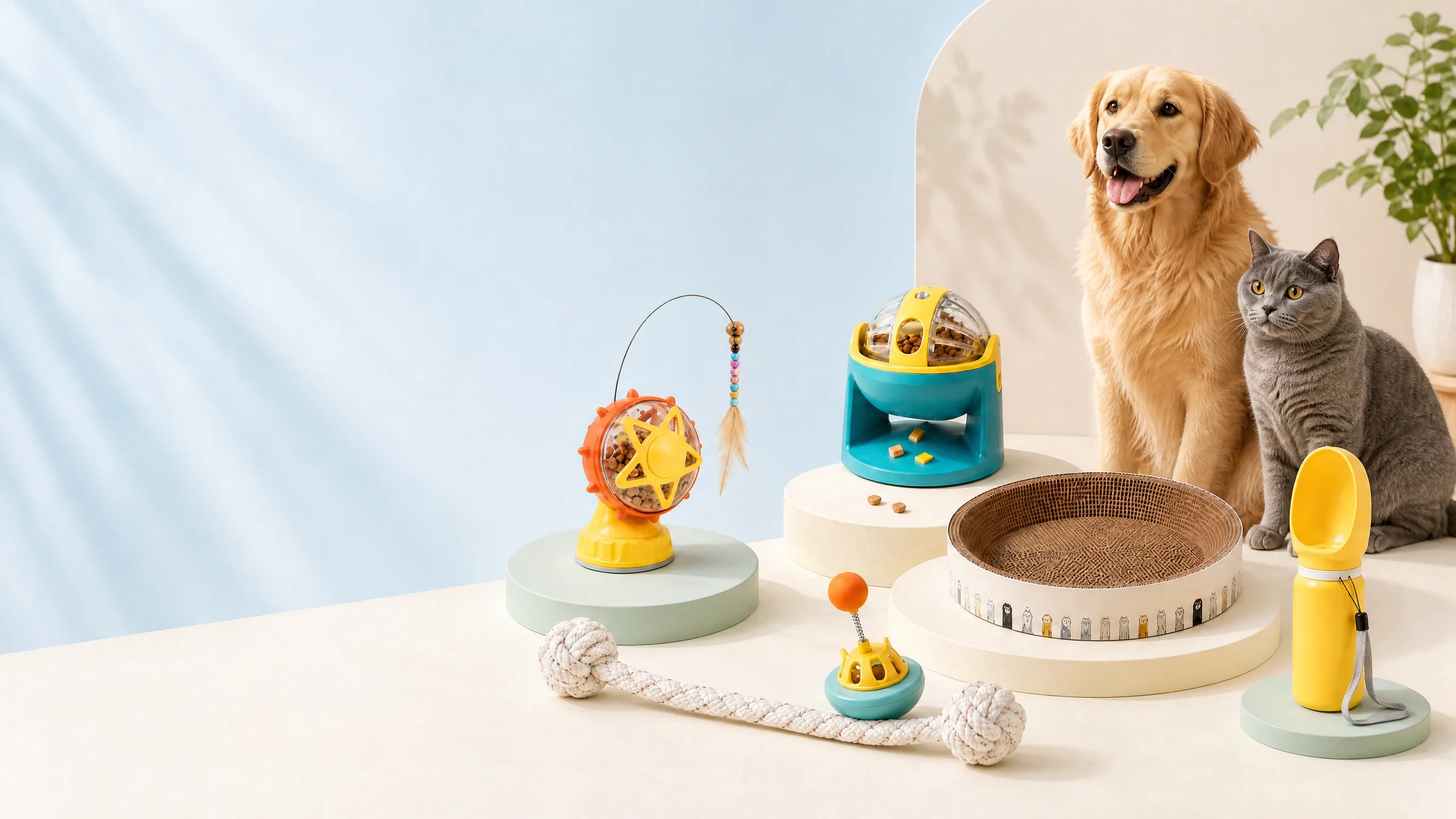
A buyer should approve a pet-product sample only when it proves that an identified configuration is suitable to become the production reference. A visually attractive dog toy, feeder, grooming accessory, cat furniture item, travel product or retail pack is not enough. The review must show which SKU, variant, components, artwork and packaging version were seen, what was checked, and whether unresolved differences are allowed. From the perspective of a China-based B2B pet-product factory and procurement partner, the fastest way to lose control is to approve “the sample” without naming the version.
This guide gives buyers a cross-category method for turning samples into an auditable commercial baseline. It separates product review, factory process checks and laboratory work; it also keeps packaging and production release visible rather than treating them as afterthoughts. Market requirements must be confirmed by the responsible buyer or importer for the actual SKU, destination, sales channel and claims. A pet product is not automatically subject to children’s-product rules, and a buyer should not transfer rules from one product class to another without a project-specific assessment.
Module 1 — Decide what the sample must prove before you request it
Start with a direct decision: are you selecting a concept, verifying a configuration, or releasing a production reference? Requesting a sample before answering that question creates false expectations. A concept sample may only prove appearance or approximate form. A functional prototype can explore use or assembly. A pre-production sample should represent the controlled configuration that the buyer intends to release, including the relevant product and pack elements. State the stage in the request, assign a project ID and SKU or variant ID, and identify the buyer who can make the decision. This gives the Chinese supplier, procurement partner and buyer one shared review target.
Write the business decision beside the request: select, revise, quote, test, approve conditionally or release. Then state the risk that sample must reduce. For a leash or harness, the risk might be the agreed fit, hardware operation and presentation; for a feeder, it may be assembly, stability and pack completeness; for a cat scratcher, it may be construction and retail-pack dimensions. Avoid asking a sample to prove claims that have not been specified. In markets such as the EU, general product-safety rules are intended to ensure that only safe products are available on the market, so destination-market obligations should be established before the release decision rather than inferred from a photograph or a courier sample.1
Module 2 — Select the right sample tier for each pet-product category
Buyers do not need the same sample tier for every assortment decision. The right tier depends on product complexity, number of variants, packaging visibility, intended use and the remaining uncertainty. A simple colourway comparison may need a controlled colour and artwork reference, while a multi-part travel accessory may need a fully assembled representative configuration and retail pack. Define what the tier includes and excludes. The table is a planning tool, not evidence that any item meets a market requirement.
Ask the supplier to mark the tier on both the sample label and the covering document. Where product and packaging are developed on different schedules, create separate but linked sample IDs; otherwise an approved product can be mistakenly paired with an unapproved insert, barcode or carton mark. For assortment buying, compare like with like: same intended variant, same test condition, same document revision and same photo angles. A disciplined tier prevents a buyer from accepting a showroom-style reference as if it were a production-ready sample.
| Sample tier | Buyer decision supported | What should be controlled | What it does not decide by itself |
|---|---|---|---|
| Visual or concept reference | Whether to pursue a direction | Product identity, visible form, colour direction and proposed range position | Final construction, full function, packaging or production release |
| Functional development sample | Whether the configuration merits refinement | Named parts, intended operation, critical dimensions and observed issues | Consistency of future lots or destination-market suitability |
| Packaging and artwork sample | Whether retail presentation is ready for correction | Pack format, artwork revision, barcode data supplied by the buyer, insert and visible contents | Product performance or transport resilience |
| Pre-production reference | Whether the documented configuration may enter a release gate | Current product, pack, labels, evidence and open-item status | Automatic approval of later substitutions or every production unit |
Module 3 — Freeze one controlled approval pack and revision baseline
Create one approval pack before comparing samples. It should contain the commercial brief, current specification, annotated images or drawing where available, component list, dimensions and agreed tolerances, artwork, packing instruction, sample label, review protocol and decision log. Give every file a revision and status such as draft, review copy, approved-for-sample or approved-for-production. Put the same project and revision identifier on the sample, photo folder and decision record. A verbal instruction or an unlabelled chat image cannot reliably establish what was approved.
The pack should name an owner for each document and a single source of truth for the released files. It should also distinguish buyer-provided information, supplier proposals and unresolved assumptions. For example, record whether barcode data, retailer carton markings, language copy or inserts are buyer-supplied, pending or not in scope. Before sending a sample, the supplier can check the pack against the physical label; before approval, the buyer can check that the evidence refers to the same revision. This simple reciprocal check is more useful than trying to reconstruct the baseline after a change request.
Module 4 — Translate buyer expectations into measurable acceptance criteria
A useful acceptance criterion tells another reviewer how to reach the same conclusion. Separate a must-pass requirement from a commercial preference and an observation. “Good quality” is not a criterion. “Measure the named critical dimension using the agreed tool; record the result against the approved tolerance” is a repeatable criterion. For a closure, specify the action, sample condition, observation and pass/fail boundary. For a textile item, identify the location of the seam or attachment being reviewed. The buyer must set the project-specific limits and method; there is no universal force, duration or tolerance that works across pet products.
Build criteria around the actual risk rather than a generic form. A grooming tool may need checks for intended assembly and moving parts; a feeding accessory may need checks for fit, stability and access for the specified use; a travel product may need checks for closure operation, dimensions and pack contents. Record the result, not merely the conclusion. A high overall score must never hide a must-pass failure. If a buyer accepts a deviation, label it as a concession with scope and expiry instead of silently changing the standard.
| Decision area | Example of a measurable review question | Evidence to retain | Decision rule |
|---|---|---|---|
| Identity and version | Does the sample label match the SKU, variant and revision in the approval pack? | Label photograph and document check | Mismatch blocks review until identified |
| Dimensions and fit | Do named critical dimensions fall within buyer-approved limits? | Dated result sheet and measurement images | Compare each result with its stated limit |
| Assembly and appearance | Are listed parts present and located as specified, with no unapproved visible condition at named points? | Component checklist and close-up images | Must-pass or preference status recorded in advance |
| Function | Does the defined action complete under the stated sample condition? | Test log and setup photo or video | Record every interruption and the decision |
| Packaging | Does the sample show the current artwork, contents and supplied identification data? | Front, back and pack-content photographs | Packaging approval is a separate line item |
Module 5 — Choose evidence that makes comparison repeatable
Use the same review sequence for every supplier and every sample round: confirm identity, compare visible construction, measure specified attributes, perform the agreed functional checks, then inspect the product and transport packaging documents. Photograph the whole item, critical features, measurement setup, packaging panels and observed defects. Include the sample ID and revision in the filename or a visible frame. Catalogue renderings and edited sales images may help a buyer discuss design, but they are not evidence of the particular sample under review.
Treat production inspection evidence differently from sample evidence. ISO 2859-1:2026 describes acceptance sampling plans for inspection by attributes and is aimed at lot-by-lot inspection; it is not a substitute for defining a development-sample specification.2 If the parties choose a lot-sampling plan, they should document the edition, inspection setting, defect definitions, lot identity, sampling instruction and release authority in their own quality agreement. A result from one sample review does not establish that later production conforms, just as a production inspection result does not prove every requirement not included in that inspection.
Module 6 — Decide what a golden sample will and will not control
A golden sample is a retained physical reference for the explicitly approved configuration. It is valuable where written descriptions do not communicate surface feel, visual finish, construction positioning, colour appearance, retail presentation or the relationship between assembled parts. Label the reference with project ID, SKU, revision, approval date, approved scope, custody location and known deviations. If both buyer and supplier keep a reference, record whether they are equivalent and link each to the same controlled photo set and specification.
Do not let the golden sample become an undefined substitute for documentation. It cannot reliably disclose a hidden component, prove a test method, authorise a material or process substitution, or resolve a conflict with the current drawing, artwork or packaging instruction. State the precedence order in the approval record, such as released specification first, approved artwork second and golden sample as a visual comparison reference. If an item in the retained reference was provisional or conditionally accepted, mark the limitation directly on the record. An ambiguous golden sample reproduces disagreement rather than controlling it.
Mid-article CTA — Need a cleaner sample decision? Share the product type, destination market, intended configuration, packaging status and current revision with PawViso. We can help structure an approval pack and a comparison brief before the next sample round. Email: info@PawViso.com.
Module 7 — Separate buyer sample review, factory checks and laboratory testing
These three activities answer different buyer questions. Sample review asks whether the submitted, identified configuration matches the buyer’s controlled brief. Factory testing or process checks ask whether the agreed in-process or finished-product control was performed on identified samples or a defined lot. Laboratory testing evaluates a specimen against the requested method and reported scope when the buyer, importer, market, retailer or claim requires it. One stream may inform another, but none automatically replaces the others. Plan the evidence before tooling, artwork release or commercial claims make changes expensive.
The responsible buyer or importer must confirm requirements for the actual SKU, materials, claims, target user, destination and sales channel with qualified parties. Do not assume a pet accessory needs the same evidence as a children’s product, or that an accessory and a food product share the same route. If a change affects what was tested, declared, labelled or claimed, ask whether new evidence is needed before release. A laboratory report only supports the specimen, method, result and scope stated in that report; a passing buyer review does not broaden that scope.
| Evidence stream | Main question | Useful record | Limit of the record |
|---|---|---|---|
| Buyer sample review | Does this named sample meet the buyer’s acceptance criteria? | Scorecard, measurements, photos, decision and concessions | Does not establish ongoing lot consistency or unreviewed requirements |
| Factory process check | Was the agreed control performed on the identified sample or lot? | Method, date, lot link, result, responsible person and corrective action | Does not independently validate all market or retailer requirements |
| Laboratory testing | What did the submitted specimen achieve under the stated method? | Report with specimen identification, method, result and scope | Does not prove every production unit matches the specimen |
| Market or retailer file | Is the project evidence aligned to the stated market and channel requirement? | Buyer-confirmed requirement list and release check | Must be confirmed for the actual SKU and destination |
Module 8 — Approve packaging, labels and barcode readiness as a separate scope
Packaging can alter the buyer experience, retail acceptance and transit risk even when the product sample is unchanged. Review retail packaging, inserts, labels, master-carton marks and any required channel information as controlled items with their own revision. Check that printed wording, declared contents, language versions, supplied barcode data and visible product identity match the buyer-approved files. GS1 describes its General Specifications as the core document for how GS1 barcodes and identification keys should be used; a buyer should therefore verify the applicable barcode data and scan-readiness with the responsible brand owner or channel before printing.3
Separate retail presentation from transport protection. A clean retail pack does not demonstrate that the packed product will withstand its distribution route, and a sound outer carton does not prove that artwork or contents are correct. ISTA describes its 3-Series as general simulation performance tests designed to simulate damage-producing transport motions, forces, conditions and sequences; selecting any procedure must fit the actual distribution scenario.4 Where transit performance matters, the buyer should define the route, configuration, test question, acceptance condition and evidence owner rather than writing “drop test passed” into a sample email.
| Packaging level | Buyer approval focus | Evidence that links it to the SKU | Typical open question to close |
|---|---|---|---|
| Product and retail pack | Visible configuration, artwork, insert, declared contents and supplied identification data | Labelled pack images and current artwork revision | Is this the approved consumer-facing version? |
| Inner pack or display unit | Count, orientation, handling and presentation | Packing instruction and annotated images | Does it preserve the retail configuration? |
| Master carton | SKU mapping, pack count, marks and handling information | Carton artwork or mark file and packing instruction | Can receiving teams identify the correct item? |
| Distribution configuration | Product-plus-pack arrangement for the stated route | Defined configuration and relevant test or review record | What transport question has actually been evaluated? |
Module 9 — Govern changes, concessions and re-sampling before production
Use one numbered change request for every proposed change after a sample baseline exists. Identify the starting revision, requested change, reason, affected component or file, possible impact, evidence needed, approver and decision. Review changes to product form, components, assembly, colour, print, packaging structure, supplier source, tooling, factory location or subcontracted work when they could affect form, fit, function, appearance, documentation, claim relevance or market review. A supplier’s practical improvement may be commercially sensible, but it remains a proposed change until the authorised buyer accepts it in writing.
Choose an explicit outcome: approved, rejected, approved with conditions or re-sample required. A conditional decision should say what may proceed, what remains blocked, who owns the action and how closure will be verified. Update the specification, sample label, photos, golden-sample status and release log after approval; do not leave the live documents at the earlier revision. A concession should be specific to the identified issue and sample, not a blanket permission for future variation. If a change could affect lab-report scope, labels, claims or destination-market requirements, the responsible buyer or importer should obtain project-specific confirmation before production release.
Module 10 — Build a quote and inspection scope around the approved configuration
A quote should be compared against the same controlled configuration used for approval. Before placing an order, align product version, variants, pack format, supplied artwork, inserts, marking responsibility, quality controls, inspection point, sample retention, change procedure and release condition. This does not require publishing prices or assuming a fixed order quantity; it requires removing scope ambiguity. When two quotations differ, the buyer should first ask whether they describe the same product and packaging baseline, not merely compare their totals.
The inspection scope should name the inspection type, timing, reference files, lot identification, attributes to review, defect classification or buyer decision rule, evidence required and party authorised to release. It is acceptable for some commercial preferences to remain outside the release gate, provided that the distinction is documented. For multi-SKU orders, use a matrix that shows which evidence applies to each variant. This makes it easier to detect when one colourway, pack size or accessory set has slipped beyond the approved scope.
| Scope category | Buyer should define | Decision risk if omitted |
|---|---|---|
| Product baseline | SKU, variant, revision, approved components and visible configuration | A quotation or order can refer to a similar but different item |
| Packaging baseline | Retail pack, insert, carton marks, packing instruction and supplied data owner | Product approval can be mistaken for packaging approval |
| Quality controls | Review points, criteria, evidence and treatment of nonconformities | “Quality check” has no common operational meaning |
| Inspection and release | Timing, lot link, reference documents and authority | A result may be produced without a release decision |
| Change control | Notification trigger, documentation and re-approval route | Unseen substitutions can enter production |
Module 11 — Make a documented production-release decision
Release production only after the buyer can answer a simple question: what exact configuration is authorised, on what evidence, with which open conditions? The release record should identify the product and packaging revisions, must-pass criteria and results, current golden-sample status, completed factory or laboratory evidence where applicable, concessions, open actions, documents used and release authority. It should also distinguish approval to begin tooling, material preparation, packaging printing, pilot work or mass production. These are separate permissions; a conditional step forward is not a general production approval.
Before authorising the final release, reconcile the latest sample, approval pack, quote scope, packaging files and change log. Resolve conflicts or state their precedence in the signed decision record. Confirm market, retailer, labelling and claim requirements with the responsible buyer or importer for the actual SKU, not with a generic category assumption. For pet food or treats entering the United States, FDA states that animal food must be safe to eat, produced under sanitary conditions, contain no harmful substances and be truthfully labelled; a presentation sample cannot replace the appropriate food controls and evidence.5 Retain the release package so a later inspection, reorder or complaint review can trace the decision without relying on memory.
Frequently asked questions
How many samples should a buyer compare before ordering?
There is no universal number. Set the number and purpose of samples in the approval plan based on assortment complexity, variants, packaging differences, unresolved changes and the decision to be made. Several unlabelled samples provide less control than one identified pre-production reference reviewed against clear criteria.
Is a supplier photo enough to approve a pet product?
No. A photograph can support an appearance discussion, but it does not reliably identify the revision, dimensions, hidden components, function, pack contents or evidence condition. Use labelled physical samples and controlled photographs when the buyer needs to make a release decision.
When does a changed sample need another review?
Review again when the proposed change could alter the approved configuration, test relevance, product or packaging presentation, declarations, claims or destination-market assessment. The buyer should record why no re-sample is needed when approving a limited administrative correction; otherwise the documented route should be re-sample, review and revised release.
Does a golden sample replace a production specification?
No. It is a physical comparison reference with a defined scope. The controlled specification, artwork, packing instruction, acceptance criteria and release record explain what is required and how variation will be judged.
Who confirms whether a laboratory test is required?
The responsible buyer or importer should confirm the requirement for the actual SKU, destination, sales channel and claims with qualified parties. A factory, procurement partner or laboratory can help organise inputs and evidence, but a generic pet-product sample review is not a regulatory determination.
Conclusion
The reliable way to compare pet-product samples is to control the configuration before judging it. Select the sample tier that fits the decision, freeze one approval pack, state measurable criteria, retain labelled evidence and define the limited role of the golden sample. Keep buyer review, factory checks, laboratory testing, packaging approval, change control, quote scope and production release as connected but distinct gates. That structure helps a buyer and a Chinese B2B sourcing partner move from a promising sample to a traceable commercial decision without claiming more evidence than the record supports.
Final CTA — Request a project-specific approval brief from PawViso. Send the product reference, target market, variant plan, packaging direction and sample status so the review can start from an identified baseline. Email: info@PawViso.com WhatsApp: +86 186 8106 4480 — https://wa.me/8618681064480
This article is general B2B sourcing information, not legal, regulatory, veterinary, medical, laboratory or product-safety advice. The responsible buyer or importer and qualified parties must confirm requirements and evidence for the actual SKU, market and production release.
Related PawViso resources
- Continue with How to Create a Pet Product Specification Sheet. Use this specification guide to turn product ideas into clear factory requirements.
- Browse the PawViso product catalogue to identify product formats for a sourcing brief.
- Follow the PawViso sourcing process and review the B2B buyer FAQ before sharing project requirements.
External reference
For independent quality-management system context, review ISO 9001 quality-management systems overview. Confirm the requirements that apply to the selected product, target market and order.