
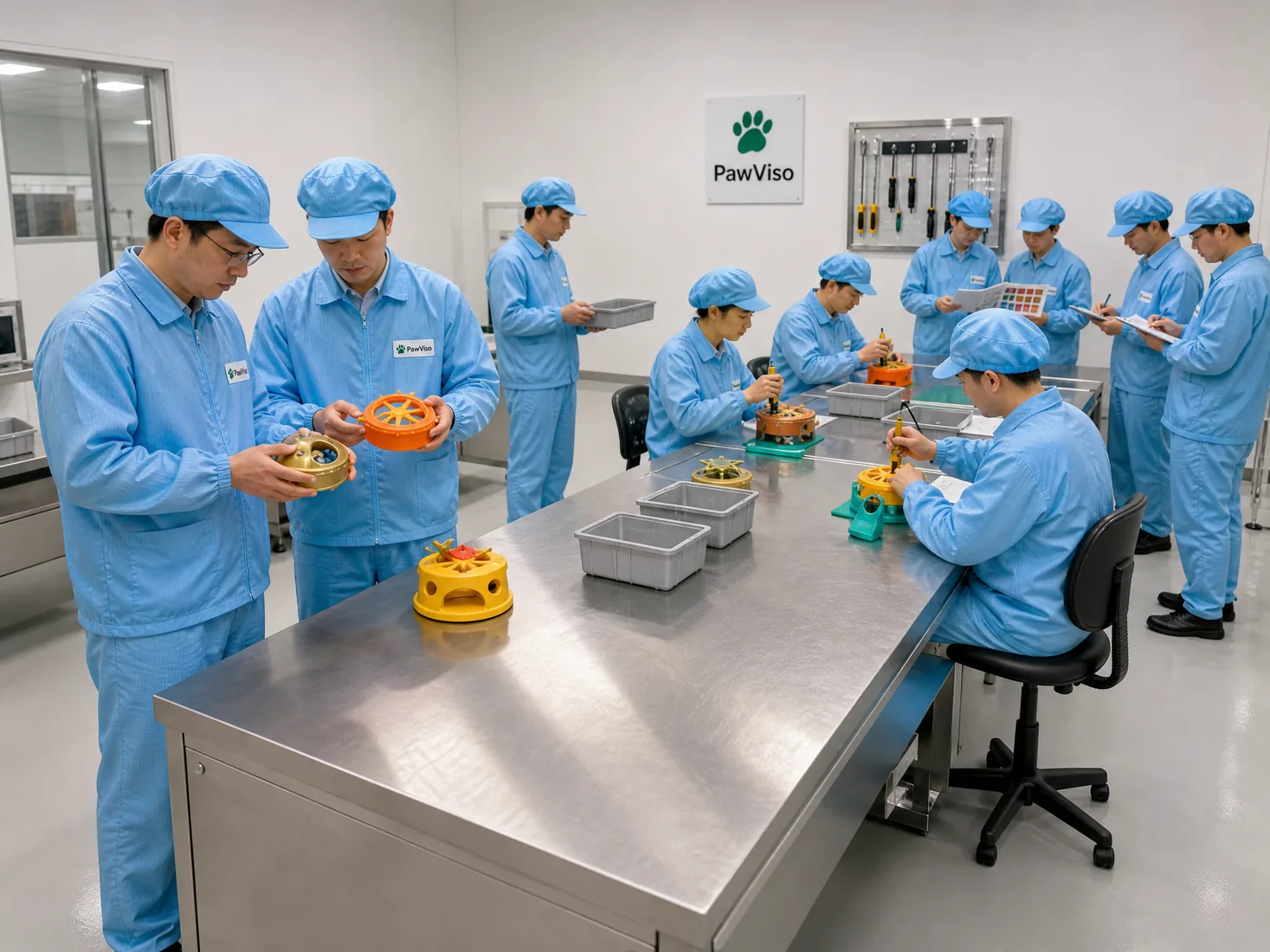
A pet product specification sheet is the controlled record that tells a factory what the buyer expects to receive for one identified SKU. It links product identity, components, dimensions, artwork, packaging, sample approval, inspection and changes in one versioned instruction set. A sourcing idea, catalogue image, chat history or approved-looking sample may inform that record, but none should replace it.
From a Chinese pet-product factory and procurement-partner perspective, the sheet is most valuable when it exposes uncertainty before material purchasing or print release. It should distinguish a buyer requirement from a supplier proposal and a genuinely open decision. That lets the factory ask a precise question, lets the buyer approve one defined configuration, and lets an inspection team compare finished goods to a current reference. It is a production-control tool, not an assertion of certification, product performance, or market approval.
Module 1 — Decide what configuration the sheet must control
Create a separate controlled baseline for every sellable configuration that can differ in a way a factory, retailer or buyer needs to recognise. A product family name such as “dog harness” or “cat teaser” is not a baseline. Start with the buyer SKU, working product name, variant code, intended retail unit, and whether size, colour, language, bundle contents or packaging creates a distinct version. One master sheet can govern common construction across variants, provided a matrix makes every permitted difference visible.
Choose the sheet’s depth by decision risk rather than by a fixed page count. A simple branded accessory may need a product image, component summary and packing instruction. A multi-part feeder, travel item or gift set may need a drawing, component register, artwork pages and a pack-out schedule. The European Union’s General Product Safety Regulation describes technical documentation as containing a product description and essential characteristics relevant to safety assessment, with the amount of information proportionate to complexity and possible risks.1 This sourcing sheet is not a substitute for that technical documentation, but the same discipline—describe the actual product rather than a generic category—is useful.
| Configuration case | Controlled-sheet approach | Buyer decision to make | Failure if omitted |
|---|---|---|---|
| Catalogue item with private label | Base product record plus branding appendix | What standard features remain unchanged? | A catalogue image can be treated as the ordered build. |
| Size or colour range | Master record and variant matrix | Which fields vary, and which are common? | Variant differences disappear in a general quote. |
| Multi-component product | Full sheet and component register | Which interfaces, parts and finishes are required? | Purchasing selects a part not reviewed by the buyer. |
| Retail set or bundle | Parent record and unit-content schedule | What belongs in one sellable unit? | Accessories, inserts or counts are interpreted differently. |
Module 2 — Decide the product identity the factory must recognise
Define the unit of sale before you describe appearance or quality. Record the buyer SKU, variant, brand where relevant, plain-language product description, intended retail-unit contents, exclusions and product family. Describe intended use in neutral operational language instead of creating a marketing, veterinary, medical, safety or performance claim. Attach an annotated image or drawing, and label it accurately: required target, appearance reference, or supplier inspiration. An inspiration image cannot decide hidden construction or pack contents.
Next, set a document hierarchy. Name the current product drawing, product image, colour reference, logo file, component register, retail artwork and carton artwork. State which item prevails when sources conflict. Many buyers use a hierarchy that gives a buyer-approved drawing and written specification priority over artwork, then over an approved physical reference and illustrative images. Ask the factory to return unclear points in a numbered query log. A silent assumption is not confirmation.
If a barcode is in scope, identify the data owner, the pack level where it belongs, the artwork revision and the proof route. GS1 defines a trade item as a product or service priced, ordered or invoiced in the supply chain and says a GTIN can uniquely identify those items.2 That is why the sheet should separate buyer-supplied trade-item data from a factory’s internal carton label. A barcode visible in a reference image is neither an instruction to print nor proof that the data is current.
| Identity field | Buyer records | Factory confirms | Why it matters |
|---|---|---|---|
| SKU and variant | Buyer code, name and version | Code used on quote, sample and packing records | Connects the physical item to commercial records. |
| Consumer-unit contents | Included items, insert and exclusions | Count and assembly sequence | Prevents incomplete retail units. |
| Reference files | File names, revisions and precedence | Files received and open questions | Stops old images becoming instructions. |
| Identification data | Owner, location and approval status | Application proposal and proof timing | Separates data ownership from printing. |
Module 3 — Decide how materials and components will be specified
List every component that changes the buyer’s configuration, and request a declared proposal when the buyer has not selected it. Typical lines include body material, filling, hardware, fastener, thread, trim, coating, print, label, insert and packaging. Each line should identify a required feature, applicable reference, source status and approval route. “High-grade metal” and “safe plastic” are impressions, not production requirements. “Factory to declare proposed buckle material and finish; buyer to compare it with the approved sample and drawing” gives both parties an actionable task.
Keep declared materials separate from controlled characteristics. A declared material describes the supplier’s proposed input. A controlled characteristic tells production or inspection what to compare: visible weave, width, closure orientation, logo placement, finish or assembly interface. This distinction lets a buyer ask for a particular effect without pretending to know an unverified composition. It also lets the factory disclose an alternative rather than calling it equivalent without review.
For a bowl, feeder or other item intended for animal-food contact, the buyer/importer should define the actual contact scenario, destination market and evidence question. FDA maintains resources on packaging and food-contact substances, including regulatory-status information and conditions of use.3 That resource does not approve a particular pet item or material. It illustrates why “food grade” alone is an inadequate factory instruction and why project-specific review belongs to the responsible buyer/importer.
| Component line | Buyer instruction | Supplier response | Buyer record |
|---|---|---|---|
| Main body | Required family or “proposal requested”; visible reference | Declared material and construction | Confirmed, proposed deviation or open |
| Closure/hardware | Position, visible finish and mating relationship | Part description and source status | Approval reference or action |
| Decoration | Logo file, location and colour reference | Application method and limitations | Artwork-proof decision |
| Filler/accessory | Required inclusion, count and location | Declared component and assembly proposal | Check at sample review |
| Contact-relevant surface | Intended contact context and evidence request | Available information and stated limits | Buyer/importer review |
Module 4 — Decide the dimensions, assembly points and functions to control
Specify only the dimensions and observations that the buyer needs to judge, but make them repeatable. Use an annotated drawing or image to identify measurement points, units and target values or buyer-approved ranges where those are decided. For textile or soft goods, state the condition in which the item is measured. For an assembly, say whether the point is checked before or after a particular operation. Do not invent tolerances to make a document look technical; a guessed limit can create a false acceptance rule.
Use the same approach for function. Define the action, sample condition and observable result the buyer intends to examine. A reviewer may verify that a named closure mates with its counterpart, that stated pieces are present, or that a fold aligns with the pack instruction. These are controlled review steps, not universal performance claims. If a requirement involves a test method, duration, load, safety outcome or regulatory claim, the responsible buyer/importer must establish the applicable requirement and evidence route for the actual SKU.
| Control area | Sheet entry | Evidence to retain | Avoid this wording |
|---|---|---|---|
| Overall size | Measurement points, unit and target/range | Dated result and image | “Normal size” |
| Mating parts | Part IDs, orientation and interface | Assembly image or record | “Fits well” |
| Visible build | Named seam, edge, attachment or moulded detail | Close-up comparison | “High quality” |
| Intended operation | Defined action and observation | Sample-review note | Unsupported performance claim |
| Unit count | Included pieces and exclusions | Count checklist | “Complete set” |
Module 5 — Decide how supplier quotations will stay comparable
Use the sheet revision as the configuration appendix to every quotation request. Ask each supplier to quote a stated SKU, variant, quantity and packaging stage against the same revision, then return a deviation register. The register should mark each material, component, dimension, pack assumption and open item as accepted, proposed differently, unavailable or needing clarification. No response should remain unconfirmed. This prevents the common comparison error in which one factory prices a plain product and another prices a branded retail-ready version.
Keep commercial assumptions in a separate quotation-scope page. Require currency, quantities, unit contents, sample scope, retail and export packaging assumptions, quote validity, delivery basis and exclusions. The sheet does not replace commercial terms, but it lets the buyer see whether a price belongs to the desired configuration. If the factory proposes a different component or pack format, write the commercial consequence beside the technical deviation rather than burying it in a revised headline price.
| Quote-scope question | Supplier must state | Buyer comparison action |
|---|---|---|
| Which revision is priced? | Sheet code, revision and variants | Do not rank different revisions together. |
| What is in one unit? | Itemised product and retail-unit contents | Treat an omission as a scope difference. |
| What packaging is assumed? | Consumer, inner and master-carton basis | Align pack levels before price comparison. |
| What remains provisional? | Open material, artwork, dimension or process point | Keep it outside the release baseline. |
| What is excluded? | Unpriced work and buyer-supplied items | Do not infer inclusion from silence. |
Module 6 — Decide the sample gates that earn approval
Name the decision each sample must support before requesting it. A concept sample selects a direction. A material or colour submission supports a limited input choice. An artwork proof supports printed-content review. A pre-production sample compares a defined build. A packed sample reviews the stated consumer unit and pack-out. Treating all of these as “the sample” allows a prototype to be mistaken for a release reference.
Label the physical sample and its digital record with project code, SKU, variant, sheet revision, stage, date and factory sample ID. The buyer’s approval form should identify the purpose, references used, deviations, decision, conditions, approver and date. A conditional decision must state what remains blocked. “Approved subject to carton correction,” for example, should make clear whether material preparation, print release or mass production is permitted.
| Sample gate | Buyer decision | Required link | Recorded outcome |
|---|---|---|---|
| Concept | Continue, redirect or stop | Identity and visual direction | Direction only; no production release |
| Component | Accept a stated material/part | Component line and reference | Approve, reject or request information |
| Artwork proof | Release or revise printed content | Artwork revision and location | Proof decision and correction owner |
| Pre-production | Advance the defined configuration | Product, component and pack revisions | Approve, conditional, reject or re-sample |
| Packed sample | Approve shown unit and pack arrangement | Pack-out instruction and files | Packaging decision separate from product |
Mid-article CTA — Need a factory-ready pet product specification sheet? Share your product reference, target market, variant plan, available drawings or samples, packaging direction and approval timeline with PawViso. A clear brief gives buyer and factory teams a common starting point before sampling or quotation.
Module 7 — Decide the packaging hierarchy and artwork release
Control packaging by level: consumer unit, inner pack where used, master carton and shipment configuration. For each level, identify purpose, format, count, SKU mapping, files, mark location and approval owner. Consumer packaging presents the product and may carry buyer-approved information. A master carton identifies, consolidates and protects a shipment. They need different checks even if the same designer prepared both files.
State whether artwork is buyer-supplied, supplier-proposed or pending. Put a revision code on the actual print-ready file, not merely on a screenshot. Identify exact copy, language, identification placement, inserts, logo treatment and marks that the buyer has approved. If a requirement is unsettled, label it not approved for print and name the decision owner. A factory should not infer production artwork from a previous SKU or a chat attachment.
Environmental and comparable consumer-facing claims need their own control field. The U.S. Federal Trade Commission states that product and package environmental claims need competent and reliable scientific evidence.4 That statement does not validate a specific “eco,” recycled or recyclable claim, and it is not destination-market advice. It means a packaging discussion should not silently become claim approval; the responsible buyer/importer must confirm the actual wording, market and evidence before print release.
| Packaging level | Buyer specifies | Factory verifies | Buyer gate |
|---|---|---|---|
| Consumer unit | Format, contents, artwork and supplied data | Product-to-pack fit and application | Artwork proof or packed sample |
| Inner pack | Count, orientation and SKU separation | Pack count and handling arrangement | Pack-out confirmation |
| Master carton | Units, assortment, marks and file revision | Carton identity and proposed packing data | Carton proof and instruction |
| Shipment configuration | Known pallet, loading or fulfilment conditions | Proposal and open assumptions | Buyer logistics review |
A packaging sheet should state what is known, not imply that transport protection has been demonstrated. Where a buyer needs route-specific evaluation, define the shipment route, product-plus-pack configuration, method, acceptance question and evidence owner. ISTA distinguishes basic screening tests from general simulation procedures that model damage-producing transport conditions and sequences.5 A procedure name alone therefore does not establish suitability for a particular distribution plan.
Module 8 — Decide the inspection points and quality records
Position checks where they can find a sheet-defined mismatch before it becomes a shipment issue. Use incoming-component checks where source or appearance matters, a first-off review for early assembly, in-process checks for features that later become hidden, and final checks for named SKU identity, unit contents, visible characteristics and packaging. For each check, define the current reference, reviewer, record and escalation owner. An inspection point without a named reference is an observation exercise, not a controlled decision.
| Control point | Question from the sheet | Record | Escalate when |
|---|---|---|---|
| Incoming check | Does the part match current identity/source status? | Receiving record and component reference | Source is unapproved or visibly different |
| First-off | Does early output match the released build? | Comparison record and images | A required part/orientation is wrong |
| In-process | Are selected build or print points aligned? | Dated line-check record | Drift appears against current reference |
| Final check | Does the named finished scope meet selected checks? | Order/lot-linked inspection record | Deviation or evidence gap remains |
| Shipment reconciliation | Do goods, carton IDs and records agree? | Release checklist | Revisions or scope are mixed |
When a buyer elects lot-by-lot attribute sampling, ISO 2859-1:2026 describes acceptance sampling plans indexed by acceptance quality limit.6 It does not choose defect definitions, inspection level, acceptance criteria or shipment authority for a pet-product order. Record those project choices in the inspection plan and link that plan to the sheet. An inspection report supports a stated review; it does not alone establish legal, veterinary, medical, safety or market suitability.
Module 9 — Decide how the factory and buyer will retrieve the right record
Create a short record chain that answers which configuration was made, packed and released. At minimum, link the purchase order, SKU/variant, specification revision, approved sample, artwork revision, packing instruction, inspection record and shipment or carton reference. A controlled folder and release register may be enough for a modest program. The important point is that the identifiers agree and an authorised reviewer can retrieve the applicable version without reconstructing a decision from messages.
Assign one source of truth for each record. The buyer or brand owner may control SKU identity and artwork approval. The factory may control production and pack records. A procurement partner may operate the deviation log. Name the keeper, location, access rule and backup. Use email or messaging to notify people of a revision, but preserve the approved file and decision in the controlled record. The “latest photo” is not an adequate production system.
| Record | Essential identity | Owner | Buyer question answered |
|---|---|---|---|
| Specification sheet | Project, SKU, variant, revision, status, date | Buyer/product owner | What build was current? |
| Sample approval | Sample ID, revision, decision, conditions, approver | Buyer | What was approved and with what limit? |
| Artwork/pack file | File revision, location, approval date and level | Brand/buyer | What was authorised for print or packing? |
| Inspection record | Order/lot, SKU, revision, checks and disposition | Factory/inspection owner | What was reviewed on which scope? |
| Change record | Baseline, proposal, impact, decision and boundary | Change owner | Which goods are affected? |
Module 10 — Decide how changes will be requested and approved
Require written authorisation before a proposed product, component, artwork, packaging or process change takes effect. Put notice triggers in the sheet: material or source substitution, construction or dimension revision, hardware change, colour or finish revision, artwork update, pack-out revision, or relevant production-location change. A change request should name the baseline, proposal, reason, affected scope, possible effect, evidence available, requested decision and proposed effective boundary. “Improved version” is not sufficient change information.
Classify the response needed for each change. An artwork correction may need a revised proof. A component substitution may need a comparison sample or buyer/importer review of its effects. Name one buyer approver and one factory change coordinator. If time is tight, the coordinator should be able to hold an identified component, work order, lot or carton scope while the buyer decides. A verbal message should not be widened into permission for future orders.
| Proposed change | Information before decision | Possible disposition | Boundary to record |
|---|---|---|---|
| Component-source change | Current/proposed status and comparison plan | Approve, reject, request sample or hold | Purchase order or lot |
| Material/build revision | Baseline, reason and evidence request | Re-sample, conditional approval or reject | First permitted production scope |
| Artwork/label update | Current/proposed files, language and placement | Approve proof, revise or stop print | Print run/carton batch |
| Pack-out revision | Count, orientation and carton effect | Approve, review again or reject | Named shipment |
| Process/location change | Affected configuration and control effect | Review evidence and release condition | Work order or production period |
Module 11 — Decide the release and reorder baseline
Release production only when one record identifies the authorised configuration, reviewed evidence, open conditions and release owner. Reconcile the selected quote, current sheet revision, sample approval, declared components, dimensions, artwork, packaging, inspection plan and change log. A release can approve discrete actions—sample work, material preparation, packaging print, pilot output or mass production—rather than all of them at once. Make the gate explicit.
Record each unresolved point as a hold, a controlled concession or an action with a named owner and date. Do not recast market, label, claim, contact-material or evidence questions as ordinary factory quality issues. The responsible buyer/importer must confirm actual-SKU requirements for the destination and selling route before production or sale. For a reorder, start with the last released sheet and ask the factory to declare any proposed difference in components, artwork, pack-out or production arrangement. Then mark the order identical, revised, expanded or stopped.
Frequently asked questions
Is a pet product specification sheet the same as a bill of materials?
No. A bill of materials lists inputs and parts. A specification sheet is the wider controlled instruction set that may include or link to that list. It also identifies the sellable unit, references, critical dimensions, product and pack approvals, inspection questions, records and change rules. Simple products may use a component table inside the sheet; complex products often need a linked, separately controlled bill of materials.
How detailed should the first version be?
Use enough detail to support the next decision, not invented technical detail. Before quotation, identify the unit contents, known components, visible direction, quantity, packaging assumptions, destination context and open questions. Before a pre-production sample, add the approved build, measurement points, artwork and pack instruction. Before mass production, confirm the release record and change path. The sheet should gain precision as decisions are made.
Can the factory complete technical fields for the buyer?
Yes, provided factory input is clearly marked as a proposal until the authorised buyer accepts it. A factory can describe its proposed materials, construction, measurements, pack arrangement and process assumptions. The buyer still owns the decision about what is required, accepted, print-approved and allowed to change. A supplier-completed field without buyer disposition is not a released requirement.
Does an approved sample replace the written sheet?
No. A sample can be a useful visual and assembly reference, but it cannot reliably carry hidden-component identity, artwork data, version history, packing instructions, inspection criteria or change boundaries. Link the sample to the current sheet and state its limited role. When a sample and writing conflict, use the precedence order set by the buyer’s controlled record.
What if an error appears after packaging has started?
Identify the affected material, work in process or cartons; preserve the records; and submit a written nonconformity or change request to the named buyer approver. State the baseline, actual condition, affected scope, options and timing. The buyer can request correction, information, a limited concession or a hold. A shipment deadline does not by itself make an unapproved configuration acceptable.
Conclusion
A usable pet product specification sheet turns a sourcing concept into a controlled factory instruction. It begins with an identified SKU and consumer unit, then connects component questions, dimensions, function, quotation scope, sample purpose, packaging, inspection, records and changes. It does not demand that the buyer know every production answer on day one. It does require the buyer to distinguish fixed requirements, supplier proposals and unresolved decisions.
For Chinese factory and procurement workflows, that distinction protects both speed and accountability. The factory can manufacture against a current revision, the buyer can approve a specific baseline, and an inspector can look at named controls rather than a vague idea of quality. Preserve that baseline through production release and reorders, then update it deliberately when the product or its packaging changes.
Final CTA — Build a clearer pet-product factory brief with PawViso. Send your product category, reference files, target market, SKU/variant plan, packaging direction and sample status to Email: info@PawViso.com or WhatsApp: +86 186 8106 4480. URL: https://wa.me/8618681064480
Disclaimer: This article is general B2B sourcing information. Product, market, labeling, claims, evidence, packaging and project requirements need buyer/importer confirmation for the actual SKU.
Related PawViso resources
- Continue with How to Compare Pet Product Samples Before Ordering. Use this approval framework to make sample evidence comparable before a purchase decision.
- Browse the PawViso product catalogue to identify product formats for a sourcing brief.
- Follow the PawViso sourcing process and review the B2B buyer FAQ before sharing project requirements.
External reference
For independent quality-management system context, review ISO 9001 quality-management systems overview. Confirm the requirements that apply to the selected product, target market and order.
References
- 1Regulation (EU) 2023/988 on General Product Safety
- 2Global Trade Item Number (GTIN) — GS1
- 3Packaging & Food Contact Substances — U.S. Food and Drug Administration
- 4Environmental Claims: Summary of the Green Guides — Federal Trade Commission
- 5Test Procedures — International Safe Transit Association
- 6ISO 2859-1:2026 Sampling Procedures for Inspection by Attributes