
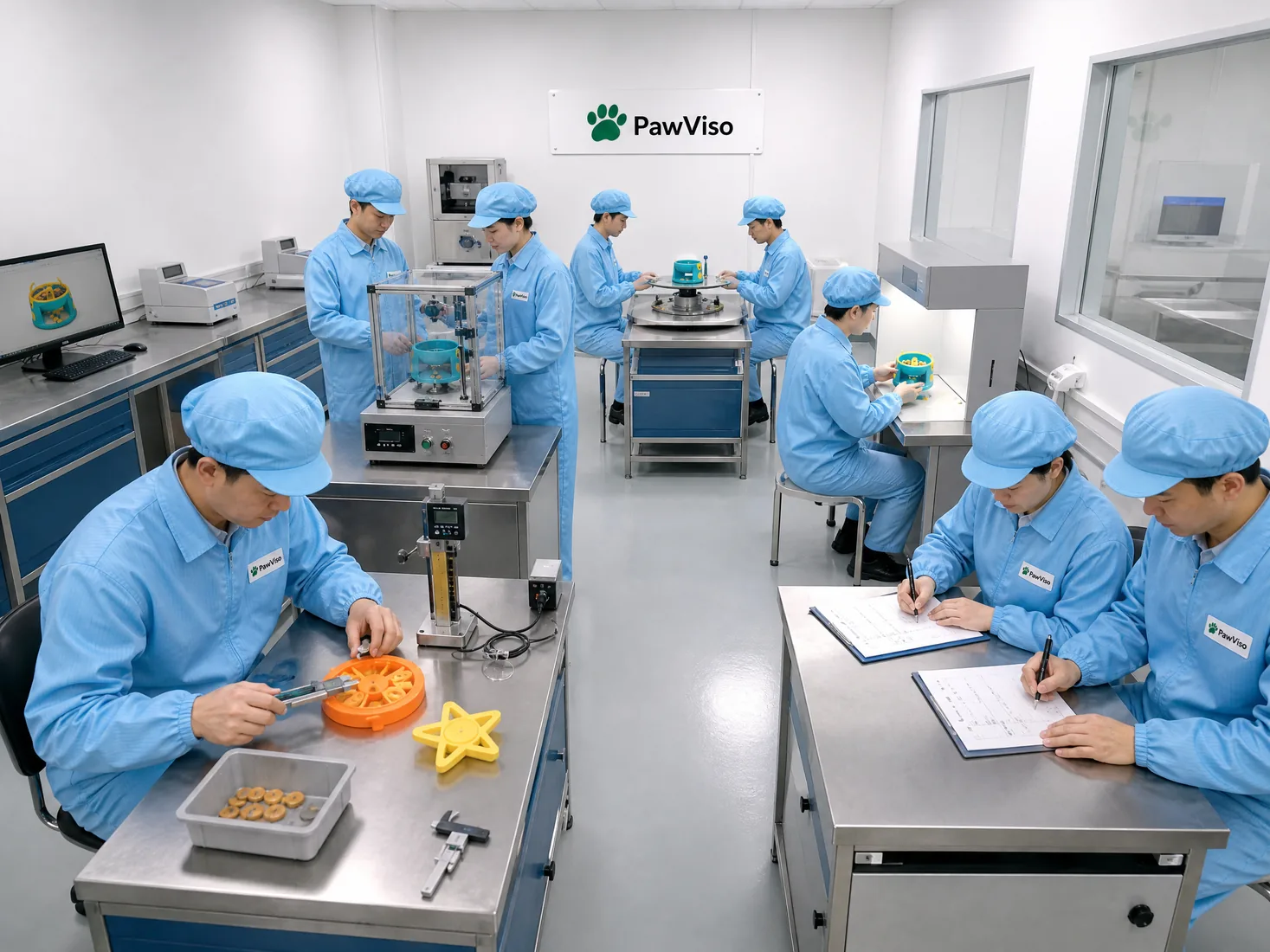
Effective pet toy quality control planning helps reduce late shipment surprises, buyer-supplier friction and costly reorders. This guide presents a buyer-focused framework you can use to plan controlled QC for pet toys. It focuses on establishing an approved baseline, inspecting components and appearance, checking basic function and packaging, categorizing defects, defining acceptable evidence, and setting a clear shipment-release process. The intent is to make decision points explicit so you can assign risk, specify supplier inputs and decide corrective actions before production begins.
A practical QC plan balances prescriptive detail with realistic tradeoffs: the more stringent the checks and documentation you require, the higher the supplier time and inspection cost. This part covers six modules that together form a complete pet toy quality-control plan at SKU level: approval samples and SKU conformity, component and material observations, appearance and workmanship, function and basic durability checks, packaging and labeling observations, plus shipment release and corrective-actions workflow. The plan does not give safety certifications, lab results, or legal advice; confirm all market-specific regulatory requirements with your importer or legal counsel before you finalize acceptance criteria 3.
Module 1 — Approve baseline samples and confirm SKU conformity — buyer action: decide approved-sample rules
Before bulk production starts, decide how many and which types of approval samples will represent the SKU for future inspection comparisons. Typical choices include: 1) a pre-production sample (PPS) produced on the intended tooling and processes, 2) a golden sample kept by the buyer for visual and fit reference, and 3) a supplier retained sample for factory reference. Your buyer action is to choose which of these are mandatory and whether photo or physical return is required. Communicate the sample retention period and who pays for shipping and disposal.
Supplier inputs should include photos with a scale, materials lists, process notes (molding, fabric cut files, stitching details) and batch identifiers that map the sample to a production run. Evidence for conformity is the approved-sample sign-off document with date, signatory and stated tolerances for measurable attributes (dimensions, weight, color codes). Tradeoffs: insisting on physical golden samples increases assurance but raises cost and logistics complexity. Next step: make the approved-sample sign-off a gating criterion for production release and include SKU-level references in the purchase order and packing list 1 2.
| Approved-sample type | Buyer decision point | Supplier evidence |
|---|---|---|
| Pre-production sample (PPS) | Mandatory / optional | Photo set + batch ID + process notes |
| Golden sample (buyer-held) | Return / retain at factory | Signed sample-sheet with tolerances |
| Sign-off elements | Include? |
|---|---|
| Measured dimensions | Yes |
| Material descriptions | Yes |
| Color codes (Pantone / RGB) | Buyer to confirm 2 |
Module 2 — Inspect components and materials — buyer action: set acceptable component list
Component-level inspection focuses on parts that materially affect function or market acceptance: fabrics, fillings, rubber parts, stitching threads, fasteners, squeakers, adhesives and paints. Buyer action: provide an acceptable-component list (ACL) that identifies permitted suppliers, material grades, and any forbidden substances or construction methods—without substituting for regulatory testing. Require the supplier to declare component origins and provide batch IDs for traceability.
Supplier inputs: material specification sheets, supplier certificates of authenticity (not test certificates), photos of incoming material lots, and in-line process checks. Evidence you should expect at inspection includes material color swatches compared to approved sample, measured thickness/weight for fabrics, and visible marking on molds or parts that matches ACL. Tradeoffs: broad ACLs allow supplier flexibility but reduce control over quality consistency; narrow ACLs increase control and may raise cost or lead time. Next steps: decide whether on-site raw-material checks are needed, or if you accept supplier documentation plus random spot checks during production.
Module 3 — Record appearance and workmanship observations — buyer action: define defect categories and AQL policy
Appearance and workmanship account for most buyer complaints in consumer pet toys. Buyer action: define defect categories (critical, major, minor) and either an AQL-style acceptance rule or a pass/fail policy. Critical might include choking hazards or separated parts (note: do not treat this as a safety certification), major may include missing components or severe color mismatch, and minor covers cosmetic blemishes. For clarity, provide photo examples of zero-tolerance conditions and acceptable variances referenced to the golden sample.
Supplier inputs: inspection plans and photos from inline checks, repair logs for reworked units, and batch-level defect statistics. Inspection evidence should include photographed defects with annotated measurements and sample IDs, plus counts by defect category. Tradeoffs: tight AQLs reduce visible defects but increase rework/rejection rates and cost. Next steps: align defect definitions with your market positioning (premium vs low-cost channel) and set a re-sampling rule and disposition path for batches that fail the agreed threshold.
| Defect category | Typical buyer examples | Suggested buyer response |
|---|---|---|
| Critical | Detached small parts, exposed metal | Reject batch; require containment + corrective action |
| Major | Wrong color, missing feature | Rework or remove units; negotiate downgrade |
| Minor | Surface scratch, tiny stitch variance | Accept with price allowance or rework plan |
| Inspection evidence | What buyer expects |
|---|---|
| Photo of each defect type | Annotated and linked to SKU/sample ID |
| Defect tally | By category and sample lot |
Module 4 — Check basic function and durability observations — buyer action: choose test scope and evidence format
Functional checks for pet toys usually focus on the intended toy actions (squeaker function, bounce, tensile strength of seams, attachment security). Buyer action: select the scope of functional checks to be performed on-line or at final inspection. Decide whether you require documented simple tests (e.g., repeated actuation counts, pull tests) performed by the supplier or by an independent inspector. Specify pass/fail criteria at the SKU level, and require a test-log format for recording outcomes.
Supplier inputs: records of in-line function testing, test samples from the production run, and clear descriptions of test method (number of cycles, pull force procedure). Acceptable evidence includes short video clips of the test with timestamps, photos of test setups, and a signed test-log sheet that maps tested units to production lot numbers. Tradeoffs: more rigorous functional checks reduce field failures but increase inspection time and cost; simple checks reduce upfront burden but increase risk. Next step: decide whether periodic destructive testing is acceptable for key components and include that allowance in the purchase terms.
Mid-article CTA — If you want a QC checklist template tailored to soft and rubber pet toys, contact PawViso with SKU details (materials, expected weekly volume, target market). We’ll prepare a draft inspection checklist and proposed evidence formats for your review.
Module 5 — Verify packaging, labeling and product data — buyer action: require GTIN and labeling confirmation
Packaging and labeling are common gatekeepers to market entry. Buyer action: require the supplier to provide final packaging art proofs, packaging materials lists, and finished packaging samples for approval. Confirm product data attributes that will appear on labels and cartons—GTIN and product identifiers should be specified and verified 2. Ask the supplier to pre-print or apply labels only after your written approval of the sample art.
Supplier inputs: finished carton mock-ups, packaging material weight and dimensions, barcode images and placement photos. Inspection evidence: scanable GTIN on a sample carton, high-resolution photos of nutrition/usage/mandatory information panels (where applicable), and a pack-count confirmation sheet that matches the SKU packing plan. Tradeoffs: approving pre-printed packaging before mass print avoids costly reprints but may require longer lead time. Next steps: include packaging approval as a release milestone and confirm who owns leftover packaging stock in case of later design changes.
| Packaging check | Buyer action required | Supplier evidence |
|---|---|---|
| GTIN / barcode | Confirm GTIN & data 2 | Scanable barcode photo |
| Carton artwork | Approve mock-up | Printed carton sample |
| Pack counts | Confirm inner/outer pack | Packing list + photos |
Module 6 — Define shipment release, limitations and corrective actions — buyer action: set release rules and re-order lessons
A clear shipment-release policy prevents ambiguity at final inspection. Buyer action: declare the release trigger (e.g., third-party final inspection pass, supplier self-declaration with audit trail, or buyer approval of digital evidence) and list which documents must be submitted before release—inspection report, test logs, photos/videos, and packing list. Also define shipment limitations: partial shipments, hold-on-ship rules for non-conformities, and conditions for shipping at buyer risk with financial remedies.
Supplier inputs: full inspection report mapped to the approved sample and ACL, corrective-action plans for any non-conformities, and evidence of rework or containment where applicable. Evidence acceptable for release should be explicit: annotated photos of corrected defects, re-test logs, and updated packing confirmations. Tradeoffs: allowing shipments with known minor defects expedites delivery but creates downstream handling and potential returns; holding shipments reduces that risk but increases inventory lead times and warehouse cost. Next steps: define a structured corrective-action timeline, closure evidence, and a re-order lessons checklist for the supplier to reduce recurrence.
| Release item | Required before release? |
|---|---|
| Final inspection report | Yes |
| Test logs & videos | Buyer to specify |
| Corrective action evidence | Required if non-conformities found |
| Post-release options | Buyer decision |
|---|---|
| Hold at origin | Buyer may accept increased lead time |
| Ship with rectification plan | Buyer accepts risk with agreed remedy |
| Reject and rework | Supplier to bear rework cost unless negotiated |
Notes and limitations: this plan addresses inspection, evidence and workflow, but it does not substitute for full safety testing, market regulatory compliance, or legal advice. Confirm applicable import, labeling and safety test requirements for your target market before final acceptance 3. Also distinguish SKU-level conformity checks from a supplier-wide quality-management system; an approved SKU can still be produced in a factory whose overall QMS status you should audit separately 1.
Module 7 — Define acceptable defect levels and buyer decision triggers
Set clear, numeric criteria for what percentage of defects or non-conformities you will accept in a batch and which defects trigger immediate decisions (reject, accept with price reduction, rework). These acceptance levels should be tied to defect categories from your approved baseline: critical (must fail shipment release), major (buyer review required), and minor (tolerable within limits). Document the sampling standard you will use (e.g., AQL-style sampling or 100% check for specific components) and the exact thresholds for each category so that both your supplier and any inspection agent know when to escalate. For example, a recurring functional failure on interactive components should be classified as major or critical depending on whether it affects intended use or causes a hazard; the buyer decision trigger must state whether such a failure requires 100% re-test, batch hold, or outright rejection.
Include decision pathways for common scenarios to avoid ambiguity at shipment release. Create short, actionable instructions such as: “If critical defects >0 on sample, hold lot and require root-cause report before release” or “If major defects are between X–Y% allow price adjustment or partial replacement.” Make sure the buyer’s procurement or quality team commits to timeline SLAs for supplier communication and corrective action acceptance so the factory can respond quickly. These decision triggers form the backbone of an enforceable pet toy quality control plan and should be included in pre-production approvals, purchase orders and inspection work orders 4.
Module 8 — Specify inspection evidence and documentation required for decisions
For each inspection stage (pre-production, inline, final random, loading), list the exact evidence types you require to support a release decision. Typical required evidence includes high-resolution photos of defects with scale indicators, short video clips showing functional tests, measurement logs (dimensions, weight), lot-numbered component receipts, and laboratory test certificates where applicable. Inspections should capture both representative sampling and targeted checks for known risk areas, and every inspection report must map back to the approved sample baseline to show conformance or deviation. Stating file formats, minimum resolutions, and naming conventions (e.g., PO1234_Line2_Final_YYYYMMDD.jpg) prevents ambiguity and expedites review between buyer, inspector and factory.
Use a checklist structure inside each inspection work order to standardise the output. The checklist should force inspectors to mark pass/fail for each critical item and attach evidence items for any non-conformance. Require timestamped photos showing the inspector’s badge or agent logo to verify the inspection source. Define retention policies for inspection files (how long the buyer will keep evidence) and whether evidence must be uploaded to a shared portal or emailed directly. This documentation practice supports fast, defensible decisions and streamlines follow-up actions such as corrective action requests or shipment release approvals 4.
| Evidence type | Minimum requirement | Purpose |
|---|---|---|
| Photos of defects | 3–5 images per defect, 1600x1200 px, with scale | Visual confirmation and trend analysis |
| Functional video | 10–30s showing operation, timestamped | Reproduce functional failure claims |
| Measurement logs | Excel or PDF with calibration note | Verify dimensional conformance |
| Component receipts | Lot numbers and supplier names | Traceability for root cause |
| Inspection report | Signed PDF with checklist | Official pass/fail record |
Module 9 — Establish shipment release procedures and buyer approval steps
Define a clear, time-bound shipment release workflow that assigns roles and timelines for the factory, inspector and buyer. Typical steps include inspector upload of final report and evidence, factory corrective action note if necessary, and buyer approval or hold decision within a specified business-day window. Explicitly state whether the buyer will inspect goods again at port/warehouse or rely on pre-shipment inspection evidence for release. Include criteria for conditional release (for example, release allowed after rectifying specific minor defects and submitting evidence) versus unconditional release. Make sure the handover point aligns with your trade terms and responsibility matrix so there’s no dispute about who assumes risk at each stage 6.
Record the exact data the buyer expects on the shipment release notice: PO number, factory packing list, number of cartons, gross/net weights, inspection pass stamp (or reasons for hold), and the inspector’s contact. If the buyer delegates authority to a third-party inspection provider to approve shipments on their behalf, document the provider’s limits — which defects they may approve for conditional release and which must be escalated to the buyer. Also set a maximum hold period after which an unresolved batch either returns for rework or is dispositioned according to pre-agreed commercial terms (e.g., rework cost responsibility, rejection handling). Including these steps reduces confusion at the moment of shipment and helps match inspection outcomes to transport and delivery planning 6.
Module 10 — Define corrective action and containment expectations
When an inspection reveals non-conforming product, your pet toy quality control plan must require a formal corrective action plan (CAP) from the factory with specific, measurable steps and timelines. Typical CAP elements include immediate containment measures (quarantine, segregation, rework instructions), root-cause analysis, corrective actions to prevent recurrence, and verification steps with evidence. Insist that the supplier provides a clear statement of who will bear costs for rework, replacement or disposal where responsibilities are contractually allocated. The CAP should also specify verification sampling plans post-corrective action to confirm effectiveness before release.
Set expectations for escalation if corrective actions are unsatisfactory or slow. Define when a supplier audit or sample retest is necessary, and whether future production runs require increased inspection levels or 100% checks. For recurring issues, your plan should allow for supplier performance penalties or requalification procedures prior to future orders. Ensure the CAP format is consistent and that the buyer quality team has approval checkpoints; this keeps corrective actions measurable and prevents open-ended supplier promises that are hard to verify on receipt of later shipments 4.
| CAP element | Example requirement | Buyer decision impact |
|---|---|---|
| Containment | Immediate quarantine and photo evidence within 48 hrs | Prevents further shipment |
| Root cause | 5-why analysis within 5 business days | Basis for acceptance of CAP |
| Correction | Detailed rework SOP and estimated lead-time | Rework vs. reject decision |
| Verification | Re-inspection sample and evidence upload | Release on verified success |
Module 11 — Record limitations, assumptions and lessons for reorders
A robust pet toy quality control plan must note its own limitations so buyers make informed decisions. Explicitly record assumptions such as stable component supply, unchanged tooling, and the approved baseline remaining the reference point. Include clauses stating that the QC outcomes are based on sampled inspections and visual/functional checks, and that certain latent defects or long-term durability issues may not be fully detectable without project-specific lab testing or extended field experience. Point out any dependencies on third-party laboratories, special tooling, or seasonality that could affect defect rates or lead times. This transparency prevents misaligned expectations and supports pragmatic commercial terms during disputes.
Capture lessons learned and incorporate them into reorder specifications and supplier scorecards. After each order, compile a short “lessons” memo that highlights recurring defects, supplier strengths and weaknesses, and any changes to the approved baseline. Use this memo to update packing instructions, labeling details, or to require pre-production sample updates before the next production run. Embedding this continuous-improvement loop into your procurement process reduces repeat defects and helps focus supplier development resources where they add the most value. For high-risk items, consider formal requalification steps before increasing order size or shifting to new production lines 5.
| Topic | What to record | Action on reorder |
|---|---|---|
| Recurrent defects | Frequency, root cause, corrective action effectiveness | Add targeted controls |
| Packaging failures | Type of damage, transit phase | Update pack test or reinforcement 5 |
| Tooling drift | Tolerances exceeded vs baseline | Require new pre-production sample |
| Supplier performance | On-time, responsiveness, CAP quality | Adjust order allocation |
Frequently asked questions
Q: How exact must my approved baseline sample be? A: The baseline should be detailed enough that appearance, critical dimensions, material choices and basic function tests are unambiguous for both supplier and inspector. Include photos, callouts, and an inspection checklist. If any component or color variation is acceptable, state tolerances explicitly.
Q: When should I require a lab test versus relying on visual/functional inspection? A: Decide case-by-case. Use lab tests for claims that relate to regulatory compliance or long-term durability and document which tests are required in purchase orders or technical files. Your QC plan should refer to those requirements as separate deliverables; inspection evidence alone may not substitute for lab certificates.
Q: How do I handle a shipment already on the water when I discover a problem? A: Follow the trade terms and shipment-handover timeline in your contract to decide risk and cost responsibilities. Your QC plan should specify escalation steps for in-transit disputes and whether the buyer will accept conditional remedies (discount, return at seller cost, or destruction) based on stored evidence and agreed terms 6.
Q: Can an inspector approve a batch if minor issues are found but the buyer isn’t available? A: Only if your QC plan grants conditional approval authority to the inspector with strict limits and predefined remedies. Document which minor defects can be conditionally released and the post-release commitments required from the supplier. Otherwise require buyer sign-off to avoid later disagreements.
Q: What documentation should I keep after shipment release? A: Keep the final inspection report, all evidence files, CAP records, packing lists, and shipment release notices. Retain these according to your internal retention policy and make them accessible for warranty or dispute resolution.
Conclusion
A practical pet toy quality control plan combines a detailed approved baseline, clear defect categories, precise inspection evidence rules, time-bound shipment release workflows, and enforceable corrective action processes. Make these elements contractually explicit, iterate with lessons learned, and align release procedures to your trade terms so decisions at the factory and port are fast and defensible. Doing so reduces ambiguity, protects commercial outcomes, and makes supplier development meaningful.
Project-specific regulatory, test and market requirements, and final release decisions need buyer/importer confirmation.
Final CTA — Start a controlled pet-toy sourcing conversation with PawViso. Share the product concept, target market, customization route, package direction and estimated order structure for a focused B2B discussion. Email: info@PawViso.com WhatsApp: +86 186 8106 4480 — https://wa.me/8618681064480
Related PawViso resources
- Continue with How to Create a Custom Pet Toy Sampling Plan. Use this pet-toy guide to structure approvals, samples and evidence.
- Browse the PawViso product catalogue to identify product formats for a sourcing brief.
- Follow the PawViso sourcing process and review the B2B buyer FAQ before sharing project requirements.
External reference
For independent shipping-term and handover context, review International Chamber of Commerce Incoterms® 2020 overview. Confirm the requirements that apply to the selected product, target market and order.