
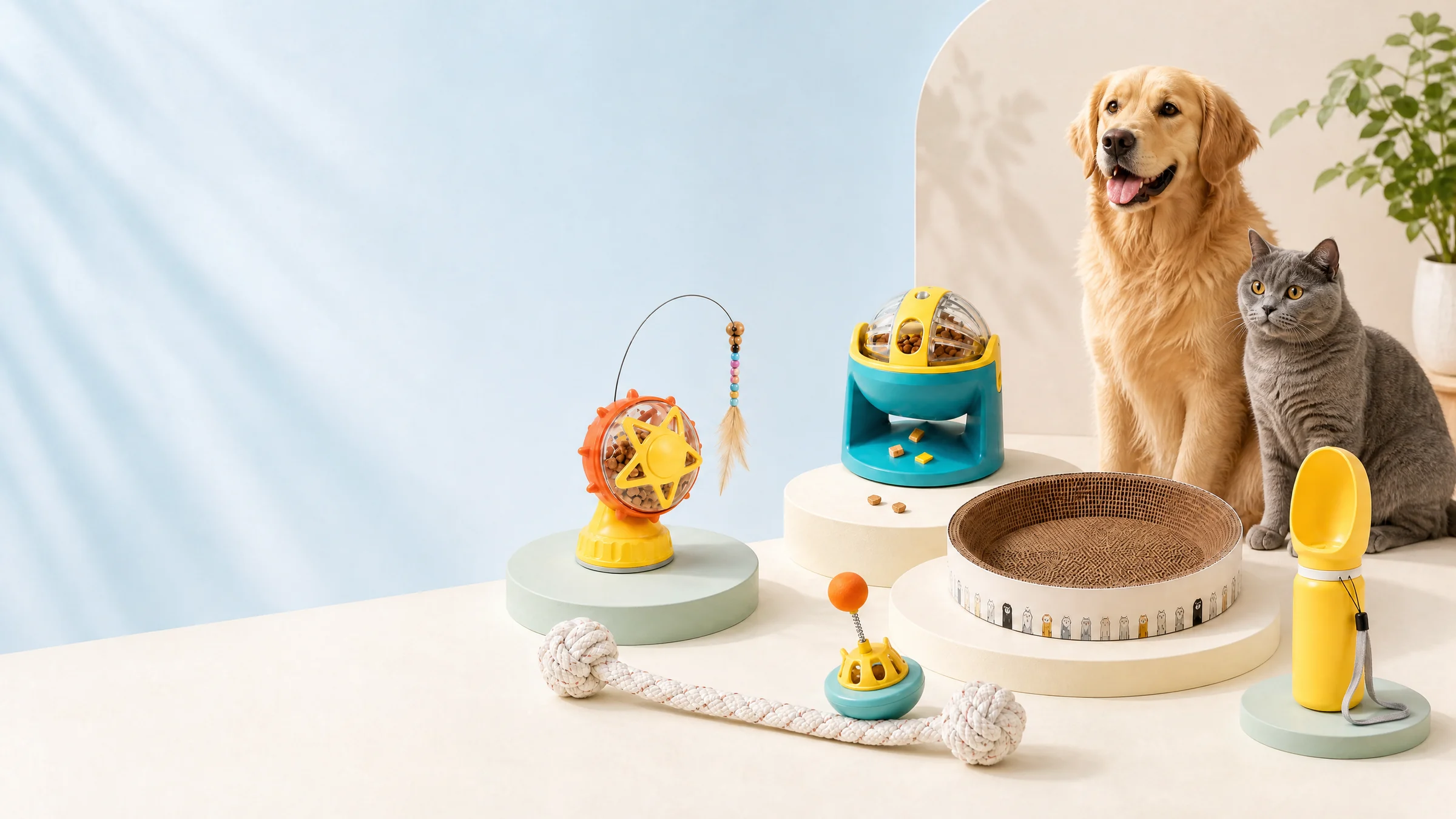
U.S. buyers should source wholesale pet products by defining the intended retail use, comparing like-for-like specifications and total inbound costs, approving representative samples, and documenting shipment-release criteria before placing a production order. A low unit price or a factory-direct headline is not enough to establish commercial suitability.
This guide connects those decisions to the PawViso wholesale and OEM sourcing page. Use that page to explore product formats and send an enquiry; use the eleven modules below to prepare the evidence and questions that make a supplier's reply useful. Advertised MOQ, sampling windows, certifications and commercial terms require written confirmation for your actual project.
Module 1 — What opportunity should your wholesale assortment serve?
Start with demand context, not a sales guarantee
The American Pet Products Association reported total U.S. pet industry expenditure of $158 billion in 2025 and projected $165 billion for 2026. It also reported 95 million U.S. households owning at least one pet in 2025. Those figures cover the wider industry, including food and services; they are not pet-toy revenue, wholesale order volume, or a forecast for a particular SKU. The 2026 figure remains a projection in the cited release. 1
For buyers, the useful implication is that the market is substantial but heterogeneous. A travel accessory competes for a different purchase occasion from a cat scratcher or a grooming tool. Category size cannot tell you whether an individual product will meet your channel's price, durability and presentation expectations.
Define the buyer problem first. A regional retailer might need a compact add-on item with clear shelf messaging. A distributor may prioritize stable replenishment and consistent carton configuration. A private-label e-commerce brand may need a distinct visual identity and instructions that reduce customer confusion. Write the role of the product in one sentence before collecting quotations.
Choose a measurable first-order objective
Set an initial commercial goal such as testing a new category, replacing an unreliable SKU or launching a coordinated collection. Then define how you will evaluate it: sell-through, contribution after channel costs, customer complaints, packaging damage and reorder feasibility.
Keep the first assortment manageable. Extra colors and pack variants create separate approvals and inventory commitments. An attractive range becomes a purchasing problem if each variation requires a different material batch or packaging minimum. The PawViso category routes can help organize a shortlist, but the final selection should reflect your own customers and operating model.
Module 2 — Which sourcing route fits: wholesale, private label, ODM or OEM?
Define the deliverable rather than relying on a label
Wholesale usually describes buying an existing product for resale. Private label describes selling under your own brand, but does not reveal how much engineering changes. Suppliers use ODM and OEM terminology differently. Establish who supplies the design, which parts may change, and what deliverables the quotation includes.
For example, a logo on an existing feeder is not equivalent to a newly engineered feeder mechanism. Both may be marketed as customization, yet the approval effort, tooling exposure and ownership questions differ materially.
| Sourcing route | Typical project scope | Evidence to request | Principal purchasing risk |
|---|---|---|---|
| Existing catalogue supply | Existing product configuration and agreed pack-out | Current specification, representative sample, availability | Assuming the photographed version matches the quoted version |
| Private-label adaptation | Branding, instructions and packaging; limited product changes | Artwork proof, branding method, approved sellable sample | Packaging or printing minimums exceed product needs |
| ODM adaptation | Supplier platform modified for the buyer | Design baseline, change list, development responsibilities | Unclear exclusivity or restricted future modifications |
| Buyer-led OEM development | Buyer-defined design or substantial custom engineering | Technical drawings, tooling agreement, validation plan | Development cost and iteration effort underestimated |
This is a decision framework, not a universal definition or PawViso service commitment. Confirm the exact scope before comparing suppliers.
Make ownership a separate negotiation
For OEM pet toys, identify ownership of drawings, molds, inserts and design revisions. Distinguish an obligation to keep information confidential from a right to own or transfer tooling. A signed nondisclosure agreement does not by itself establish ownership of every development output.
Ask whether the supplier may use the same platform for other customers, how maintenance is funded, and what happens if you change manufacturers. Put agreed rights into the project contract. Use the private-label product line guide when defining a staged launch instead of paying for deep customization before demand is understood.
Module 3 — How do you select pet products without expanding risk unnecessarily?
Compare intended use and purchase complexity
A coherent range does not need every category. Assess whether each shortlisted product supports the same retail story and whether your team can manage its technical requirements. A passive cotton tug and a powered grooming tool need different evidence, instructions and after-sales arrangements.
The following examples are drawn from PawViso's catalogue positioning. Materials, capacities, pet-size limits and available modifications remain specification questions, not assumptions.
| Product format | Catalogue example | Potential collection role | Questions before an RFQ |
|---|---|---|---|
| Treat puzzle | PT-01 Rotating Treat Puzzle | Interactive snack-time selection for cats and small dogs | Cleaning access, component retention, intended treat dimensions |
| Snack feeder | PT-02 Multi-Window Snack Feeder | Feeding-led dog and cat assortment | Mechanism function, contact materials, instructions |
| Scratch lounge | PT-03 Round Cat Scratch Lounge | Indoor-cat scratch-and-rest category | Dimensions, stability, packaging volume, wear characteristics |
| Cotton tug | PT-07 Braided Cotton Tug | Tactile dog-play selection | Fiber construction, attachment strength, size suitability |
| Travel bottle | PT-08 Travel Water Bottle | Walking and outdoor accessory range | Seal performance, usable capacity, cleaning and transport |

Catalogue illustration: inspect the current sample and specification rather than inferring material or performance from an image.
Test the assortment as an operating system
Review each SKU's retail price position, expected replenishment cadence, packaging footprint and likely complaint categories. Combine those observations with your own historical sales data where available. A product that looks simple may become costly if its box is bulky or instructions create repeated support questions.
Follow the PT-01 product record and PT-08 travel bottle record for a starting brief. Do not treat catalogue inclusion as proof of availability, exclusivity, compliance or profitability. Those are separate purchasing decisions.
Module 4 — What drives MOQ and the depth of customization?
Ask for the minimum at each relevant level
Low MOQ pet products can be useful for testing demand, but a headline minimum rarely explains the whole order. Ask whether it applies per product, material, color, printed box, logo treatment or shipment. A supplier may accept a small assembled-product order while its packaging contractor requires a larger print run.
Separate stock-format availability from a production minimum. Also ask about unused packaging ownership, storage conditions and expiry of repeat-order pricing. Avoid buying several variants merely because they share a catalogue page; they may not share the manufacturing constraints that determine MOQ.
A practical approach is to request three comparable configurations: the existing product, the same product with branding and packaging, and the desired deeper redesign. Require the supplier to identify the incremental cost, minimum quantity, development work and approval steps for each.
Customize the features customers can actually recognize
Custom pet product packaging can create a coherent brand experience without changing the mechanical product. Clear instructions, accurate images and appropriate pack protection may be more useful than adding a new color that forces a separate material batch. The decision should follow customer needs rather than a generic promise of differentiation.
For product modifications, freeze a written change list. Specify the feature, reason, tolerance and method of evaluation. Avoid open-ended instructions such as “premium quality” or “stronger design.” They are difficult to quote and cannot serve as reliable acceptance criteria.
Mid-article CTA — Compare the right customization scope. Review PawViso wholesale and private-label sourcing and send the product code, target quantity per variant, destination market and intended modifications. Request written confirmation of the SKU-specific MOQ, sample route and packaging minimum before committing to production.
Module 5 — How should buyers compare total landed cost rather than unit price?
Normalize the quotation before calculating
Pet product landed cost means the costs needed to bring the agreed goods to a defined receiving point. State that point explicitly: a port, distributor warehouse or fulfilment facility. A factory quotation and a delivered quotation cannot be compared fairly without accounting for what each excludes.
Ask whether retail packaging, master cartons, development, samples, tooling, testing and inspection are included. Freight should reflect actual dimensions, weights and shipment mode. Current duties, tariff treatment and import charges require classification and destination-specific advice; do not substitute a historical rate or a generic online calculator for a customs review.
Use a transparent illustrative model
The following figures are invented solely to explain the arithmetic. They are not PawViso prices, market averages, tariff rates or freight quotations. They assume 1,000 units received and show a budgeting allowance for import charges rather than an asserted legal duty rate.
| Cost component | Illustrative amount, USD | What the buyer must verify |
|---|---|---|
| Finished goods | 2,100 | Identical specification and quantity |
| Retail packaging | 350 | Print scope, inserts and included carton work |
| Samples and setup allocation | 200 | One-time charges and repeat-order treatment |
| Inspection | 180 | Scope, travel, reporting and reinspection |
| Freight and handling | 420 | Route, dimensions and exclusions |
| Illustrative import-duty allowance | 210 | Replace with a qualified current estimate |
| Other inbound costs | 140 | Brokerage, receiving or other agreed charges |
| Total illustrative inbound cost | 3,600 | Defined receiving point |
On these assumptions, the inbound cost is $3.60 per unit if all 1,000 units are saleable. If only 800 units are saleable, allocating the same total cost gives $4.50 per saleable unit. This is a sensitivity example, not an expected defect rate.
Retail contribution requires further deductions, including channel fees, advertising, returns, storage and customer support. Recalculate development allocations for repeat orders, but retain the actual cash exposure of the first order. A lower unit quote can lose its advantage after those adjustments.
Module 6 — How can you evaluate a supplier's capabilities and claims?
Verify the actual production route
Searching for a pet product manufacturer China can generate many apparently similar suppliers. Establish the contracting entity, manufacturing location and processes performed in-house. Ask which work is subcontracted and who controls outsourced components, packaging and inspection records.
Do not presume that a factory is always cheaper or that an intermediary is always unreliable. A specialist trader can contribute consolidation or communication services; a direct manufacturer can still lack the relevant process capability. Compare the evidence, responsibility and commercial terms of the route you are actually buying.
Request a process-specific walkthrough linked to your product. For a feeder, discuss assembly and component checks. For a tug, discuss material handling and construction consistency. For powered equipment, involve qualified technical personnel before accepting electrical or battery-related assurances. Catalogue breadth is not evidence that one workshop manufactures every category.
Separate management-system evidence from product evidence
ISO explains that ISO 9001 concerns an organization's quality management system. Certification is performed by independent certification bodies, not by ISO itself. A management-system certificate is not a product-level guarantee for every SKU. 2
Ask for the certificate holder, covered locations, scope and validity when a supplier makes a certification claim. Then request the actual product records: specification, sample identification, applicable tests and the inspection plan. Similarly, claims about capacity, export experience or rapid delivery should be supported for the chosen product and production window.
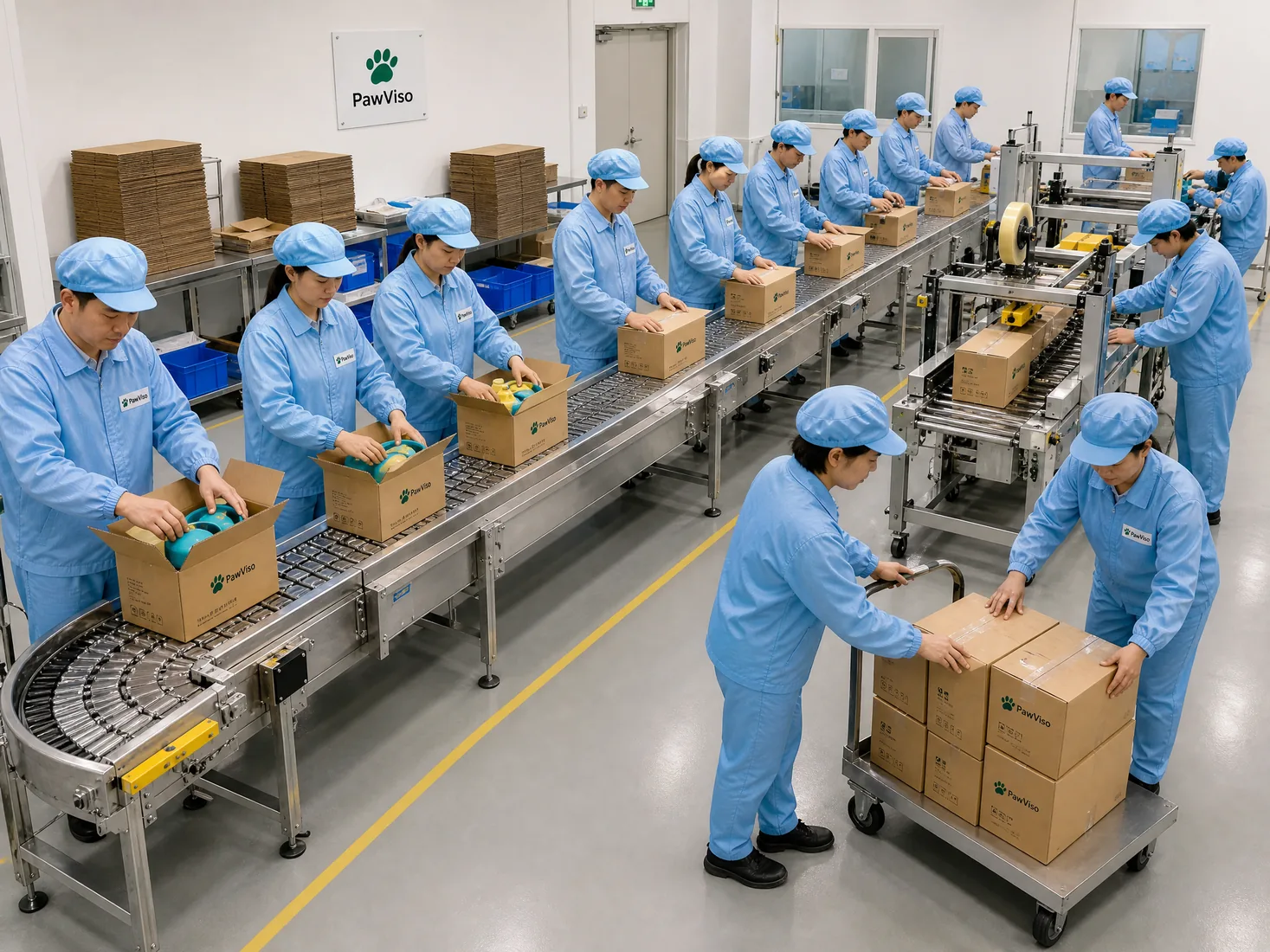
Representative workflow illustration, not documentary proof of a particular production site, live operating status, capacity or audit result.
Review the PawViso factory discussion route to structure these questions. Keep unresolved evidence requests visible instead of treating an attractive website as a completed supplier audit.
Module 7 — What samples, safety reviews and inspection criteria should you require?
Approve a reference that production can reproduce
Distinguish a stock sample, an engineering prototype and a pre-production sample made with the intended materials and process. A prototype may prove the concept without proving production consistency. Record the configuration, date, dimensions, artwork version and observed deviations for every approval.
The approved reference should include the sellable pack where relevant. Keep matched samples or a documented reference set with buyer and supplier. State which characteristics are measured, which require a functional trial and which cosmetic variations are acceptable. Material substitutions should trigger review rather than being treated as ordinary purchasing discretion.
| Review area | Evidence to define | Example acceptance question |
|---|---|---|
| Function and fit | Written method, test conditions and recorded results | Does the feeder operate consistently under the intended use? |
| Component retention | Product-specific force or cycle method | Can detachable parts create an unacceptable foreseeable hazard? |
| Cleaning and contact materials | Material identity, care instructions, appropriate assessment | Are inaccessible spaces or cleaning limits clearly identified? |
| Construction and finish | Measurable tolerances and approved reference | Are edges, seams and attachments consistent with the specification? |
| Packaging and identification | Approved artwork, barcode record, pack-out check | Is the final item identified correctly and protected in distribution? |
| Shipment release | Lot definition, inspection results and decision owner | What evidence authorizes shipment, and what failure causes a hold? |
This table is a framework, not a prescribed test standard or a universal sampling plan.
Apply the correct regulatory classification
CPSC's toy guidance describes ASTM F963 requirements for toys intended for children under fourteen, with separate age-related rules for third-party testing and Children's Product Certificates. Those definitions should not automatically be applied to every pet toy. Actual design, intended use and marketing can affect classification. 3
Voluntarily borrowing a test method does not establish a universal “CPSC-certified pet toy” status. Likewise, a BPA-free statement alone does not establish that all food-contact or destination-market obligations have been met.
Have the buyer's technical adviser define applicable requirements for the actual SKU. Agree defect classes and any sampling plan separately from performance testing. Use the pre-shipment inspection guide to document holds, corrective action and reinspection before release.
Module 8 — How do packaging, product claims and item data affect retail readiness?
Treat the package as part of the purchase specification
Packaging affects protection, freight volume, merchandising and instructions. Confirm dielines, substrate, print process, dimensions, inserts and master-carton configuration. Include artwork approval and an agreed pack-out sample in the project record rather than reviewing the product and box separately.
For online channels, a small reduction in box size may matter operationally, but confirm that protection remains adequate. For physical stores, readability and display fit may matter more. Ask your intended retailer or fulfilment provider for current requirements; do not assume that one generic “retail-ready” pack is acceptable everywhere.
Keep identification separate from certification
GS1 describes the Global Trade Item Number, or GTIN, as an identifier for trade items. Its guidance also points to Verified by GS1 for checking assignments. A valid identifier does not certify product safety or quality. 5
Assign ownership of item data, identify which sellable variants need distinct identifiers under applicable rules, and coordinate product and packaging information. A barcode can scan correctly while referring to the wrong size or color. Verify both the printed symbol and the data it represents.
Substantiate environmental and performance language
The FTC Green Guides distinguish environmental claims from certification. For an unqualified recyclable claim, the guidance includes access to appropriate recycling facilities for at least 60% of consumers or communities where the item is sold, alongside other conditions. That threshold is not the percentage of recycled material or an actual recycling rate. 4
Specify whether a claim concerns the product or its packaging. Evidence for a cardboard box cannot substantiate the same claim for a mixed-material toy. Recycled-content statements need support for the stated amount and material scope. Avoid sweeping language such as “fully sustainable,” “indestructible” or “safe for all pets” without appropriate substantiation. Approve the copy alongside the test evidence, not after printing begins.
Module 9 — How should buyers plan lead times, trade terms and repeat orders?
Build a schedule from dependencies
A sample window is not the complete time to launch. Separate specification review, development, sample revisions, artwork approval, material procurement, production, inspection, freight and receiving. Define when each supplier clock starts and which buyer approvals pause it.
Request a written schedule for the actual configuration. Include the evidence needed at each gate and who reviews it. Changes to colors, packaging or components after approval should be assessed for cost and timing rather than folded into an informal promise to “keep the same delivery date.”
Avoid universal delivery guarantees. Available capacity depends on the process, order mix and production period. A rush shipment cannot compensate for an unresolved product or packaging approval. Prioritize complete decisions early in the project rather than asking inspection staff to waive them later.
State the named place and separate contractual obligations
ICC explains that Incoterms allocate certain obligations, costs and delivery-related risks. They do not determine all payment conditions or ownership transfer, and they are not a complete sales contract. 6
Write the chosen rule, named port or place and version clearly. Then separately agree payment milestones, tooling rights, inspection access, rejection remedies and document responsibilities. Under destination-based cost arrangements, do not assume that the named destination is necessarily the place where risk transfers.
For delivered quotations, ask who performs import clearance, bears each charge and supplies the documents you need. Confirm arrangements with your forwarder and customs adviser before comparing proposals.
Finally, plan the reorder. Retain approved specifications, item data, packaging revisions and inspection history. Ask how discontinuations or material changes are communicated. A first order that works only through exceptional manual effort is not necessarily a stable wholesale supply route. The PawViso sourcing process provides a useful sequence for organizing these handover questions.
Module 10 — What questions do commercial buyers ask before requesting a quote?
Is factory-direct sourcing always the lowest-cost option?
No. Compare the same product configuration, receiving point and responsibilities. Direct manufacturing can simplify technical communication, but consolidation, packaging, freight and development costs can change the result. Evaluate pet product landed cost and the supplier's evidence rather than applying an assumed saving to every factory quote.
Can I launch private label pet products without new tooling?
Potentially. An existing product may support brand artwork, instructions or packaging changes without a new mechanical design. Confirm that each requested modification is technically available and whether it changes material or printing minimums. Ownership and exclusivity are separate questions; putting your logo on an existing platform does not automatically make the underlying design exclusive.
What MOQ or sample time should I expect from PawViso?
Request a written quotation for your product, quantity per variant and customization scope. Treat website ranges as enquiry starting points rather than binding terms. Stock samples, modified samples and new tooling have different dependencies. Confirm sample charges, any credit policy, dispatch timing and shipping arrangements before paying or setting a launch date.
Do ISO, GTIN or BPA-free claims replace product testing?
No. ISO management-system evidence, trade-item identification and a claim about one chemical characteristic answer different questions. None alone proves overall safety, performance or market eligibility for the finished SKU. Define the actual product requirements and ask for traceable supporting evidence. Where requirements are uncertain, seek appropriate technical or regulatory advice before approving the purchase.
Module 11 — How do you turn this research into a qualified PawViso RFQ?
Send a brief the supplier can price consistently
A request for quotation, or RFQ, should identify the product and decisions already made. “Send your cheapest pet toys” leaves the supplier guessing about material, packaging and use. A focused brief lets you compare a relevant configuration and exposes missing information before production.
Use the following editable structure:
- Buyer and destination: company, contact, receiving country and intended sales channel.
- Product scope: PawViso code or reference image, intended pet/use and specification questions.
- Order structure: estimated quantity per SKU, color and packaging variant; expected repeat-order direction.
- Customization: logo, artwork, instructions, material changes or buyer-led engineering.
- Evidence and approvals: sample stage, relevant tests, acceptance criteria and inspection responsibilities.
- Commercial basis: named receiving point, requested trade term, target schedule and quotation exclusions to clarify.
You can submit an early-stage brief without having every answer. Label missing decisions and request the information needed to resolve them. Keep a record of the resulting quotation so later revisions remain comparable.
Final CTA — Request a product-specific wholesale or private-label review. Visit the PawViso B2B wholesale enquiry form. Share your shortlist, target market, quantities and packaging direction. Ask PawViso to confirm MOQ, samples, specification evidence and commercial terms in writing for the actual project.
Email: info@PawViso.com
WhatsApp: +86 186 8106 4480
Continue the purchasing discussion
Browse the product catalogue for individual formats and the B2B FAQ for general preparation questions. For a structured specification request, use how to write a wholesale pet product RFQ. The next step is not a larger keyword list or an automatic purchase: it is a clearer, evidence-backed sourcing decision.
Final buyer/importer confirmation is required for product specifications, claims, testing, packaging, contracts, import arrangements and destination-market requirements. This guide does not verify a supplier's certifications, promise commercial results or replace professional advice.
References
- 1APPA — U.S. Pet Industry Reaches
References
58 Billion in 2025, March 26, 2026 - 2ISO — ISO 9001 Quality Management Systems Explained
- 3CPSC — Toy Safety Business Guidance
- 4FTC Green Guides — 16 CFR Part 260, official current text
- 5GS1 — Global Trade Item Number
- 6ICC — Introduction to Incoterms 2020, paragraphs 4 through 14