
For an importer, retailer, distributor, or private-label buyer, the question “where to buy pet supplies wholesale” should lead to a documented sourcing process rather than a search for the lowest listed unit price. A suitable supplier must be evaluated against assortment fit, destination-market requirements, packaging, quality controls, communication, and the buyer’s replenishment model. Product specifications, materials, packaging, commercial terms, and production schedules must be confirmed with the supplier and buyer for each project.
What should wholesale buyers define before contacting suppliers?
Start with a concise buying brief. State the destination country or countries, sales channel, customer segment, product categories, expected opening order, target price architecture, preferred shipment window, and whether the range will be sold under the supplier’s presentation or a private label. A retailer may prioritize shelf coherence, while a distributor may focus on case packs and repeatability.
The brief should distinguish mandatory requirements from preferences, including intended use, dimensions, colors, packaging language, barcodes, carton marks, and proposed claims. Do not assume that an online item is available in the displayed material, packaging, quantity, or market configuration. Ask the supplier to identify the exact model and revision being quoted.
Where can importers find wholesale pet supply partners?
Buyers may use manufacturer websites, trade fairs, sourcing platforms, agents, and referrals. Each route requires verification. A direct manufacturer may discuss product development and packaging coordination, while a trading company may present a broader catalog. Neither description proves suitability. The buyer should verify the legal entity, payment details, communication channel, product ownership, export process, and available documentation before placing an order.
A useful first request includes a company introduction, catalog, quotation, sample plan, packaging information, and documents available for the exact model. The U.S. Department of Commerce recommends due diligence on foreign business partners 1. For goods entering the United States, the Consumer Product Safety Commission provides business guidance on product responsibilities 2. In the European Union, the General Product Safety Regulation is a key framework for many consumer products 3. These sources do not replace legal advice or market-specific review.
How should buyers compare wholesale pet product suppliers?
Compare equivalent specifications and commercial assumptions. A unit-price comparison is incomplete if one quotation includes packaging, inspection, or freight assumptions and another does not. Ask for the same product code, dimensions, material, case pack, Incoterm, and destination basis. Every item below is a confirmation point, not a PawViso guarantee.
| Buying factor | What to request | Why it matters | Confirmation status |
|---|---|---|---|
| Assortment fit | Product code, variants, dimensions, materials, and intended use | Supports a coherent retail or distribution range | Confirm with supplier and buyer |
| Private-label scope | Logo method, packaging options, artwork workflow, and sample approval steps | Defines launch workload and ownership questions | Confirm with supplier and buyer |
| Order planning | MOQ, case pack, carton size, and reorder process | Helps model inventory and warehouse requirements | Confirm with supplier and buyer |
| Quality process | Pre-production sample, inspection points, defect handling, and batch records | Creates an auditable quality conversation | Confirm with supplier and buyer |
| Market documentation | Test reports, declarations, labeling files, and applicable country documents | Helps reduce compliance and customs surprises | Confirm with supplier and buyer |
| Commercial terms | Quotation validity, payment terms, Incoterm, freight assumptions, and lead-time estimate | Makes offers comparable on a landed-cost basis | Confirm with supplier and buyer |
Ask the supplier to separate confirmed data from estimates. Keep the approved sample, specification sheet, quotation revision, and written change approvals in one purchase record. A short, documented comparison is generally more useful than a long list of unverified product claims.
What product and packaging questions belong in a request for quotation?
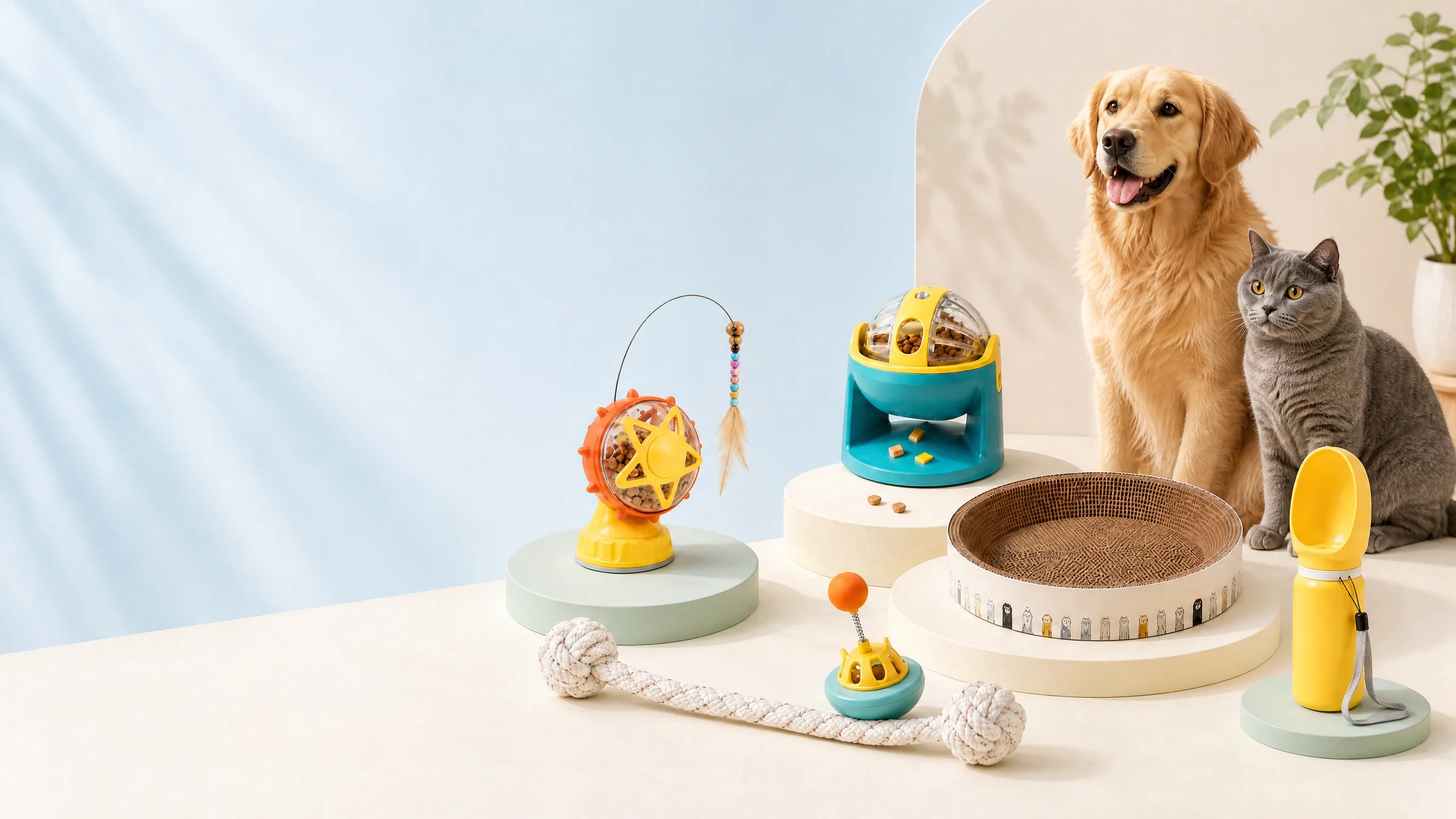
For toys and enrichment accessories, request confirmation of dimensions, construction, moving parts, surface materials, cleaning information, packaging protection, and intended-market labeling. A slow feeder or slow-feeding bowl may be treated as a non-food pet accessory for sourcing purposes; the buyer should still confirm its exact material, dimensions, finish, cleaning instructions, packaging, and applicable market documentation. This guide does not provide food, formula, feeding-quantity, nutrition, allergy, medical, or veterinary advice.
For cat scratchers and teaser toys, ask about surface materials, attachment methods, component security, replacement parts if relevant, and carton protection. For grooming tools, confirm component construction, edges or bristles, labeling, and user instructions. For cotton-rope tug toys and travel water bottles, confirm material composition, closure or attachment design, packaging, and intended-market labeling. Actual specifications, materials, packaging, compliance documents, and market claims must be confirmed with the supplier and buyer for the exact model.
Do not treat a photograph or generic test report as a complete specification. State the destination market and ask which documents apply to the exact item and material combination. The American Pet Products Association notes that product-safety considerations can vary according to the product and claim profile 4. A prudent importer therefore reviews the item, claims, packaging, and jurisdiction together.
How can private-label buyers reduce launch risk?
A controlled private-label process moves from concept to approved sample and then from approved sample to production. First, align the product brief and brand position. Next, confirm artwork dimensions, translations, warnings, barcodes, carton marks, and master-carton information. Then approve a physical sample before committing to a production run. Any change to material, color, component, packaging, or labeling should trigger a new written review.
Retain a specification sheet with the product code, revision date, approved images, packaging files, inspection criteria, and responsible contacts. Obtain destination-market evidence before printing performance, durability, environmental, or other claims. The CPSC explains that manufacturers and importers must understand when testing or certification obligations apply 5. Confirm documentation with the supplier and buyer and obtain professional compliance advice where needed.
What is a practical wholesale sourcing sequence?
A workable sequence is to define the assortment, shortlist suppliers, request comparable quotations, review samples and documents, negotiate terms, approve packaging, place a controlled initial order, inspect against the agreed specification, and review sell-through before reordering. This avoids assuming that a large first order, particular MOQ, or fixed lead time is appropriate.
For an initial PawViso inquiry, provide the destination market, sales channel, target categories, product codes if known, opening quantity, packaging brief, private-label requirements, and desired shipment window. PawViso must confirm the feasible scope, exact specifications, available documents, pricing, MOQ, customization options, and timing for the requested models. No supplier capability, certification, customer relationship, price, capacity, or market-performance statement should be inferred from this article.
Frequently asked questions about buying pet supplies wholesale
Can a small retailer buy directly from a China-based supplier?
A small retailer can request a quotation and sample discussion, but suitability depends on order economics, shipping, import obligations, and the supplier’s confirmed terms. Compare direct importing with a domestic distributor using total landed cost, operational workload, documentation needs, and reorder practicality.
Is the lowest wholesale quote the right choice?
Not necessarily. A lower unit price may exclude packaging, inspection, freight, duties, tooling, or artwork revisions. Compare equivalent specifications, Incoterms, and service assumptions, then request a complete cost breakdown before deciding.
Can PawViso support private-label pet accessories?
Availability depends on the exact product, artwork, customization method, order plan, and destination market. Send a written brief and ask PawViso to confirm the feasible scope, sample process, documents, commercial terms, and approval steps for each item. Do not treat availability as confirmed until it is documented by both supplier and buyer.
What should an importer verify before placing an order?
Verify the legal and payment details, exact product specification, approved sample, packaging and labeling files, applicable market documents, inspection arrangement, shipping terms, and change-control process. Keep all confirmations in the purchase record and obtain market-specific professional advice where needed.
Request a wholesale sourcing discussion
If you are an importer, retailer, distributor, or private-label buyer building a pet-accessory range, send PawViso your destination market, target categories, opening quantity, packaging brief, and timeline. Use the PawViso contact page to request a sourcing discussion. Product specifications, materials, packaging, compliance documents, pricing, MOQ, customization, and logistics must be confirmed with the supplier and buyer before quotation or order approval.
Related PawViso resources
- Continue with How to Build a Private Label Pet Product Line. Use this guide to connect customization, packaging and MOQ decisions.
- Browse the PawViso product catalogue to identify product formats for a sourcing brief.
- Follow the PawViso sourcing process and review the B2B buyer FAQ before sharing project requirements.
External reference
For independent product identification and barcode context, review GS1 guidance on Global Trade Item Numbers (GTINs). Confirm the requirements that apply to the selected product, target market and order.
References
- 1U.S. Department of Commerce — Perform Due Diligence
- 2U.S. Consumer Product Safety Commission — Business and Manufacturing
- 3EUR-Lex — Regulation (EU) 2023/988 on General Product Safety
- 4American Pet Products Association — Product Safety Issues
- 5U.S. Consumer Product Safety Commission — Testing & Certification