
For importers, retailers, distributors, and private-label buyers, a replacement cycle is not a promise that a product will last for a fixed number of days. It is a commercial planning window: the period in which a SKU is reviewed for replenishment, assortment changes, packaging updates, or retirement. In pet accessories, actual purchasing patterns can vary with usage, household preferences, design, price point, channel, season, and presentation.
A useful cycle therefore describes a review process rather than a guaranteed lifespan. Inventory-management practice considers product movement, available quantities, demand, order frequency, quantity, and timing.1 Applied to pet accessories, these principles support repeatable decisions without unsupported performance or durability claims.
Why replacement cycles should be planned by SKU family
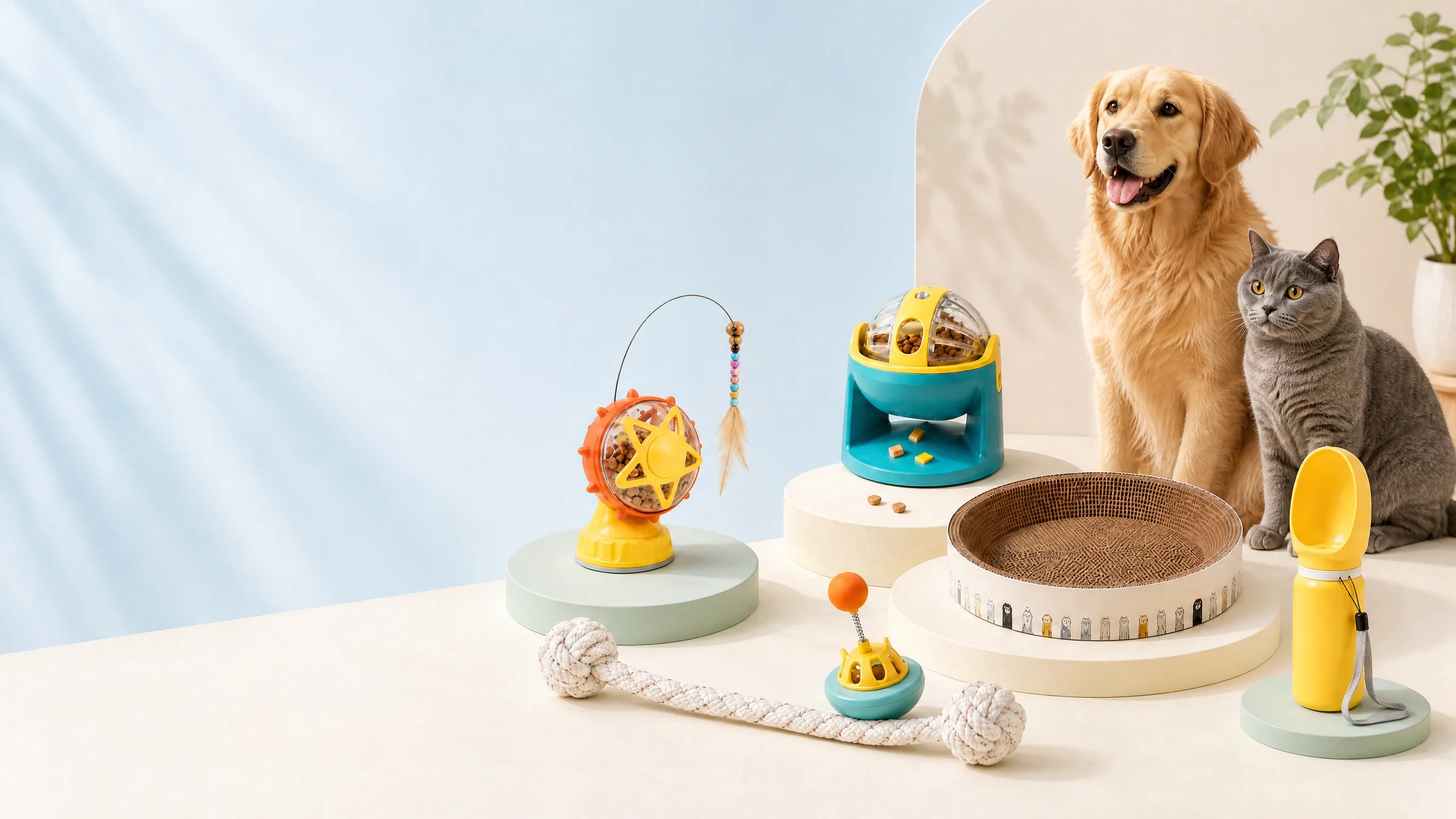
Pet accessories are bought for different commercial reasons. An interactive puzzle toy, cat teaser, cotton-rope tug toy, cat scratcher, grooming tool, or travel water bottle may be reviewed after customer feedback, visible wear reports, loss, or a seasonal campaign. A slow feeder or slow-feeding bowl can be treated as a non-food pet accessory for assortment planning; this article does not provide food, formula, portion, nutrition, allergy, medical, or veterinary guidance. Format, packaging, and use context can affect repeat purchasing.
Buyers should begin with a replacement hypothesis, not a universal lifespan statement. Group SKUs by commercial role, channel, price architecture, and purchase occasion, then test the hypothesis against the buyer’s data. Candidate families include interactive puzzle toys, non-food slow-feeding accessories, cat scratchers, teaser toys, grooming tools, cotton-rope tug toys, and travel water bottles. The final review logic must be confirmed with the supplier and buyer for the target market, intended use, specification, packaging, and documents.
A practical replenishment framework for importers and retailers
The first step is to define the unit of analysis. Use one record for every sellable SKU, variant, packaging version, and destination market whenever differences affect purchasing, identification, labeling, or compliance. Consistent product identification supports inventory visibility and information exchange across retail partners.2 Treat a new barcode, carton configuration, or product name as a distinct planning event until the buyer confirms whether historical sales can carry forward.
Next, set a review cadence. It is not automatically a reorder interval or supplier lead time. A retailer may review high-velocity items more often than test or seasonal items, but timing should be confirmed with the buyer’s reporting cycle and supplier process. Compare sell-through, stock on hand, open orders, inbound units, returns, markdowns, promotions, and channel allocation.
Separate demand signals from replacement signals. Demand signals show how quickly a channel sells a SKU. Replacement signals can include repeat orders, returns, customer comments, packaging damage, requests for a revised color, or feedback about fit and handling. No single signal proves a product-life or durability outcome. The combined evidence can instead support one of several commercial decisions: replenish the current version, adjust the assortment, request a revised sample, or pause the SKU for documented review.
| Buyer checkpoint | What to measure | Decision supported | Confirm with supplier and buyer |
|---|---|---|---|
| Sales velocity | Units sold by week or month, by channel | Review priority and reorder timing | Forecast period, reporting basis, and destination market |
| Availability | On-hand stock, open orders, and inbound units | Whether a replenishment gap may occur | Pack size, carton details, and order quantity |
| Assortment role | Core, seasonal, test, or promotional status | Keep, expand, pause, or retire | Market positioning and private-label brief |
| Replacement feedback | Returns, reviews, wear comments, and repeat requests | Product, packaging, or sample review | Intended use, construction, and inspection criteria |
| Commercial readiness | Artwork, barcode, inserts, case pack, and documents | Whether the SKU can be reordered | Final specification and required documents |
Building a cycle without inventing product-life claims
A practical planning sheet can contain three separate fields: review date, replenishment trigger, and replacement decision date. None should be presented as a guaranteed lifespan, safety outcome, or fixed supplier lead time. A buyer may define a trigger using internal evidence such as stock coverage, an approved sales forecast, a campaign date, or a documented reorder threshold. The method and threshold should be agreed by the buyer and supplier before it is used in a purchase plan.
Inventory visibility matters because insufficient stock can create missed sales, while excess stock consumes cash and storage capacity.1 A cycle should therefore combine sales history with operational facts: inbound quantities, warehouse location, channel allocation, promotional calendars, artwork approval, sample approval, and shipping planning. Any MOQ, packaging option, production capacity, inspection requirement, price, certification, and shipping window must be confirmed with the supplier and buyer for the specific order and destination.
Using cycle reviews for private-label development
Private-label buyers can use replacement-cycle reviews as an improvement loop. Begin with a brief covering target channel, price architecture, packaging language, barcode ownership, carton markings, intended use, and market documents. Ask the supplier to confirm construction, materials, dimensions, colors, accessories, packaging formats, labeling, and customization options for each SKU. Do not publish these details until confirmed for the relevant version.
After launch, collect feedback consistently. Record the SKU, lot or shipment reference where available, sales channel, issue description, photos when appropriate, and requested action. This creates a stronger basis for sample revision than “customers want a better product.” Reliable product identification and shared product information support retail operations.2 Identifiers and version control help distinguish a product change from a new packaging presentation.
A review can produce four documented outcomes: reorder the current version, reorder with an approved packaging change, request a revised sample, or retire the SKU after a commercial review. The buyer and supplier should agree the outcome in writing, with all specifications, documents, quantities, inspection criteria, prices, and timelines confirmed before a purchase order is issued.
Questions buyers should ask before setting a cycle
Before publishing a replenishment calendar, identify whether the cycle uses sales data, campaign timing, customer feedback, inventory position, or a combination. Confirm interchangeable variants, SKU effects of packaging changes, destination-market documents, the approved sample, materials, dimensions, colors, case pack, barcode, labeling, inspection method, and logistics assumptions. These checks keep an estimate from becoming an unsupported supplier promise.
For PawViso product discussions, buyers may identify a category of interest and request a supplier-confirmed specification for evaluation. Product availability, customization, compliance documents, packaging, pricing, MOQ, capacity, and delivery timing remain subject to written confirmation.
FAQ
Is a replacement cycle the same as a guaranteed product lifespan?
No. A replacement cycle is a buyer’s planning and review window based on channel evidence. It is not a guarantee about durability, safety, or useful life. Any performance statement must be confirmed with the supplier and buyer for the specific SKU, approved sample, intended use, and target market.
How often should a retailer review pet accessory SKUs?
There is no universal interval. Review frequency should reflect sales volume, promotion timing, inventory risk, reporting availability, and the buyer’s operating process. A practical approach is to review higher-priority SKUs more often and conduct a broader assortment review at a regular management interval, with the cadence confirmed by the buyer.
What should a private-label buyer confirm before reordering?
Confirm the final SKU identity, approved sample, materials, dimensions, colors, packaging, barcode, carton configuration, required documents, order quantity, inspection criteria, price, and shipping plan. Every product parameter and commercial timeline should be confirmed with the supplier and buyer before ordering.
Can a slow-feeding bowl be included in a general accessory planning model?
Yes, it may be classified as a non-food pet accessory for retail and inventory planning. The buyer should evaluate its approved specification, packaging, sales signals, returns, and market requirements without making food, nutrition, allergy, medical, veterinary, or feeding-quantity claims. Confirm all actual specifications and intended-use statements with the supplier and buyer.
CTA: Build a buyer-confirmed replenishment plan with PawViso
If you are an importer, retailer, distributor, or private-label buyer, share your target market, channel, category, current sales signals, packaging brief, and preferred review window with PawViso. You can request a category discussion and supplier-confirmed specification for evaluation. Contact PawViso about your replenishment planning needs.
References
Editorial note: This article is a commercial planning guide, not a product-life, safety, compliance, feeding, medical, veterinary, pricing, MOQ, capacity, or logistics guarantee. Confirm all specifications, documents, quantities, commercial terms, and schedules with the supplier and buyer before publication, listing, or purchase.
PawViso Editorial Team