
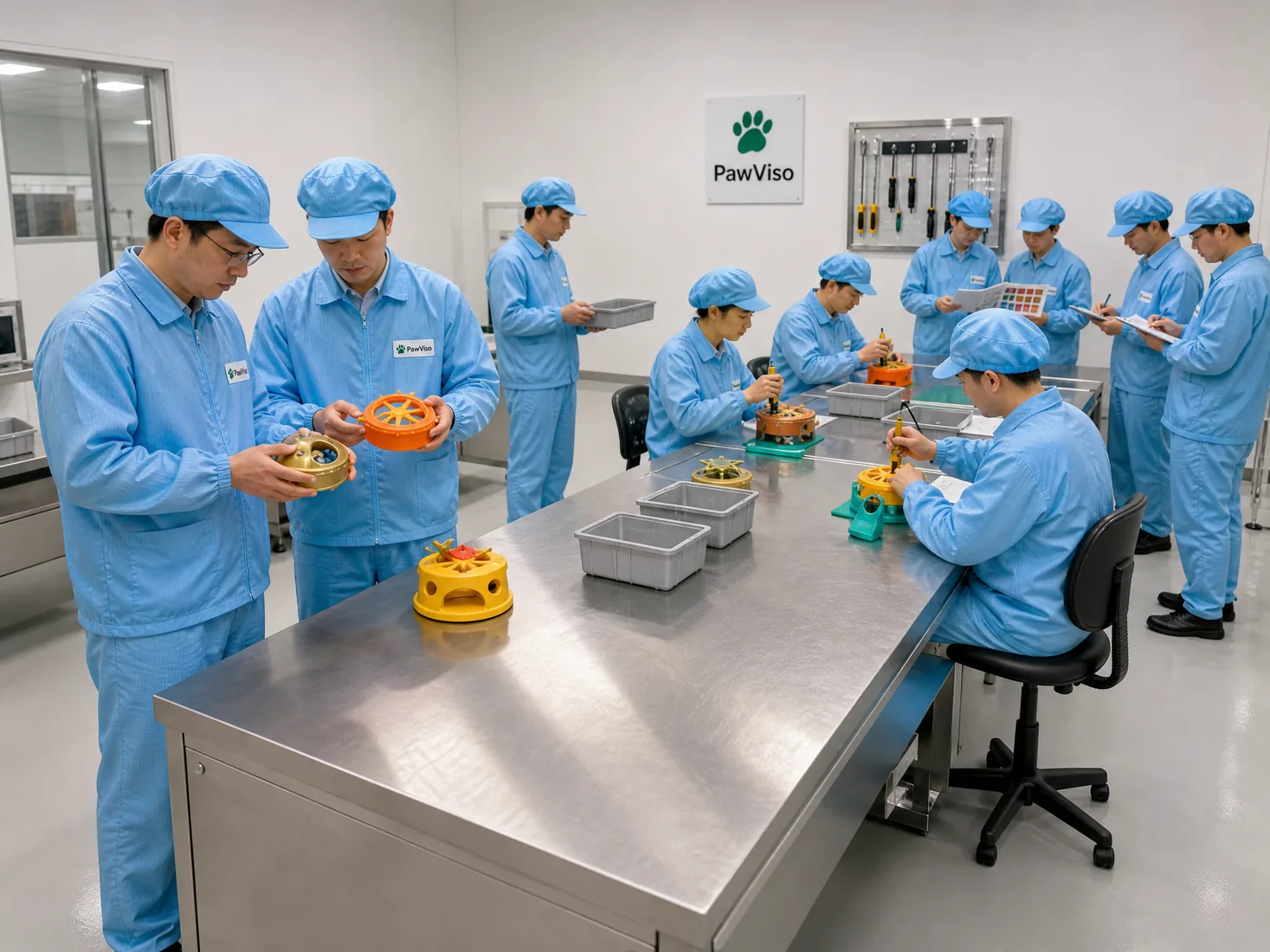
A pet product pilot run should be a controlled learning build between sample approval and mass production. It is not a smaller version of the final order and it is not a photo opportunity. Its job is to show whether one identified product and packaging configuration can be assembled, checked, packed and recorded as intended when real components, people, equipment and instructions meet on the factory floor. For a buyer working with a Chinese pet-product factory and procurement partner, the direct decision is simple: do not authorise broad production until the pilot has answered the remaining production-readiness questions for the actual SKU.
That decision requires no invented capacity, order quantity or universal test threshold. It requires a disciplined sequence. The buyer freezes an input pack, identifies components and version status, agrees a first-off review, defines measurable checks, captures corrections, verifies the corrected output, and decides precisely what is released. This guide covers ordinary pet accessories, toys, feeding items, grooming products, travel items and retail packs at a B2B process level. Requirements for the actual product, materials, claims, market, channel and importer arrangement remain matters for the responsible buyer or importer to confirm.
Module 1 — Decide whether a pilot run is the right release gate
Run a pilot when the buyer needs evidence that the approved design can become a repeatable production configuration, not merely another attractive sample. The decision is especially useful where several parts meet in one assembly, a new pack-out is involved, branding or retail inserts have moved from draft to print-ready files, or the first production instruction has not yet been proven. A simple single-piece item may need a focused first-off build rather than a broad pilot. A multi-component harness, grooming device, feeder, cat furniture item, travel accessory or gift set commonly needs a more visible pilot plan because interfaces, orientation and packing sequence can create errors that a hand-made development sample did not reveal.
State the purpose in one sentence before scheduling the build: for example, “confirm the released configuration, assembly sequence, pack completeness and inspection method before production release.” Then list what the pilot will not decide. It may not prove demand, establish a universal market approval, validate a marketing claim or substitute for project-specific laboratory work. In the EU, the General Product Safety Regulation is intended to ensure that only safe products are available on the market; that market responsibility is separate from a factory’s internal pilot decision and must be checked for the actual SKU and route to market.1 The buyer should therefore treat the pilot as an execution gate inside a wider project release plan.
| Pilot objective | Buyer decision supported | Appropriate evidence | What remains outside the pilot by default |
|---|---|---|---|
| Configuration confirmation | Is the current product version the one intended for production? | First-off unit, revision check and component reconciliation | Approval of future substitutions |
| Assembly proof | Can the stated process produce the intended build? | Observed work sequence, operator feedback and line record | A guarantee of every later unit |
| Packaging proof | Is the stated unit, inner pack and carton arrangement executable? | Packed first-off, count record and artwork check | Performance on an unreviewed distribution route |
| Control proof | Can agreed checks detect defined errors at the right point? | Check sheet, measurement records and defect examples | A generic certification or market determination |
| Release decision | What may proceed and under which conditions? | Signed release log with open items and owner | An unrestricted permission to change the product |
Module 2 — Freeze the controlled pilot input pack
Release one input pack for the pilot, and stop treating chat attachments, old samples and supplier memory as production instructions. The pack is the shared baseline for the buyer, procurement contact, factory purchasing team, production leader, quality reviewer and packaging team. Give it a project ID, SKU or variant ID, revision number and issue date. Its cover page should name the build date, the decision owner, the first-off reviewer and the place where current files are held. If any source is provisional, say so visibly; a pilot cannot clarify uncertainty that the team has hidden.
The input pack should connect the commercial promise to the physical unit. Include the approved product description, drawing or annotated images where available, bill of materials, artwork, pack-out instruction, critical characteristics, work instruction draft, check sheet draft and change-log status. Mark every item as released, reference-only, buyer-supplied, supplier-proposed or open. A physical retained reference can help show appearance or assembly position, but it must carry the same identity as the documents. A signed sample from an earlier design round must not override a later written component or artwork revision without an explicit precedence decision.
| Input-pack record | Minimum identifier | Pilot-use decision | Common failure prevented |
|---|---|---|---|
| Product configuration sheet | SKU, variant and revision | Confirms the unit being built | A similar sample being mistaken for the released version |
| Component list | Part name, revision and source-status field | Tells purchasing and assembly what may be used | An unapproved substitute entering the build |
| Artwork and label file | File name, revision and approval status | Controls printed and visible information | Old artwork being printed or packed |
| Work instruction | Operation number, version and intended sequence | Gives operators a common method | Each operator deciding the order independently |
| First-off check sheet | Checkpoint, method, record field and disposition | Makes the review repeatable | “Looks fine” replacing observable checks |
| Pack-out instruction | Unit contents, orientation and pack-level revision | Connects product to retail and transit packaging | A correct product leaving in an incorrect package |
Module 3 — Decide the configuration and component status before materials move
Do not begin a pilot with a general product name; begin with a component-by-component status decision. Divide inputs into approved-for-pilot, buyer-supplied, proposed-for-review, unavailable, and prohibited pending decision. This is more useful than a single instruction to “use approved material.” The list should cover visible product parts, functional hardware, trims, threads or adhesives where relevant, labels, inserts, retail packaging, inner packs, master cartons and any accessories included in the sellable unit. The buyer decides which lines are critical enough to identify by part number, source, photograph, drawing or physical reference.
A component may be commercially available yet still be wrong for the pilot because its revision, finish, interface, print or pack relationship differs. Record actual receipt status and lot or batch references where the buyer needs future traceability. For product and packaging identifiers, the brand owner should keep the intended data under its own control. GS1 describes a Global Trade Item Number as a way to uniquely identify trade items that are priced, ordered or invoiced in the supply chain.2 That does not mean every factory component needs a GTIN. It does mean that the pilot should clearly distinguish the buyer’s sellable SKU and its packaging levels from informal workshop names.
| Component status | Factory action during pilot | Buyer decision needed | Record to retain |
|---|---|---|---|
| Approved for pilot | Receive, identify and issue against the current list | None unless an exception appears | Receiving or issue record linked to revision |
| Buyer-supplied | Segregate and confirm quantity or identity | Confirm use conditions and artwork ownership | Receipt confirmation and labelled storage reference |
| Proposed for review | Hold from routine use or use only in the stated trial scope | Accept, reject or ask for comparison evidence | Change request and first-off observation |
| Missing or unavailable | Do not silently replace | Decide whether to reschedule, revise or cancel scope | Shortage note and decision log |
| Prohibited pending decision | Segregate from the pilot | Resolve before it can affect output | Hold label and disposition record |
Module 4 — Decide how the pilot cell will build the product
Use a concise work instruction that makes the intended build observable to the people doing it. A work instruction is not a sales description and should not become a long technical manual just to look formal. Break the operation into logical steps: prepare identified components; assemble the named interface; verify orientation or fit at the stated point; apply branding or labels; conduct the specified in-process check; and move the accepted unit to packing. Use photographs, diagrams or reference positions where they communicate better than abstract language. Mark which steps are critical because an error cannot readily be found later.
The buyer does not need to prescribe every factory motion. The buyer does need to decide the output condition, critical interfaces, approved appearance points and evidence expected. The factory should identify any sequence that is impractical, unclear or likely to cause variation before the first-off review rather than quietly adopting an alternate route. Make the instruction version available at the workstation and remove superseded copies. ISO 9001 is a quality-management-system requirements standard; its practical relevance here is not a claim that any particular factory is certified, but the useful discipline of controlled processes and reviewable information.3
Module 5 — Approve the first-off before the pilot continues
Hold a formal first-off review before allowing the planned pilot quantity or next operation to proceed. The first-off is the earliest production-representative unit, or defined small set of units, made with the controlled pilot inputs and work instruction. It is not automatically the same as a hand-built sample. First confirm identity: project, SKU, variant, product revision, component list and packaging revision. Then review the agreed characteristics in a repeatable order—identity, assembly, dimensions or fit where specified, operation under the stated condition, visual points, label and package contents. Photograph the complete unit and the decision-critical details with the first-off ID visible where practical.
Give the reviewer only four outcomes: accepted; accepted with a bounded written concession; rejected and held for correction; or incomplete pending defined evidence. Avoid vague phrases such as “okay to proceed.” A concession must say which characteristic differs, why it is accepted, what product scope it covers, who approved it and when it expires. The factory should not use a concession as a blanket substitution permission. If a characteristic is essential to the buyer’s release decision, mark it as a must-pass gate; a good overall impression cannot offset its failure.
| First-off check | Question the reviewer answers | Evidence format | Disposition if not met |
|---|---|---|---|
| Identity | Is this the exact pilot configuration? | Label, revision check and component reconciliation | Stop review until identified |
| Assembly | Are listed components present and positioned as instructed? | Checklist and close-up images | Correct instruction, parts or sequence |
| Measurable attribute | Does the named measurement meet the buyer-approved criterion? | Tool, result and observation record | Hold, investigate and recheck |
| Functional action | Does the stated action complete under the stated condition? | Test setup and result record | Define failure mode and corrective action |
| Retail pack | Do contents, artwork revision and visible identity match the pack plan? | Packed-unit photographs and count check | Hold printing or pack-out scope |
Module 6 — Use measurable checks rather than broad quality language
Specify checks as a question, a method, a record and a decision rule. “High quality,” “durable” and “retail ready” cannot be applied consistently by an operator or a buyer representative. A usable instruction names the feature, the condition being checked, the tool or observation approach, the recording field and the outcome that requires escalation. For example, the buyer may define a critical dimension to measure against a stated tolerance, a closure to operate through a stated action, or a kit to verify against a named contents list. The buyer must set project-specific limits; this guide does not supply universal forces, durations, tolerances or product-performance claims.
Separate identity checks, process checks, finished-unit checks and pack checks. An identity check asks whether the correct component reached the station. A process check asks whether the operation was completed in the specified order or position. A finished-unit check asks whether the product shows the defined condition. A pack check asks whether the correct unit, insert, label and quantity were combined. This separation helps the factory correct a problem where it starts instead of hoping final inspection will catch every error. Retain the actual results, including failures and retests, rather than recording only a final pass mark.
Mid-article CTA — Turn your next build into a controlled pilot. Send PawViso the product category, current sample revision, component list, target market, packaging status and intended release decision. We can help frame the buyer-side input pack, first-off agenda and evidence questions before the pilot is scheduled.
Module 7 — Decide how deviations trigger a correction loop
Stop, contain, diagnose, correct and verify—do not correct silently and call the same pilot approved. When the first-off or an in-process check finds a deviation, first define the affected scope: one unit, an operation, a component batch, a pack station or the whole pilot. Identify and segregate the units so an unreviewed version cannot move into packing. Describe the fact before naming the cause. “The logo faces the wrong direction on units observed at operation three” is a useful record. “Operator error” is an unsupported conclusion until the team has checked the instruction, materials, fixture, sequence and training context.
The correction loop should state the immediate containment, suspected cause, corrective action, verification method, owner and deadline. A corrected unit needs the same relevant check repeated, with the result linked to the original deviation. If the action changes a component, construction, artwork, work instruction or pack-out, treat it as a controlled revision and ask whether a new first-off is required. Do not overwrite the original record. The record should show what was learned and how the new configuration differs from the rejected one.
Module 8 — Decide whether packaging and distribution questions are ready
Treat the packed unit as a second first-off, because a correct product can still be sent in the wrong retail or transport configuration. Confirm the consumer unit first: current artwork, visible product identity, buyer-provided barcode data where applicable, inserts, labels and count. Then confirm any inner pack, master carton and shipment arrangement against the current packing instruction. Each level should have its own revision and evidence. A retail box that closes neatly does not establish that the carton count, outer mark or distribution configuration is correct.
If transit performance is a project question, define the actual question before selecting a test or claiming a result. ISTA explains that its 1-Series procedures are screening tests and that its 3-Series procedures simulate damage-producing motions, forces, conditions and sequences in transport environments.4 The right procedure, configuration and acceptance condition depend on the product-plus-pack combination and the intended distribution route. A pilot may therefore prepare the representative packed configuration and identify the evidence owner, without pretending that a general “drop test” addresses every route or channel.
Module 9 — Decide which records make the pilot traceable
Keep a compact pilot record set that can answer what was built, from which revision, with which outcome and under whose authority. Excess paperwork does not create control if identifiers do not connect. For most pilot projects, the core records are the released input-pack index, component issue or receipt list, first-off record, in-process and pack check sheets, photos, deviation and corrective-action log, revised work instruction if any, and release decision. Link each record to the SKU, variant, revision, build date and pilot identifier. Where useful, link components and packed output to a lot, work order or packing identifier.
Set retention and custody expectations before the build. Keep original source files and approvals in one controlled project location; preserve exported PDFs or photographs that show what reviewers saw at the time. Label retained physical first-offs with their project, SKU, revision, date, decision and known limitations. Do not call a physical sample a “golden sample” unless its approved scope and document precedence are clear. It may be a visual comparison reference, but it cannot reliably prove hidden component identity, authorise a later substitution or replace the released pack specification.
| Record | Primary owner | Retrieval question it answers | Status to record |
|---|---|---|---|
| Input-pack index | Buyer or project coordinator | Which documents governed this build? | Released, superseded or open |
| Component reconciliation | Factory purchasing or pilot lead | Which identified inputs were issued to the pilot? | Matched, discrepancy or hold |
| First-off approval | Buyer-designated reviewer | What did the reviewer accept or reject? | Accepted, conditional, rejected or pending |
| Deviation log | Factory lead with buyer disposition | What changed after an issue was found? | Open, contained, verified or closed |
| Pack check | Packaging owner or quality reviewer | Which pack configuration was reviewed? | Approved, revise or hold |
| Release record | Named release authority | What is permitted to proceed? | Pilot only, preparatory step, production release or blocked |
Module 10 — Decide the release boundary after the pilot
Release only the activity supported by the pilot evidence; do not turn a successful first-off into an unlimited mass-production approval. The release record should state whether the buyer authorises a corrected pilot continuation, procurement of identified materials, print release of a named artwork version, a defined production order, or nothing further until an open item closes. Connect each permission to the product and packaging revision, the evidence reviewed, accepted concessions, remaining actions and the named authority. A project may legitimately authorise component preparation while withholding final shipment release. Those are separate business decisions.
Before authorising production, reconcile the first-off record with the current input pack, actual work instruction, component status, corrected output, pack check and quote or order scope. Ask a direct question: “Can the factory build and check the same configuration that the buyer is paying for and intends to sell?” If the answer depends on a new material, unapproved artwork, revised packing method or future test, the release record should say so. It is better to hold a narrow scope than to rely on an informal understanding across time zones and factory departments.
Module 11 — Decide how the pilot becomes the next order’s baseline
Close the pilot with a short learning review and convert the accepted configuration into the only baseline a reorder may reuse. Record what worked, what changed, what remains conditional and what should be reviewed earlier next time. Useful questions include whether the input pack was complete, which component or artwork ambiguity caused delay, whether the work instruction was followed without interpretation, whether checks found issues at the right stage, and whether the pack-out could be understood from the files alone. The purpose is not to allocate blame. It is to remove the same ambiguity before the next purchase order.
Issue a final baseline index that identifies the released product sheet, component list, work instruction, artwork, packing instruction, first-off or retained reference, quality checks and release record. Supersede prior versions clearly. At reorder, request a written no-change confirmation against this index, or a change request identifying each departure. A repeat order is not automatically the same order: the factory, buyer, component source, artwork, destination, retail channel or transport arrangement may have changed. The baseline gives both parties a practical way to ask what is genuinely unchanged.
Frequently asked questions
Is a pilot run the same as a pre-production sample?
No. A pre-production sample is an identified physical reference submitted for review. A pilot run is a controlled build activity that may create a first-off or small set of production-representative units while also proving the work instruction, component flow, checks and pack-out. The buyer may use a pre-production sample as an input to the pilot, but should not assume it proves the factory process or packaging execution by itself.
How large should a pet product pilot run be?
There is no universal quantity. Define the scope by the uncertainty that must be reduced. A focused first-off may be enough for a straightforward configuration, while a product with several interfaces, operations or pack stages may need a larger controlled build to observe those handoffs. The plan should state the intended learning, build boundary and decision rule rather than presenting any fixed quantity as appropriate for every pet product.
Can the buyer approve production with open issues?
Only with a written, bounded decision. The release authority can permit a defined preparatory action while holding the affected product, packaging or shipment scope. The record should name the open issue, affected SKU or revision, owner, evidence needed and verification route. Do not use a conditional approval as a vague permission for a factory to choose the final configuration later.
What is the difference between a first-off check and final inspection?
A first-off check examines the earliest representative output against the current instructions before more work proceeds. Its purpose is early correction. Final inspection reviews an identified finished scope later in the process against the agreed inspection plan. One does not replace the other: a first-off cannot demonstrate that every later unit stayed on baseline, while final inspection may find problems that were cheaper to correct at the start of the build.
Conclusion
A buyer should plan a pet product pilot run as a controlled bridge from approved design to production readiness. Begin with one released input pack, known component status and a usable work instruction. Require a first-off decision before broader activity continues. Use measurable checks, retain actual records, contain deviations, verify corrections and treat packing as a separate controlled scope. Then release only the next action the evidence supports.
This approach gives a Chinese factory and its procurement partner clear instructions without asking them to guess the buyer’s standard. It also gives the buyer a traceable answer to the most important question before mass production: which exact configuration was proven, what was corrected, and what is now authorised to happen next.
Final CTA — Plan a production-ready pilot with PawViso. Share your product reference, current sample revision, component status, target market, packaging plan and intended release decision to begin a structured first-off discussion. Email: info@PawViso.com WhatsApp: +86 186 8106 4480 — https://wa.me/8618681064480
This article is general B2B sourcing information. Product, testing, labeling, claims, packaging, destination-market and production-release requirements need confirmation by the responsible buyer or importer and qualified parties for the actual project.
Related PawViso resources
- Continue with How to Create a Pet Product Specification Sheet. Use this specification guide to turn product ideas into clear factory requirements.
- Browse the PawViso product catalogue to identify product formats for a sourcing brief.
- Follow the PawViso sourcing process and review the B2B buyer FAQ before sharing project requirements.
External reference
For independent quality-management system context, review ISO 9001 quality-management systems overview. Confirm the requirements that apply to the selected product, target market and order.