
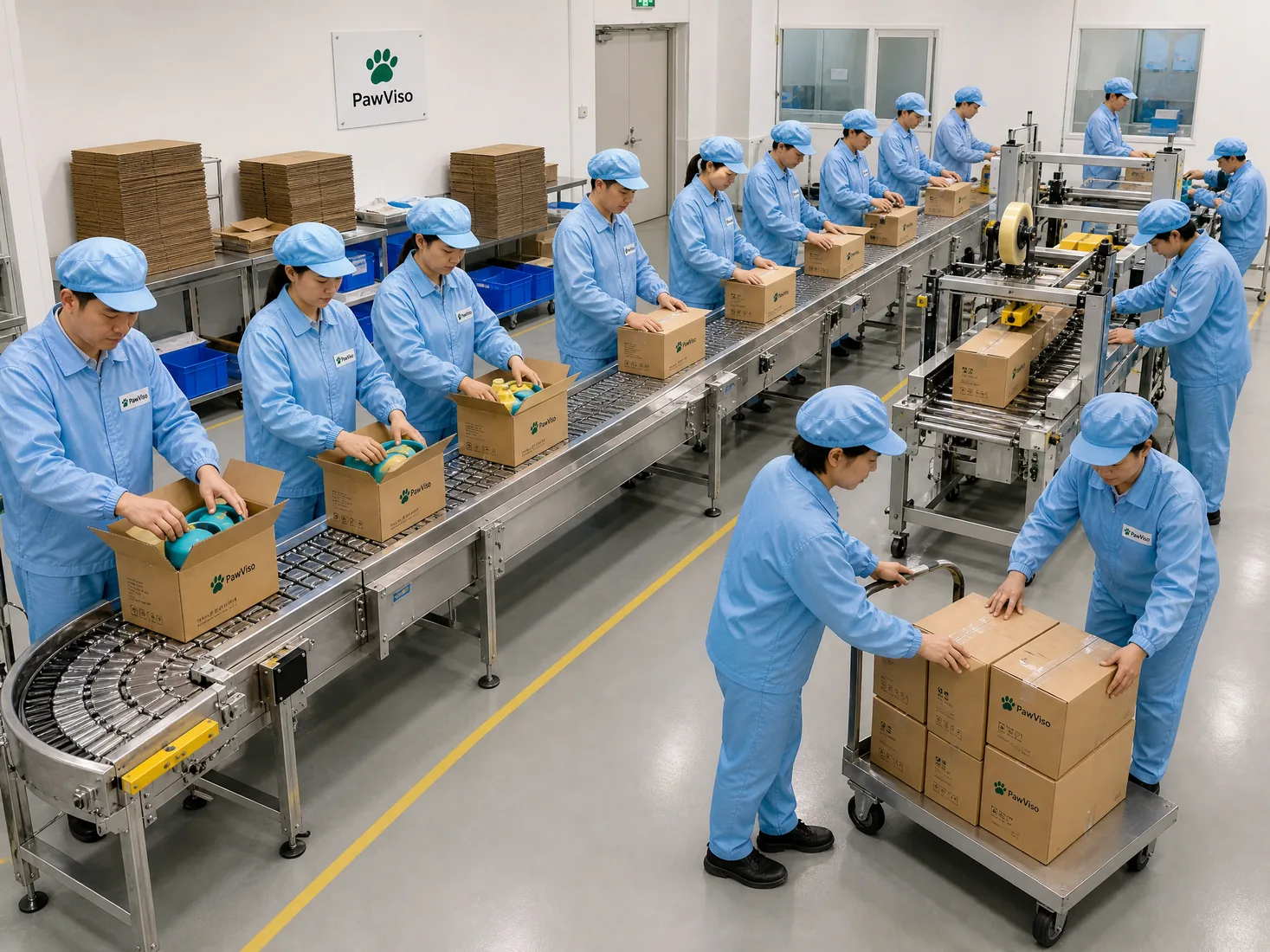
Retail-ready packaging for pets combines merchandising, supply-chain efficiency and regulatory compliance. For buyers sourcing pet toy packaging wholesale, the packaging’s role goes beyond protection: it is the product’s primary interface with shoppers and with retail systems. This guide focuses on practical buyer decisions you must make with suppliers — artwork control, pack-out strategy, barcode and product-data alignment, claims review, inserts, master-carton relationships, and the proofing/inspection steps that protect your order and your retail launch.
Throughout this piece, actionable buyer steps are paired with the typical supplier inputs and the evidence you should expect. Where requirements depend on the buyer’s target market, we flag that explicit confirmation from the buyer or importer is required 3. We differentiate system-level quality controls from SKU-level conformity so you can assign responsibilities and inspection points efficiently 1, and we call attention to GTIN/product-data alignment for retail-ready barcodes and listings 2.
Module 1 — Shelf role and pack-out configuration: decide how the toy will sell on-shelf
Start by defining the shelf role for each SKU: impulse grab, gift, premium feature, or multi-pack. The shelf role dictates the pack-out configuration — single hanging card, boxed retail carton, blister card, or multi-pack tray. As buyer, specify the primary retail channel(s) (big-box, pet speciality, Amazon FBA, grocery) because each channel has different preferred pack formats and incoming handling. Ask your supplier for a pack-out proposal that lists materials, expected dimensions, net/gross weight, and palletization scheme so you can evaluate logistics cost and shelf facings.
Supplier inputs: full dielines for proposed pack formats, hand-cut or digital mockups of pack-outs, list of materials and recyclability claims, and pallet-layout suggestions. Evidence to request: prototype photos with a standard sized reference, carton-scanable barcode placement on mockups, and a pack-out table showing units per inner, inner per master, and masters per pallet. Tradeoffs: a display-ready tray may reduce secondary display costs but increase unit cost and pallet volume; a small hanging card lowers unit cost but may reduce premium perception. Next steps: approve one pack-out option for pre-production sample and confirm master-carton quantities for initial PO and for forecasting storage needs.
Compact pack-out checklist (buyer decision focus)
| Decision item | Buyer action |
|---|---|
| Primary shelf role | Select impulse / premium / gift / bulk |
| Preferred format | Approve single-hang / blister / box / tray |
| Units per master | Confirm units/inner/master for logistic planning |
| Pallet footprint | Accept supplier proposed pallet layout |
Supplier deliverables for pack-out approval
| Deliverable | What to verify |
|---|---|
| Dieline and 3D mockup | Fit, barcode placement, hang-hole location |
| Prototype photo | Scale and material appearance |
| Pack-out table | Unit counts and pallet configuration |
Module 2 — Product/pack interface and fit: verify how the toy interacts with its packaging
The product/pack interface ensures that the toy is secure, presented correctly, and protected during transit. As buyer, specify tolerances for fit and clamping if the design uses inserts, carding or blister cavities. Request a fit-check sample early: the physical toy in the proposed retail pack, photographed and measured. This is where you verify that moving parts are immobilized, sharp edges won’t stress pack materials, and small accessories are restrained to prevent loss — but specific safety tests or performance validations are not substituted here; those must be confirmed separately by the buyer/importer for the target market 3.
Supplier inputs include CAD or dieline files showing exact cavity dimensions, proposed insert materials (EVA, molded pulp, cardboard), and a short risk note from the pack engineer about pinch points or pressure points. Evidence to expect: measured clearances between toy and pack, photos of drop or vibration simulation on the prototype (if offered), and a statement of whether the pack allows easy in-store unboxing. Tradeoffs: tight clamping reduces movement but can increase assembly time and damage risk; passive cavities simplify packing but may need additional void-fill. Next steps: approve final cavity design or request a revised prototype, and confirm any special packing instructions for the line during production runs.
Fit verification summary
| Checkpoint | Buyer acceptance |
|---|---|
| Cavity tolerance | ± value approved or request revision |
| Access for scanning barcodes | Confirm unobstructed area |
| Assembly practicality | Approve manual/automated pack method |
Supplier-provided fit evidence
- Cavity CAD/dieline with dimensions
- Photographs of toy in pack with rulers
- Notes on assembly and material recommendations
Module 3 — Artwork control and proofing: establish the approval path and color expectations
Artwork control is a buyer-led process that needs structured checkpoints. Define a single artwork owner on your side who consolidates marketing, compliance and retail-channel edits. Supply the supplier with final print-ready files and a brand-style guide that includes color values (Pantone or CMYK), typography rules, minimum readable sizes, and mandatory marks (e.g., manufacturer name, address) that your importer or legal team requires 3. Insist on a proofing workflow with clear sign-off steps: digital proof (PDF), color-proof (if color-critical), and physical press proofs prior to mass production.
Supplier inputs should include a pre-press checklist, dieline with bleed/trim/safe zones, and a color management statement (e.g., intended CMYK or Pantone targets). Evidence: a digital PDF proof annotated for changes, a physically trimmed press proof or short-run sample, and a record of revision history. Tradeoffs: tighter color tolerances increase cost and lead time; looser tolerances speed production but may not meet premium brand expectations. Next steps: finalize and sign the approved artwork file, schedule press proofing, and lock the SKU artwork version to prevent uncontrolled edits in later POs.
Artwork approval workflow (buyer actions)
| Step | Buyer action |
|---|---|
| Submit master files | Provide layered files and brand guide |
| Review digital proof | Annotate and return within set SLA |
| Approve physical proof | Sign-off to release to production |
Supplier artifact list
| Artifact | Purpose |
|---|---|
| Dieline with marks | Layout and cut guidance |
| Press proof | Confirm color and registration |
| Revision log | Change control for later orders |
Module 4 — Barcode, GTIN and product data: align codes and retail metadata
Barcodes and product data connect the physical pack to retail systems. As buyer, confirm which GTINs/UPC/EAN you will assign and whether you or the supplier will print them. Ensure the GTIN and associated product data (title, brand, dimensions, net weight, legal manufacturer) are consistent across artwork, carton, and any retail data feeds 2. If selling through marketplaces, verify additional attributes required by that channel (material, age grade, primary color) and feed them to your supplier so barcode placement and pack space accommodate scannable labels and any mandated panels.
Supplier inputs: suggested barcode placement area per GS1 guidelines, high-resolution barcode artwork (do not scale from low-res), and a verification report if the supplier offers barcode quality scans. Evidence: barcode verification (grade report) before mass printing, sample scans showing the barcode reads at the proposed placement point, and a cross-check table mapping GTINs to SKU identifiers. Tradeoffs: printing barcodes on curving or glossy surfaces complicates scanning and may need a white rectangular block; reprinting due to a GTIN mismatch is costly. Next steps: lock GTIN and product-data spreadsheet, obtain a verification scan of the final press sample, and include barcode QA in pre-shipment inspection.
Mid-article CTA — If you want a checklist template for artwork approval, pack-out tables and barcode verification steps tailored to pet toys, contact PawViso. We provide editable templates and supplier-facing checklists to speed approvals and reduce revision cycles.
Module 5 — Claims, labelling and buyer-reviewed copy: control what the package says
Claims on pet toy packaging — such as material descriptors, usage instructions or environmental marks — must be controlled and defensible. As buyer, compile a list of permitted claims and a source for substantiation; where legal or market-specific requirements apply, confirm these with your importer or legal counsel 3. Provide the supplier with exact claim text and any required mandatory language (e.g., manufacturer address, batch code locations). Require that the supplier does not change claim wording without written approval and that every print run uses the approved text file.
Supplier inputs: proofed label copy on the dieline, placement recommendations for mandatory marks and regulatory panels, and a statement about which claims they can support with available materials (e.g., recyclability stamping). Evidence: annotated artwork showing claim placement, a signed buyer-supplier approval for claim text, and a version-controlled artwork file. Tradeoffs: adding multiple claims increases visual clutter and may reduce key marketing messages; minimizing claims reduces legal exposure but may lower shelf differentiation. Next steps: finalize approved claim language, document who signs off for future print runs, and include claim verification in your incoming inspection checklist.
Claims approval matrix
| Claim type | Buyer input required | Supplier deliverable |
|---|---|---|
| Marketing claims | Approved text and priority | Proof on dieline |
| Regulatory labels | Buyer/importer confirmation 3 | Placement and language proof |
| Environmental marks | Buyer substantiation | Supplier confirmation of material compatibility |
Module 6 — Master-carton relationship and proofing/inspection: confirm pack quantities and acceptance checks
Master-carton configuration affects transit damage rates, warehouse handling and retailer receiving. As buyer, confirm inner-pack and master-carton counts aligned to the pack-out approved in Module 1. Require the supplier to provide the master-carton dieline, strength rating or test method used for carton selection, and the pallet-loading plan. Schedule pre-shipment inspection criteria that include carton integrity, unit count per inner, correct SKUs per carton, barcode readability on masters, and photographic evidence of pallet builds.
Supplier inputs: master-carton samples or photographs, pack counts per inner/master, and test reports if a specific compression or drop test was requested (note: do not rely on supplier test claims without seeing documentation and buyer confirmation). Evidence to expect at pre-shipment: AQL inspection results for SKU conformity 1, pallet photos showing label faces and overhang checks, and a signed packing list matching PO and GTINs. Tradeoffs: higher-density palletization reduces freight but may increase carton damage risk; fewer units per master simplify retailer returns but raise transport costs. Next steps: finalize acceptance criteria for the pre-shipment inspection, set the AQL levels and sampling plan, and confirm who signs the shipment release.
Master-carton and inspection checklist
| Item | Buyer requirement |
|---|---|
| Units per inner/master | Confirm and lock |
| Carton strength | Supplier spec and photo sample |
| Pre-shipment inspection | AQL plan and photographic evidence |
Pack-level evidence to collect before release
- Packing list signed against PO and GTINs
- Photos of masters on pallet with label faces visible
- Pre-shipment inspection report and any rework documentation
Module 7 — Choose pack-out format and master-carton logic for your logistics needs
Pack-out decisions (how individual retail packs are arrayed inside master cartons and on pallets) directly affect freight efficiency, damage risk, receiving speed at retail, and the ease of store replenishment. For pet toy packaging wholesale, buyers must decide whether retail packs will ship as singles, pre-packed multipacks, or display-ready shippers. Each option changes inner cushioning, orientation of printed faces, and how UPC/GS1 barcodes and handling marks are positioned on master cartons. Consider how stores will receive and store the product: backroom capacity, whether staff will unpack into pegboard, shelf, or floor displays, and whether the shipper should double as a POS display to reduce store handling steps.
From a supplier and inspection standpoint, clearly define the master-carton template: number of SKUs per carton, carton dimensions, stacking pattern, void fill instructions, and pallet pattern. This specification should be part of the purchase order and quality checklist so factory packers and third-party inspectors can verify correct pack counts, pack orientation, and securement. If multiple SKUs are packed together, call out how retail pack artwork should face outward (or be hidden) to avoid cross-contamination of branding and to meet retailer planogram expectations. For cross-border shipments, ensure master-carton markings include required consignee, country-of-origin, and handling codes per the buyer’s logistics provider 6.
| Decision area | Why it matters | Buyer action |
|---|---|---|
| Singles vs multipacks | Affects cube, freight cost, and store replenishment | Specify pack type and pack count per PO |
| Display-ready shippers | Reduces store labor, increases front-of-store presence | Provide dielines and artwork; confirm hinged/tear strips |
| Mixed-SKU cartons | Saves freight but complicates retail receiving | Approve pick-list and external carton labeling |
| Pallet pattern | Impacts damage risk and shipping stowage | Approve pallet layout and stack height limits |
Include instructions for internal dividers, anti-abrasion liners, and desiccant or moisture-barrier needs when applicable. For toys with mixed materials (fabric, rubber, plastic), detail whether separation is required to prevent staining or transfer. These operational specifics are part of pack-out engineering and should be validated through pre-shipment photos and, for high-value or fragile lines, a pre-shipment inspection report that confirms pack integrity and label placement 5.
Module 8 — Align artwork control with prepress and production realities
Artwork for pet toy retail packs has to be accurate, print-ready, and manufacturable at scale. Buyers must provide final artwork files in the factory’s accepted formats (usually vector PDFs with specified bleed, dielines, color profiles, and embedded fonts), but also be prepared to approve prepress proofs that reflect the factory’s printing technology and substrate. Ask suppliers for the specific press profile and ink set they will use so the buyer’s design and brand team can confirm color expectations before mass production. Include spot varnish, emboss, or special coatings in the artwork file notes and explicitly call them out in the approval workflow.
Establish a structured approval timeline that includes digital mockups, PDF preflight, and physical press proofs or print-control panels for color-critical elements. For pet toy packaging wholesale, where multiple SKUs and sizes are common, use an artwork version-control table to track die revisions, copy changes, and claim statements. This reduces the risk of mismatched copy (e.g., SKU names versus UPCs), inconsistent construction instructions, or incorrect legal text. Since trade terms and delivery milestones can hinge on meeting production milestones, tie artwork approvals to the production schedule and confirm when the factory will hold off on mass runs pending buyer sign-off 6.
| Artwork control item | Minimum buyer deliverable | Factory deliverable |
|---|---|---|
| Dieline with measurements | Final dieline PDF | Confirm fit and provide sample cut |
| Color profile and Pantone spec | Pantone references / brand guide | Print-control panel / press proof |
| Legal and claims text | Final approved text | Positioning and font in dieline |
| Varnish/finish spec | Clear instruction in artwork | Mock-up with finish applied |
Plan for a small engineering run or pre-production sample that replicates final print and diecut conditions. For complex structures or multi-piece packs, a physical prototype will reveal issues that digital proofs can miss: glue flap interference, weak corners, or varnish pooling. When possible, include a short approval window in the purchase order to avoid production starting without signed proofs; this prevents costly rework and schedule slippage.
Module 9 — Barcode, SKU and product-data governance for seamless retail onboarding
Retailers require accurate product data and properly encoded barcodes to accept product at receiving and to enable point-of-sale scanning. Buyers should assign and communicate the exact GTIN/UPC for each SKU, including pack-level GTINs for multipacks and case-level GTINs for master cartons. Require the factory to print a scannable barcode on every retail pack and to place human-readable numbers below the bars. Confirm barcode size, quiet zone, and contrast meet the retailer’s scanning standards; poor contrast between ink and substrate or varnish over the barcode can cause read failures at POS.
Beyond barcodes, include a product-data sheet template with every purchase order: dimensions, net/gross weight, materials, safety/care instructions (as provided by buyer), lifecycle or SKU active dates, and carton-level logistics data (cube, pallet pattern). Use a single source of truth—an approved data table that both buyer and supplier reference—to prevent mismatches when generating EDI advance ship notices or retail assortment files. Where retailers require GS1-compliant identification, clarify whether the buyer or factory will be the GS1 license holder and who is responsible for assigning GTINs and maintaining the registry 6.
| Data element | Who provides | Verification step |
|---|---|---|
| Retail GTIN/UPC | Buyer | Scan test on sample pack |
| Case GTIN | Buyer/factory | Verify in packing list |
| Net/gross weight | Factory | Weigh test and include on packing list |
| Cube and pallet pattern | Factory | Pallet trial or photo evidence |
Plan barcode testing into QC steps: have the factory provide a scanned proof and include a barcode quality grade in the inspection report. If the product will be distributed through multiple retail channels that use differing label requirements (e.g., small pet stores vs big-box chains), document any alternate barcode placements or supplemental labels needed so the pack structure and artwork accommodate those variations without rework.
Module 10 — Claims, copy and regulatory text: control, review and versioning
Claims on pet toy packaging—such as material attributes, suitability statements, or marketing claims—must be exact and provable by the buyer/importer; factories can print what the buyer authorizes but cannot independently certify. Create a claims register that lists every on-pack claim, the approved wording, the supporting evidence source (e.g., supplier material spec, third-party test—buyer-provided), and the end-market applicability. This register should be part of the artwork approval packet so that legal text and claims appear in the correct location, size, and prominence per retailer and jurisdiction requirements.
Because regulatory and advertising rules vary by market and change over time, limit on-pack claims to those the buyer has confirmed with its compliance team or counsel. Include fallback copy for markets where a claim is not permitted and track which SKU/artwork applies to each territory. The artwork approval workflow should capture a final sign-off from the buyer’s compliance or brand manager, and the factory should be instructed not to proceed with mass printing until receiving that explicit approval. For claims that may trigger testing or certification (for example, dust-mite resistance, chemical limits, or fire retardancy), buyers must independently confirm requirements and supply the supplier with the necessary certificates or test references to include on pack only as authorized 4.
| Claim type | Buyer responsibility | Factory action |
|---|---|---|
| Marketing claims (e.g., “interactive”) | Provide approved copy and evidence | Print approved text only |
| Material composition | Provide material spec sheet | Print factual content as given |
| Regulatory statements | Confirm with counsel | Apply exact legal text |
| Country-specific disclaimers | Provide localized text | Integrate into artwork files |
Keep an audit trail: store signed artwork approvals, the claims register, and any supporting evidence together with the PO and inspection reports. This trail supports traceability in case a retailer questions a claim during onboarding or a regulatory body requests provenance. If the buyer expects the factory to source materials or components that underpin a claim, that sourcing and any certifications should be clearly documented and reviewed before authorizing the claim on packaging.
Module 11 — Proofing, pre-shipment inspection and release controls
Proofing and inspection close the loop between design intent and mass output. Prepare a checklist that aligns with the buyer’s acceptance criteria: print color and registration, dieline accuracy, barcodes that scan, pack counts, internal separation, and cosmetic defects per agreed AQL or tolerance levels. Specify whether the buyer requires an in-line press-check, a pre-shipment press sheet photo, or an independent third-party inspection (or a combination). For display-ready shippers, verify functional elements (tear-off panels, tuck locks) through mechanical tests or simple manual activation to ensure they perform reliably in store use.
Include release controls that dictate what evidence the factory must provide before full production or shipment. Common release items are: a signed press proof, photos of production-line packed cartons, a barcode scan report, and the final inspection certificate. For complex orders or new factories, consider staged releases—initial small-production test, then ramp to full production after successful inspection. Coordinate with logistics and the buyer’s receiving teams about hold points (e.g., do not ship until the ASN and COA are provided) so production and transport are synchronized with the buyer’s supply chain timeline 5.
| Proof/inspection item | Evidence required | When to require it |
|---|---|---|
| Press proof | Signed hard-copy or verified photo | Before mass run |
| Pack-out photos | Images of cartons/pallets | After packing, before sealing |
| Barcode scan report | Scan screenshots or scanner file | Before labeling cartons |
| Final inspection | QC checklist & inspection report | Prior to shipment release |
Document non-conformances and set clear remediation steps: rework, reprint, or re-inspect. Define cost responsibility and timing for rework in the original procurement contract to avoid surprises. Finally, ensure records from each lot are retained for traceability—these help with warranty claims, retailer scorecards, or future design improvements.
Frequently asked questions
Q: Who assigns GTINs for retail pet toy packs? A: The buyer/importer generally assigns GTINs when they are the brand owner or marketplace seller; clarify GS1 ownership and who will manage the registry in advance 6.
Q: How do I ensure on-pack barcodes will scan at POS? A: Include barcode specifications in the artwork pack and require the factory to provide a barcode scan report and photos of the barcode on the finished pack during pre-shipment inspection. Also confirm substrate contrast and varnish compatibility with scanning.
Q: What proof types should I demand for color-critical branding? A: Require a press-control panel or hard-copy press proof that reflects the factory’s press profile, plus a physical prototype of the final pack. Tie approval to your production schedule so the factory cannot begin mass printing without signed approval 5.
Q: How do I manage claims that differ across countries? A: Maintain a claims register with territory-specific copy. Use localized artwork versions and require buyer sign-off for release in each jurisdiction. Do not print claim text without documented buyer approval and supporting evidence 4.
Q: What pack-out details reduce damage during transit? A: Specify inner dividers, orientation, void fill, carton strength, and pallet stacking patterns. Require photos of packed cartons and pallet patterns during inspection and set maximum stack heights for transit 5.
Conclusion
Packaging decisions for pet toy packaging wholesale are operational and strategic: they affect shelf presence, store handling, compliance, freight, and brand consistency. Buyers should control artwork, claims, product data, pack-out, and release evidence through clear specifications, versioned approvals, and inspection gates. Integrate those controls with logistics handover requirements to ensure smooth retail onboarding and minimize rework or delays.
Project-specific packaging, claims and compliance requirements must be confirmed by the buyer/importer prior to production.
Final CTA — Start a controlled pet-toy sourcing conversation with PawViso. Share the product concept, target market, customization route, package direction and estimated order structure for a focused B2B discussion. Email: info@PawViso.com WhatsApp: +86 186 8106 4480 — https://wa.me/8618681064480
Related PawViso resources
- Continue with How to Create a Custom Pet Toy Sampling Plan. Use this pet-toy guide to structure approvals, samples and evidence.
- Browse the PawViso product catalogue to identify product formats for a sourcing brief.
- Follow the PawViso sourcing process and review the B2B buyer FAQ before sharing project requirements.
External reference
For independent product identification and barcode context, review GS1 guidance on Global Trade Item Numbers (GTINs). Confirm the requirements that apply to the selected product, target market and order.