
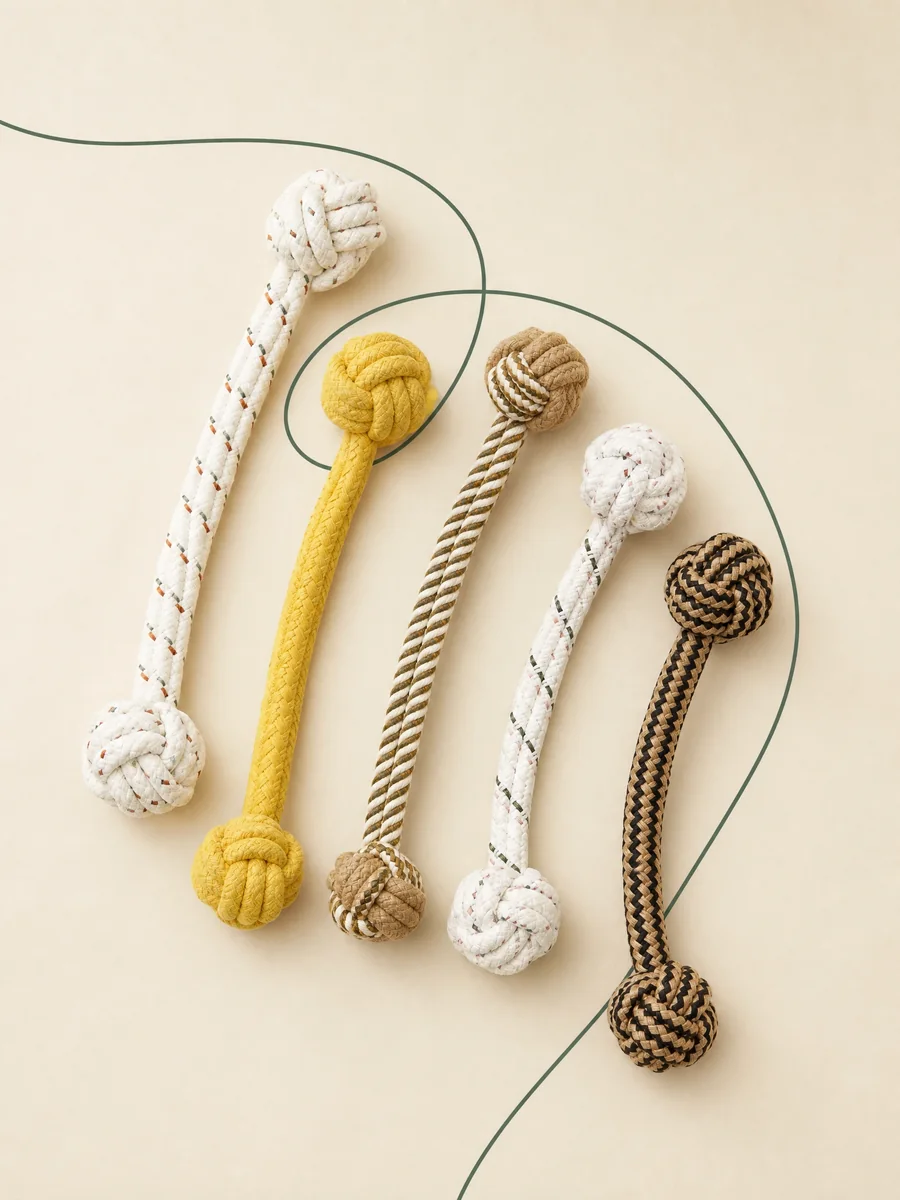
A braided cotton dog tug is best bought as a controlled textile assembly, not as a generic rope silhouette. The purchasing decision includes the supplier’s declared fiber basis, yarn and rope construction, braid geometry, knots, any sewn or added elements, the approved appearance, and the retail and export pack. From a Chinese B2B pet-product factory and procurement perspective, the most efficient way to make quotations comparable is to turn those elements into a short, written specification that a supplier, buyer, sample reviewer, and inspector can all use. A photo is useful for direction; it does not fix the construction that lies behind a similar-looking item.
This guide is designed for buyers developing a braided cotton dog-tug range. It offers sourcing and quality-planning questions, not a promise that any tug is indestructible, appropriate for every animal, or compliant everywhere. The responsible buyer or importer must confirm product, labeling, testing, packaging, marketplace, and destination-market requirements for the actual SKU. Do not automatically apply children’s-product rules to a pet product: identify the rules that apply to the product, its intended claims, destination, importer, and sales channel.
Module 1 — Which braided cotton tug range should enter the RFQ?
Decide the commercial role before asking for a quote. Is the range a simple rope-only tug, a two-knot interactive tug, a looped construction, or a coordinated family of sizes and colorways? State the intended play description, target retail channel, visual direction, desired size architecture, and whether one pack format will serve several SKUs. “Braided cotton” should be a requested supplier declaration for each SKU, rather than a phrase that conceals blends, cores, threads, labels, panels, or components. A defined role prevents a buyer from comparing a basic rope quotation with a more complex textile assembly as though they were the same product.
Use commercial tiers to structure choices, not to imply durability or an unverified quality ranking. A tier can distinguish configuration complexity, presentation, or the number of controlled interfaces while requiring the same discipline in records. A factory or procurement partner can return alternative constructions against the same fields, enabling the buyer to remove unwanted options before sampling. This is more reliable than asking for “best quality” because it shows exactly which decision makes an assortment option commercially distinct.
| Assortment tier | Buyer decision | Construction focus | Pack direction | Approval question |
|---|---|---|---|---|
| Entry rope tug | Establish a simple opening position | Rope body, end finish, knot layout | Minimal approved unit presentation | Does the reference sample match the specified silhouette and finish? |
| Core braided tug | Build a repeatable everyday range | Braid consistency, two-end geometry, colorway control | Branded sleeve, band, or card if specified | Are size, color, and knot placement clearly differentiated? |
| Feature-format tug | Add a loop, fabric panel, or approved feature | Every material interface and attachment path | Pack shows the feature without distortion | Does the added element have a controlled part and attachment record? |
Module 2 — Which fiber and rope construction must be declared?
Request a construction schedule before treating a quotation as firm. It should identify the supplier’s declared fiber content for the rope or textile body, core status, yarn or strand arrangement where known, number of rope legs, braid pattern, nominal dimensions, finished weight if the buyer requires it, colorway, and all non-rope elements. A braid may look fuller because of yarn bulk, twist, tension, or color contrast, so a product image cannot replace a construction basis. Where the retail name uses “cotton,” the buyer should establish what declaration and substantiation are needed for the intended market rather than rely on informal supplier language.
Separate material identity from finished construction. Material identity helps procurement compare inputs; construction describes the actual silhouette and interfaces of the assembled tug. Request an unknotted sample section or close photographs before knots are tied, plus images of both end treatments. If the supplier proposes a different yarn source, rope source, core, or color process, record it as a proposed change even when the visible result looks close. This protects the approved comparison point without implying that one configuration has a universal performance advantage.
| Decision criterion | Define in the RFQ | Review on the sample | Control during production |
|---|---|---|---|
| Fiber declaration | Supplier declaration for each relevant component | Match component list to visible construction | Require notice before declared-content changes |
| Rope architecture | Core status, legs, strand arrangement, braid pattern | View unknotted section and cross-section if agreed | Compare braid regularity to the retained reference |
| Dimensions | Measurement points, units, and agreed ranges | Measure at named points | Use the same points on first-off and finished goods |
| Colorway | Approved swatch, photo, or artwork reference | Review under the agreed viewing condition | Record color separately from construction observations |
Module 3 — How should knots, seams, and added elements be controlled?
Treat each change in load path as a separate interface. In a rope-only tug, those points include the body, each knot, exposed tails, and finishing method. In a hybrid design, the rope-to-fabric junction, a seam, decorative panel, loop, label, or optional component creates another interface. Decide whether these features are essential before sampling, because later additions change the component list, assembly steps, and inspection plan. A marked drawing or reference image should show knot count, knot position from a named measurement point, expected tail length, seam route, component location, and which details are aesthetic versus controlled.
Specify knot style, orientation, desired compactness appearance, and whether adjustment after tying is allowed. For sewn elements, identify the fabric, thread, stitch route, and photo locations; for added parts, use an approved part reference with declared material, finish description, and attachment method. Do not call a ring, clip, or label chew-proof, unbreakable, or safe without project-specific supporting evidence and responsible-party approval. ISO 2062 describes single-end breaking force and elongation testing of yarns taken from packages using a constant-rate-of-extension tester; it can inform review of yarn data, but it is not a protocol for a finished braided dog tug.1
Module 4 — What shedding criterion should the supplier inspect?
Do not write “zero shedding” unless it can be observed and repeated. A textile tug can show surface fuzz, short loose fibers, an exposed strand end, displaced braid, debris inside the pack, or a genuine opening of the construction. These outcomes have different commercial meanings and should not be hidden in one broad phrase. Select the appearance result that matters for the SKU, such as no visible foreign debris in the unit pack, no detached strand, no open braid, no unsecured loose end, and no departure from the approved sample. State the viewing condition if important, handling action, sample units, and required photographs.
An in-house appearance review can remain simple if it is defined. The plan might name visual inspection, hand flexing, gentle shaking, or a specific surface contact, then state exactly what is recorded and what triggers segregation. It should not claim to simulate every chewing or use condition. Separate loose fiber from structural change: a surface observation may require cleaning, trimming, or comparison to the sample, whereas an open braid or unsecured end may require a root-cause review of rope preparation, knotting, or finishing. This gives production staff a practical action route instead of an unsupported guarantee.
Module 5 — Under which conditions should samples and checks be compared?
Sample condition matters because appearance and handling can be affected by storage, transport, humidity exposure, and whether a sample is reviewed from the pack or after an agreed conditioning step. ASTM D1776/D1776M covers conditioning and testing of textiles when conditioning is specified in a test method, and notes that prior high or low humidity exposure can affect equilibrium moisture pickup.2 That reference does not prescribe a dog-tug test. It does support recording whether an appearance review or pull evaluation is performed as received, after an agreed conditioning procedure, or after a separately defined exposure.
The sample sheet should therefore carry condition information beside the product description: sample code, receipt date, buyer SKU, colorway, construction revision, pack state, condition instruction if any, evaluator, and photographs. A bare development rope should not be compared casually with a packed production-intent sample. Where the project requires external laboratory work or formal evidence, agree the method, specimen condition, acceptance criteria, and reporting format before samples are sent. A factory or procurement partner should not imply test capability, laboratory approval, or a result that has not been substantiated for the project.
| Sample-record field | Why it matters | Example of a controlled entry |
|---|---|---|
| Identity | Prevents colorway or revision confusion | Buyer SKU, supplier code, and sample revision |
| Condition | Makes observations comparable | As received, or condition named in the agreed plan |
| Construction observations | Preserves the approval baseline | Braid pattern, knot layout, end finish, sewn interface |
| Evaluation record | Separates results from assumptions | Named check, stated outcome, photos, reviewer, and date |
| Disposition | Shows what approval actually means | Approved, approved with deviation, or resample requested |
Module 6 — What project-specific pull checks belong in the sample plan?
Decide first what question a pull check must answer. An end-to-end check considers the body and knots in a defined arrangement; a knot-focused check considers movement or opening at a named knot; an interface check considers a rope-to-sewn-panel or part-attachment path. These checks are not interchangeable. Write the protocol before evaluating the sample: name the specimen, grip arrangement and location, pull direction, loading approach, rate or dwell time where relevant, condition, buyer-established observation or target threshold if any, failure definition, and photographs. Do not transfer a force number from an unrelated rope, fabric, or toy as though it validates the completed tug.
Material standards help explain what evidence represents without becoming a finished-product claim. ASTM D5034 covers grab and modified-grab procedures for breaking strength and elongation of most textile fabrics; it explains that grab results reflect effective fabric strength, not direct yarn strength.3 A project may use material data as an input, but the tug still has braid geometry, knots, end treatment, and perhaps seams or components. Record whether each pull result is an observation, a development comparison, or an agreed acceptance decision. One sample result cannot establish behavior for every animal, every use, or a later construction change.
Mid-article CTA — Make Your Tug-Toy RFQ Comparable Send PawViso a reference image, intended market, proposed size range, construction priorities, packaging idea, and evaluation questions. We can help organize the supplier questions for a project-specific sourcing discussion at info@PawViso.com.
Module 7 — How should approval samples become controlled production references?
Approval should create a reference system rather than end in an email that says “approved.” Give every development and approval sample a unique code and link it to the buyer SKU, colorway, construction revision, artwork revision, pack version, date, and disposition. Retain dated photographs of the full product, unknotted braid where feasible, knots, ends, seams, components, unit pack, and carton marks when relevant. The approved sample anchors visual comparison; the written specification controls measurable details and agreed requirements. If a buyer keeps a physical reference, record its storage location and status.
Set the change-control gate before purchase-order release. Require written buyer review for a change to declared fiber content, yarn or rope source, core, braid pattern, knot process, thread, textile panel, component, color method, label, packaging material, artwork, or production location. The change request should state what changes, why, which SKU and pack versions are affected, and whether a new sample or evaluation is proposed. A factory and procurement partner can coordinate records, but the responsible buyer must decide whether a change is commercially and market-wise acceptable for the actual SKU.
| Approval gate | Buyer evidence | Supplier or procurement action | Release decision |
|---|---|---|---|
| Development sample | Marked comments and revision list | Revise named construction or appearance points | Proceed to revised sample or hold |
| Approval sample | Dated approval record and reference photos | Freeze listed version identifiers | Authorize production-intent preparation if instructed |
| Production-intent pack | Artwork, barcode, assembly, and carton records | Confirm pack hierarchy and controlled files | Release only the agreed pack version |
| Change request | Reason, affected SKU, and proposed evidence | Segregate proposed substitute from approved baseline | Buyer approves, rejects, or requests resampling |
Module 8 — Which quote scope exposes cost drivers without invented prices?
Ask for a quote that states scope, assumptions, and cost-driver categories instead of treating unit price as the whole negotiation. Braid complexity, declared fiber basis, yarn or rope source, color treatment, finished size, knot labor, sewn features, components, packaging materials, artwork changes, barcode work, inner packing, carton configuration, sample development, inspection requests, and shipment terms can change a commercial comparison. The aim is not to estimate a price from a photo. It is to show which requested decision produces a different quote, so the buyer can simplify or protect a feature deliberately. Suppliers should identify inclusions, exclusions, and details still needing confirmation.
Keep the product specification separate from the commercial quote scope. The specification states what will be made; the quote scope states commercial presentation and assumed services or documentation. Ask suppliers to identify unknowns rather than bury them under “standard.” A barcode may be supplied in buyer artwork, its placement can be controlled, and a verification method can be agreed; none should be assumed from a prior SKU. This makes later packaging and inspection discussions traceable while avoiding unsupported statements about prices, fixed minimums, lead times, capacity, or laboratory work.
| Quote-scope category | Buyer should state | Supplier should clarify | Decision effect |
|---|---|---|---|
| Product body | SKU count, construction brief, size range, colorway | Which construction details remain open | Separates comparable configurations |
| Added elements | Sewn panels, labels, loops, or parts requested | Part references and attachment assumptions | Reveals interface and assembly scope |
| Retail pack | Format, artwork source, barcode responsibility | Inclusions, material assumptions, revision status | Prevents a product-only quote being read as packed-goods scope |
| Export pack | Inner/carton concept, marks, handling needs | Configuration data still required | Frames transport-packing decisions |
| Evaluation and inspection | Requested records or third-party coordination | Proposed scope and excluded work | Keeps verification separate from a product promise |
Module 9 — Which packaging level protects presentation and traceability?
Build packaging as a hierarchy: unit presentation, any inner arrangement, outer carton, and shipment marks. The unit pack should present the tug in its intended orientation without visibly compressing knots, hiding an essential feature, trapping debris, or separating included pieces. Specify coiling or folding method, attachment points, visible product area, artwork revision, barcode position, inserts, and buyer-approved wording. ASTM D3951 addresses commercial preservation, packaging, exterior packing, unitization, and marking for supplies and equipment; its stated context includes Department of Defense shipments, so it is not a universal retail-pack certification for a pet tug.4 It is still a useful prompt to document package levels and handling assumptions.
Review production-intent packs as packed goods, not as a rope dropped into a sleeve. Check for shifted knots, compressed rope, opened seals, poor print presentation, wrong artwork, unreadable or misplaced barcode, missing insert, incorrect count, or incomplete carton mark against the controlled file. Route conditions and market rules vary, so the responsible buyer or importer should decide what package validation, labeling, barcode, and transport requirements apply to the actual SKU. A procurement partner can collect carton dimensions and pack photographs, but no pack should be called transit-proof without agreed, project-specific evidence.
| Packaging level | Controlled details | Production inspection focus | Evidence retained |
|---|---|---|---|
| Unit pack | Format, orientation, artwork, barcode position, included items | Appearance, closure, product presentation, contents | Pack photos and approved artwork revision |
| Inner arrangement | Units per inner and separation method if used | Count, orientation, protection from scuffing or compression | Count record and inner-pack photographs |
| Outer carton | Carton configuration, marks, sealing method, specified gross-weight instruction | Quantity, integrity, marks, dimensions if requested | Carton photos, count, measured data where agreed |
| Shipment documentation | Buyer-required marks and packing-list linkage | Match approved SKU and pack revision | Controlled packing record |
Module 10 — How should production inspection be planned and recorded?
Plan inspection against the approved baseline rather than against a general impression. A first-off review can confirm the rope body, braid pattern, knot layout, end treatment, seams, components, and pack version before production continues. In-process checks can focus on braid regularity, knot position, tail finishing, stitch appearance, pack assembly, and segregation of suspected nonconforming units. Finished-goods inspection can review identity, specified measurements, workmanship, agreed loose-fiber criterion, components, pack completeness, artwork revision, barcode placement, carton count, and separately agreed evaluations. Record the observation, location, sample, corrective action, and disposition; do not replace evidence with a broad assurance.
If the buyer chooses acceptance sampling, ISO 2859-1:2026 defines sampling schemes for lot-by-lot inspection by attributes indexed by an acceptance quality limit (AQL).5 It does not choose the sampling level, defect classification, acceptance action, or suitability for a particular order. Those choices belong in the project inspection plan, with the lot definition, sampling method, critical or major/minor terminology if used, reinspection terms, and escalation route. An inspection is a sample-based conformity review; it does not mean every unit is defect-free or that all destination-market obligations have been met.
| Inspection stage | Key decision | Record to retain | If a concern is found |
|---|---|---|---|
| First-off | Is the line starting from the approved version? | Dated photos, observations, release status | Pause or correct the affected point before continuation |
| In-process | Are named workmanship criteria being observed? | Check sheet, sample location, corrective note | Segregate affected units and investigate the process point |
| Finished goods | Does the sample conform to the written baseline? | Inspection report, measurements, defect photos | Document scope and buyer-directed disposition |
| Packed goods | Are unit packs and cartons the approved version? | Count, artwork, barcode-placement, carton records | Rework, relabel, recount, or recheck as agreed |
Module 11 — What should the buyer release before shipment?
Before release, assemble a decision file rather than relying on verbal confirmation. It should connect the purchase order to the approved SKU list, construction schedule, sample code and disposition, current artwork and package files, change approvals, inspection records, pack and carton records, and project-specific documents requested by the responsible buyer. Confirm that product descriptions, commercial claims, and listing copy do not go beyond the available evidence. The absence of an observed defect in a sample is not evidence for a universal durability claim, and a material declaration should not be expanded into a market claim without the buyer’s substantiation.
Close outstanding commercial and compliance questions explicitly. Confirm ownership of destination-market labeling, importer information, language, traceability, recycling or waste obligations where applicable, marketplace rules, testing needs, shipment documentation, and customer-specific package requirements for the actual SKU. These matters vary by destination and channel and remain the responsibility of the buyer/importer and its qualified advisers or service providers. A Chinese factory or procurement partner can organize product and package records, but should not promise compliance approval, legal clearance, test outcomes, fixed capacity, or shipment timing unless separately verified and agreed.
Frequently asked questions
Should a buyer use “100% cotton” in the product name? Only if the supplier’s declared composition and the buyer’s required substantiation support that wording for the particular SKU and intended market. Keep the component declaration in the controlled specification and review retail wording separately from factory terminology.
Is a rope-level tensile result enough to approve a braided dog tug? No. Yarn or rope data may inform material selection, but the finished item also has braid geometry, knots, ends, and possibly seams or added parts. The approval plan should identify which finished-assembly interfaces are assessed and what each result means.
What is an appropriate shedding standard? There is no useful universal phrase for every tug. Define a repeatable visual-and-handling criterion with sample condition, action, observation point, unacceptable outcomes, photographs, and disposition. Keep surface fuzz, loose fibers, debris, unsecured ends, and an open braid separate when they require different actions.
Can a supplier quote from a product photo alone? A supplier can hold an indicative discussion, but a comparable production quotation needs a construction and packaging brief. The buyer should identify the range format, declared fiber basis, rope or braid direction, dimensions, knots, added elements, colorway, pack, and quantity assumptions.
Does a retained sample replace a written specification? No. A sample shows approved appearance and construction at a point in time. The written file sets out measurement points, declared components, artwork version, inspection criteria, and approved deviations that a photograph or physical sample may not communicate.
Can final inspection correct an unapproved substitution? It may detect a visible difference, but cannot settle whether a changed material, rope source, braid process, component, or pack is acceptable for the intended market. Apply formal change control and buyer review before the substitute enters production.
Should pet-tug packaging use children’s-product rules? Do not assume so. Establish requirements that apply to the pet-product SKU, intended claims, destination, importer, and sales channel. The responsible buyer/importer should seek qualified regulatory advice when necessary.
Conclusion
A strong braided cotton dog-tug program is a chain of controlled decisions: define the range, declare the construction, map knots and interfaces, convert shedding into visible criteria, and plan a pull review around a real load path. Then retain the approved sample, quote the commercial scope transparently, check production against the same baseline, and inspect packed goods rather than an isolated rope. This approach does not promise universal durability or market approval. It gives buyers, suppliers, and inspection teams a common record for the actual SKU.
Final CTA — Start Your Dog-Play Sourcing Brief Email: info@PawViso.com WhatsApp: +86 186 8106 4480 Share your intended market, product reference, SKU range, packaging concept, and evaluation priorities. PawViso can help organize the questions for a project-specific sourcing conversation.
This article provides general B2B sourcing information, not legal, regulatory, veterinary, medical, or product-safety advice. The responsible buyer, importer, and qualified partners should confirm requirements and evidence for the actual SKU, intended use, destination market, and sales channel.
Related PawViso resources
- Continue with How to Create a Custom Pet Toy Sampling Plan. Use this pet-toy guide to structure approvals, samples and evidence.
- Browse the PawViso product catalogue to identify product formats for a sourcing brief.
- Follow the PawViso sourcing process and review the B2B buyer FAQ before sharing project requirements.
External reference
For independent product identification and barcode context, review GS1 guidance on Global Trade Item Numbers (GTINs). Confirm the requirements that apply to the selected product, target market and order.
References
- 1ISO 2062:2009 Textiles — Yarns from Packages — Determination of Single-End Breaking Force and Elongation at Break
- 2ASTM D1776/D1776M-20(2024) Standard Practice for Conditioning and Testing Textiles
- 3ASTM D5034-21 Standard Test Method for Breaking Strength and Elongation of Textile Fabrics (Grab Test)
- 4ASTM D3951-18 Standard Practice for Commercial Packaging
- 5ISO 2859-1:2026 Sampling Procedures for Inspection by Attributes — Part 1